The Cult of Classification

We, as a people, seem to love classifications. As humans, it is what we do best: identification. It separates us from primates. We can identify and classify things into systems, genres, classes, subclasses, and so on.

This is a great skill; a skill that could even save your life someday as you classify “dangerous, not dangerous – deadly, not deadly”. The ability to identify (what is it?) and then extrapolate accurately (what does it mean?) is indeed a critical skill. A skill no less critical even as we get more and more civilized. In fact, it could be argued that the dangers get ever more complex and demanding of this skill the more complex our society becomes, and the more knowledgeable we become.

When this gets interesting is when we apply and over apply this skill to other human beings where physical safety is clearly not a concern. We have all sorts of categorizations and systems of classification. We have ethnicity, sexual preferences, and orientation, political party affiliation, zodiac sign, political orientation or leaning, class separation, high school cliques, enneagram number, etc., etc.

These are all tools we use to classify, to categorize, and to put people into some box or drawer. At first, it may seem like we use these tools to gain a better understanding of who they are, really.cult of classification inset

Is that how we typically use them, in actuality? The way I have seen myself and others use them is as I described above. We put them into a box. We now think we “know” them, or at least that portion of them. They are a democrat or a republican and all of a sudden, we now “know them” politically. They are a 3 on the enneagram, and all of a sudden we “know” what to expect of their behaviors; their light and beautiful side and their darker patterns.

We put them into a box and we can then relax, or tense, or whatever, but some part of us relaxes. We know them; we can now relax and move on to putting another part of them into a box. Are they heterosexual or homosexual? Ah, they are bi-sexual. We can now relax (or tense [laugh]) because we now “know” who they are sexually.

But do we? (It is fascinating to see someone feed their ego when they think they have “nailed” someone’s zodiac sign or enneagram number by guessing at it; excited about putting someone in a box.)

Once we put someone into a box, we then stop relating to who they are as a unique and beautiful being -- we begin to relate to the box. We begin to fit all of their behaviors into that box or view their behaviors through the filter of said box.

Sure, we are more comfortable ourselves once we have classified them, but the real relating begins to die a slow (or rapid) death. We now stop relating to who they are in this moment, right now, and begin to relate to what we read about them in a book, or what we see about their “type” on TV, Etc. Then what began as a tool for greater understanding and deeper relating has ended up as a wall or a barrier to greater and truer understanding – a barrier to more intimate relating; a wall around the heart. A wall and a filter we are often not even aware of.

And what are human Beings anyway? They are manifestations of the divine.

Can we really classify that?

Human Beings at their best and most inspirational are creative, spontaneous, dances of improvisation, which is completely unpredictable, and if we get too caught up in who we think they are, we may miss a glimpse of God as it dances right before us, right within our grasp. While these tools for classification are useful to a certain point, they are only useful to a certain point, where if we want true relating, true intimacy, they must then be cast aside. If we truly desire peace on this planet, it will take something like this, from all sides, from all perspectives, from all lands.

From the heart, guided by the head, enveloped in Spirit.

  • Created on .
  • Last updated on .
  • Hits: 1815

Discolored Vision

Have you ever noticed how some people’s perception of the world seems more accurate than others? How some people’s perception of you seems more accurate than others? Have you ever stepped out and noticed the degree of accuracy of your own perceptions? Have you ever had the experience of badly misjudging someone’s motives, being, intentions, behaviors, or character—thereby noticing your own inaccuracy? How did you account for this discrepancy? Have you ever noticed that you are more accurate about some people than others and how some people or some people’s behaviors trigger you and other’s do not? What would your life be like if you were freed from disproportionate emotional responses and you could see the pure and innocent core of others? It is commonly known in the world of platform skills training that most feedback tells you far more about the giver of the feedback than the recipient. In other words, if I do something in the world, like give a talk, or write something such as this piece you are reading, or even simply tell a joke in a public a small percentage of the feedback I receive will be solid, objective feedback. A larger percentage will be a demonstration of the person’s level of development, prejudices, beliefs, and—at worst—unresolved emotional events form their past and their issues of esteem for themselves. Why? The Buddhists speak of using Vipassana meditation to “clear away the clouds so you can see the sun”. The sun is always there—as it is. But in your perception, it is grayed. It is blocked. It is obscured. The word “vipassana” actually means to clear things away to see them “as they are”. Not as you would have them be, believe them to be, or think they are—but as they are. There is this I.D.E.A. of cleansing your vision. Giving your Self clarity of vision. How is this possible? We are lead to believe in our world of post-modern philosophy that this is not possible. There is only our skewed subjective experience. Yet simultaneously, many of us seek out coaches, gurus, leaders, and friends who have this very clarity. They “see” things—accurately and clearly. And these people are widely respected, valued, and many acquire great wealth in the process. Be it wealth of spirit or community or material wealth—or all of the above. How is this accomplished? How can we clear our vision such that we see things more accurately and can relate with others in a space of clarity and presence? To answer that we need to back up a bit… The first step is noticing. Do I have a preconceived notion about the person/organization/community? Am I dealing with and relating to them right now? Or am I dealing with my internal representations of them? Have I verified my interpretations of them/it? Do I have “disproportionate” emotional responses? Do I experience anger, guilt, shame, blame, fear to a degree that stops me from being fully self expressed in the natural disposition that the spiritual warriors of Shambhala teach, which is the natural disposition of pride, joy, and a general upright posture and attitude? Do the “little things” in life bother me? Do I judge others as bad and wrong rather than experiencing compassion and wisdom for them and if so, to what degree? Disproportionate emotional responses typically have two sources: unresolved past experiences that we have coded as “negative” in our subjective experience. These may come in the form of parental “imprints” or they may come in the form of a “gestalt” of negative emotions rooted in our childhood when we did not have the wisdom to see the positive learning or meaning in the pain. Meaningless pain leads to misery and agony and creates a deep gouge in our emotional consciousness. This can be resolved with any number of technologies and turned into a gift. Self-esteem is the other primary source of a disproportionate emotional response. Using the definition that self-esteem is the knowledge that you are competent to handle life’s challenges and the belief that you deserve to be happy [self efficacy and self-regard] then what happens when one has insufficient self-esteem in any given context? One responds with fear, uncertainty, and this can often appear as anger or some other disproportionate response. A person with high self-esteem can respond with graciousness, clarity, and ease. The higher degree of self-esteem one has, the more gracious one will be. Unresolved events and disproportionate emotional responses can actually “color” or skew our vision—and actually alter our internal representations. We have all heard of the “green monster” of jealousy and “seeing red” when one is angry. An excellent example of this was a client I worked with had their visual sub-modalities colored as red in memories where anger was present beginning at an impact experience when they were 4 years old. In other words, when they visualized the events, there was a red tint to the image. Once we worked with the events using Time Line Therapy™, all of the events had lost the red tint and they were now seen in black and white. Of course, even to get to a place where one would choose to clear their vision requires self-reflexive awareness and a certain degree of personal responsibility; it requires the ability to notice and assess one’s own behavior and an acceptance of the truth that we are all responsible for our own emotional life and a desire to evolve one’s self. This in and of itself is a monumental breakthrough for most who experience it. The next step is to take the necessary action to clear one’s past and begin to build a strong sense of self, a large component of which is healthy self-esteem, and then to begin to generate a new compelling future—one of your own design that will inspire, uplift, and draw one to new heights unburdened of the past habit patterns. From this place of freedom and generative creativity nothing is impossible. It is your natural born right to live a joyous and free life full of love and happiness. All that stands in your way is a choice. The choice of course belongs to you. What will you choose?

  • Created on .
  • Last updated on .
  • Hits: 1382

What is N.L.P.

What is N.L.P.?

NLP--the set of tools titled Neuro-Linguistic Programming--is misunderstood far more often that it is understood. There is nothing new in NLP. There is no magic. It will not revolutionize your life whole-sum in one fowl swoop, contrary to the marketing of some. However, it can produce amazing rapid results in a specific context ...

So what is it?

The co-founder of NLP, John Grinder, says that it is simply a learning tool. Nothing more than a set if filters and tools to give you access to more of your neurology for the purpose of accelerated learning.

Gregory Bateson, the world famous behavioral scientist, said that NLP is the only class 3 learning tool on the planet.

What does that mean?

With NLP you learn how to learn. So then, why is NLP used the way it is used in the world most often—for brief and result-oriented therapy? This is a good question and certainly worth addressing. In the beginning, in the early 70s, there were therapists producing amazing results. They were Virginia Satir, the founder and pioneer of Family Therapy; Fritz Pearls, the pioneer and founder of Gestalt Therapy; Milton Erickson, the grandfather of medical hypnotherapy.

Additionally, there was the genius of Gregory Bateson--the world-renowned behavioral scientist. Given the results they were producing, the founders of this class of tools called NLP wanted to find out what patterns these geniuses were employing (at the meta level) that could be modeled, distilled, and reproduced.

So, with their permission, they were studied by the co-founders of NLP along with the supporting staff. Who were these people that modeled the original patterns of these therapeutic geniuses? John Grinder and Richard Bandler assisted by Robert Dilts, Judith Delozier, Todd Epstein, and Leslie Cameron-Bandler. If you’ve a scientific or skeptical mind, read anything by Robert Dilts on NLP. He will make you a believer. It could be argued that this original modeling is just one possible application of NLP.

That argument would be stunningly accurate. NLP is simply a class of tools. It allows you to distill out the structure, process, and context of any given experience. Because of this, I call NLP “the study of the structure of human subjective experience”.

Given that emotions are seemingly the biggest challenge facing human beings, then it could also be argued that investing so much time in studying the patterns of genius that have therapists get results was one of the most generous applications possible for this new-found tool. I would agree with that argument.

That was 30 years ago. Since then, NLP has come a long way thanks to the practitioners of this tool. They have modeled out many processes that the human being goes through naturally for the purpose of accelerated movement through said process.

For example—how does someone naturally resolve a traumatic experience and come out of it with an outlook of positivity and even gratitude? This has been modeled. How does someone align themselves on multiple, holarchical levels of their experience—environment, behaviors, capabilities, beliefs/values, identity, and Spirit? This has been modeled. How does a human being take a part of themselves that they previously disliked and through greater understanding and negotiation, use it as a gateway to core states of being and connectedness? This has been modeled. How does a human being take some parental experience that was traumatic for them and move to a place of resource, gratitude, and compassion? This has been modeled. What is intuition, the most useful of all trans-rational experiences? This has been modeled.

The world owes NLP a debt of gratitude. This may not even be acknowledged for another generation and that is just fine... NLP, as a field, does not care for dissertations or academia. This is largely why it is not accepted in the academic world. NLP, as a field, does not focus on whether or not something is true. “Truth” in this context has no meaning. What matters is whether or not something is useful. In that sense, NLP, as a field, is highly scientific.

However, scientific in the broad sense, not the narrow sense. By scientific in the broad sense, I mean this: experiment, get some result, and offer up your findings to a group of your peers for rigorous testing. In this sense, NLP is deeply and rigorously scientific.

Scientific in the broad sense. Not the narrow sense.

What is NLP? A set of tools to distill out models of excellence. Human models of excellence. Nothing more, but assuredly nothing less.

What is N.L.P.? a summary by Mark Michael Lewis NLP is sourced in the realization that that all human emotion is a function of how a person re-presents (represents, thinks about) any aspect of their experience. If you shift/change/alter how someone re-presents any aspect of their experience, you will shift/change/alter how they understand that aspect, what they feel about it, how they relate to it, and who they *be* around it. In more technical terms, a "top 10" might be:

1. The map is not the territory, the menu is not the meal - human beings make maps of their experience, they re-present their experience to themselves in the five senses/modalities.

2. How we understand, feel about, relate to, and BE around any aspect of our experience is determined by the map we make about that experience (our "occurring" world), not the experience itself.

3. You can change/alter/manipulate the maps (representations, how the world occurs) directly, by altering one or more of the five senses in the “map”.

4. When you change the map, you will change how people understand, feel about, relate to, and BE around that aspect of their experience

5. People work perfectly, they are not broken. They are getting exactly the results that they are getting. They can learn to get different results.

6. People already have all the resources they need and anything one human being can do/be/have/know/relate another human being can learn to do/be/have/know/relate.

7. People always make the best choice they experience as available to them.

8. Every human behavior is driven/caused/sourced by a positive intention, every aspect of human experience is to be respected/honored/integrated .

9. Anything worth doing is worth doing poorly AT FIRST.

10. Choice is better than no choice, the element in any system which has the most flexibility will control that system - NLP is about adding choices, not subtracting them. In plain language, NLP provides tools with which to resolve virtually any human emotional issue.

NLP is 1) a set of filters through which to process our experience such that we have more power to achieve our values, and 2) a collection of hundreds of patterns/techniques/”interior rituals” that are specially designed to powerfully and permanently alter how someone represents (feels/BEs about) virtually every/any aspect of their life.

Since human behavior (how we do/be/have/know/relate to our “world) is driven by our emotions 99 percent of the time, the more choice we have around how we “feel,” the more powerfully and elegantly we can create and move through our lives. It is the most powerful form of fix/change/improve technology I have ever encountered. If transformation is all about shifting who we are/BE/relate to our world, NLP is all about shifting how that world automatically occurs for us through time. It is designed to alter not the "fact" of our Already Always Listening (AAL), but the standards by which our AAL automatically judges and assesses our experience.

It is a tool for resolving our past (rather than getting off of it) and tapping into the juice/value of any/every experience we have. If transformation gives us the freedom to "be with" our occurring world, NLP gives us tools to shift the unconscious processes by which that world “occurs.”

But really, what NLP is, is the study of the structure of subjective experience, and by extension, the study of human excellence.

Nothing more. And assuredly nothing less.

Jason D McClain © 2003

  • Created on .
  • Last updated on .
  • Hits: 9647

Past, Present, Future; Our Relationship to Time

"it's okay to lose, so long as you learn from every game you choose..."

“If there is no future, and there is no past; if all we’ve got is right now, then…let’s make it last.”

"Remember your dreams because your dreams become the life you lead..." --Prince Rogers Nelson

Human beings have a strange relationship to time. We sometimes get stuck in moments and replay them over and over again. We often fail to live in the "present"—not hearing the person right in front of us. Some of us are so focused on our goals in the future we often fail to enjoy them when we attain them—rather, setting new, bigger, more impressive or more challenging goals without ever pausing to enjoy the view from this new height.

Then there is this idea that there is only “the now”-- which is certainly one way to think about it. At the same time, while the past and future may only live in our minds, so do so many other things. Does that mean they do not exist? Memories? Fondness for someone? Plans for our future? They are indeed “real” even if they are strictly intra-subjective experiences.

If we declared they were not, we would have to say things like intentionality, compassion, hope, and love, were not “real”. Are you prepared to say compassion is not real? Aside from the most dogmatic of scientific materialists, I know very few who are willing to support that argument.

What then is the most appropriate and useful relationship to time that we could cultivate, such that we accelerating our personal evolution? How can we use our internal representation of time for emotional choice and ultimately, emotional freedom?

The Past

The past, in the context of accelerating our evolution, is really only useful for two things: learning, and the storage of emotional states. It is a treasure trove of opportunities for learnings and therefore evolutionary advancement.

If, while we review past events, we simply ask two questions:

1. How am I responsible?

2. What can I learn? (that is positive or empowering about yourself or about the world)

...then our relationship to the past is a healthy one.

That is, it is one that supports increasing our spiritual depth and emotional freedom while building on "mistakes" (less than optimal choices) in a useful way. The first question builds esteem for the self as all responsibility does, so long as we are taking responsibility responsibly—that is free of shame. If we use it instead as an opportunity to shame ourselves or judge ourselves, then we have been irresponsible in this exercise and defeated the very purpose of it. The questions must be answered with a positive or empowering forward look. In the case of a “failure” or a negative event, or perhaps in exhibiting behaviors that are out of alignment with our values: what can I learn such that this will not happen in the future? Or, What will I do differently in the future?

In the case of “successes”: what can I learn such that I can continue to model this behavior? How can I increase my effectiveness even further? The Present People often speak of “staying present” or “being present” or “being in the now” as if we were somehow absent. We are always present—the question is, “what are we present to?”

Often when people are not paying attention to what is in front of them, they are paying attention to their internal representations. Their internal thoughts, fantasies, imagery, or internal dialogue. Building the muscle of mastering our minds such that we are present to what is in front of us when we need to be—fully present without atemporal or past-related thoughts—is one of the critical components of the game of Personal Evolution. There are times when we are not even aware of our internal representations. We must bring these into consciousness so they can be managed appropriately and responsibly. Once we become conscious of them, it may be necessary to use certain mental shifts and practices to “shelve” these thoughts to be dealt with later when it is more appropriate for our lives. Sometimes it is a matter of learning to simply quiet the mind through meditation. Or both.

The Future

Often when I work with clients and they are in despair, I elicit their internal representation of time and find it compressed. They are seeing perhaps only two weeks into the future and the events that are occurring in their present are unpleasant--and then it just goes black.

When we extend their sense of time out to include another 100 years these feelings often turn into convictions about what needs to be done--or at the very least, increasing ease.

The truth is that regardless of what is occurring—everything has a nature: it arises and passes away. Nothing lasts forever. This is especially true for human beings. In the greater scheme of things, or in the larger view, or with an expanded sense of time, as we literally zoom out, we become more emotionally free from whatever may be troubling us at that one moment in time. Once the events become objects in our awareness and we are no longer identified with them, we are free form them and can use the events for learnings and make more appropriate choices.

This practice is especially useful for fear and anxiety. The structure of fear and anxiety is that we are imagining some future event with a negative result or outcome. However, since we know that the future exists only in our minds [although in our subjective experience it is very real] then we can bring that imagined future into consciousness and change it to a positive one. Given that neither is more “real” or “true” than the other, the evolutionary master of their own mind will change the imagined future to a positive one and “live into” that—thereby aligning their consciousness around it. While a high level of facility is required, we can all build the muscle of a more responsible and useful relationship to time. Just like all exercise, at first It may cause soreness.

So we start off light. We increase the frequency of our exercise gradually. Eventually, we are lifting heavy weight indeed and are excited about how are new habit is transforming the way we experience ourselves and how we feel. And it is then, that we are becoming free.

  • Created on .
  • Last updated on .
  • Hits: 5932

Monogamy and Polyamory [or Ethical Non-Monogamy] | Is One More Evolved Than the Other?

[This article requires a general understanding of developmental stages in egoic, emotional, or moral developmental models, distinguished by researchers such as Graves, Kohlberg, Gilligan, etc.]

There is often talk in developmental, transformational, and alternative communities about how polyamorous and/or “open” relationships are more “evolved”. More evolved than…say the conventional forms of monogamy and marriage.

This is an easy trap to fall into, as poly- relationship forms are certainly post-conventional. There was a time when I agreed with this thinking. I used to think polyamory [distinct from what I often see which is “poly-sexual”] was the more "evolved" as is it beyond traditional structures [trans-rational and post-conventional] and by its very nature requires, and often demands advanced communication skills, a solid sense of self, a lack of attachment and more spontaneous and flexible structures than monogamy.

Plainly put—it is more challenging. But that is if it is played clean, which is all well and good on paper...but how often are poly- relationships played clean and played well? Well, not often. In my experience, they are sometimes a morass of jealousy, fear, anger, heartbreak, etc.

Additionally, the truth is, monogamy requires other sets of skill development which while different, are equally as challenging. AND monogamy requires all the aforementioned sets of skills and development if it is to be done well and stay alive and thrive. That is to say, high self-esteem and a solid sense of self, advanced communication skills, and agreements between the parties that allow for play and spontaneity as well as growth and evolution within the relationship itself. So...my thinking has since shifted.

In my experience, we cannot assess depth and evolution, using any developmental stage conception, based on form and be accurate very often. Just using the simple three-stage model I often employ of pre-rational or pre-conventional, rational or conventional, and trans-rational or post-conventional, we can see very quickly that the idea of form does not map across to any stage or level. Here is the crux of my current thinking.

We can all experience monogamy from a pre-rational, rational, or trans-rational place. And we can all experience poly- from a pre-rational, rational, or trans-rational place. In other words, form does not map across to stage of evolution with any real predictability of accuracy. Simultaneously, we can all be drawn towards one form or another…or another, as the result of our stage of development, but again, it is no guarantee which form we will be drawn to.

The key is in what the individual motivations are for seeking any particular form.

To briefly and quickly flesh this out with some big picture generalizations: we could be drawn to monogamy out of fear and attachment—a need to “stake my claim”, or out of a need to have the illusion of safety and security a monogamous commitment provides [pre-rational], or out of a desire for a practical partnership and solid family structures for children We want to have [rational], or out of a desire to explore my depths with one person as a spiritual practice for the remainder for my life [trans-rational].

On the other end of the form spectrum, We may choose poly- out of a desire to get laid as much as possible with as many people as possible [pre-rational], or out of an acceptance that We feel more aspects of myself when reflected in intimacy with more people and that better suits me [rational,] or as an expression of being Spirit at play--as an outgrowth of my experience as a spiritual being and out of a desire to explore freedom, spontaneity, and love of all sentient beings in a consensual and limitless way [trans-rational].

So we can not claim anything with respect to form of the relating being more or less evolved. Of course I wish it were simpler, but assessing evolution depends on each individual, how they are experiencing the relating and what their motivations are for being drawn to one form or another to actually assess evolution. Having tried all forms, including marriage, I like all forms for different reasons. But that is just me.

The question to ask is not which form is more evolved, but rather--are you choosing the form consciously? Are you clear about your experience of the relating and the motivations for your desires or draw to the form? Are you evolving consciously in the form of your choosing? These questions we can answer. Unfortunately, the question of which form is “more evolved” than another is a slippery slope that can easily fall into a trap of superiority and ego-centric musing.

And no one wants that…consciously.

  • Created on .
  • Last updated on .
  • Hits: 11391

Development | Transformation | Evolution

There is so much good work being done in the world today. It is astonishing how many people are dedicating their lives more and more to helping others. The human potential movement has spawned organizations and individuals committed to bringing change to the world through changing the individual.

When Ghandi said “be the change you wish to see in the world”, he probably could not have imagined how many people would take up that call and attempt to make the world a better place by making themselves better people through self-reflexive observation and intentional changework.

As a result of the richness in the field that we can now experience, it is useful to distinguish among the many offerings. There are three basic approaches I have noticed, experienced, and participated in directly. They are: 1. Development 2. Transformation 3. Evolution. These are each useful in and of themselves. They are “good”. And yet they have limitations that come along with their benefits. Let us examine this together...

Personal Development is a huge and ranging field. Workshops exist for skill acquisition that are readily available in every major metropolitan area in the Western World, and Asia is quickly cathing on as well. Corporations, having long recognized that their only asset that increases in value over time is their people, send their people to workshops to accelerate that process—to increase their value.

You can attend workshops on money management, communication skills—be it negotiation, sales techniques, relationship models, etc.—health and fitness and well being, and the list goes on and on. What all of these workshops have in common is that they focus on one domain of your life. We could think of it as a vertical line—or multiple vertical lines—of development. When we acquire skills or we “develop” ourselves in this area or that area, we increase the level of that vertical line of development in that domain. Development takes time, investment, and persistence if we are to become developed in any particular area—in other words, to become competent in some area. Skill acquisition is necessary to be successful in this world.

We all want to be more effective at something, and most of us recognize the value, benefits, and at times...need...to acquire more skills. And yet, mere skill acquisition will not solve all that troubles us. We can have all the skill in the world and have those around us not like us, be miserable or demanding, and generally unhappy and unfulfilled. Development may be necessary, but it is only a partial view of what we need as humans. Why is that? Development is a one-dimensional experience—the increase of one vertical developmental line. Increased “heights”, if you will. Yet, human beings are multi-dimensional. Skill alone will never suffice. Out of this limitation arises “transformational technologies”.

A level that is deeper and more complex than mere development. Transformation is unpredictable and at times, instant. It does not deal with any one particular domain, yet it can apply to all domains at any given moment. How is this done? By bringing a different way of being to a situation, something completely new and wonderful can arise out of a "breakdown"—that is a situation where there is an outcome that has been blocked by some circumstance or another.

Frankly, transformation is very appealing in today’s marketplace. It promises instant results in any given moment and gives people tremendous choice, empowerment, and responsibility...leading to more choice, empowerment...responsibility, and this loop feeds on itself with often wonderful results. But not always... Transformation is often reliant on breakdown and breakthrough patterns. In other words, we have some breakdown...and through that, we get to experience transformation of the situation or the circumstances or the dynamics or in ourselves...or a “breakthrough”. This often orients us towards breakdowns. Being humans that we are, we can become attached to experiencing that cycle—or worse...identified with it.

I have actually heard seminar leaders who deal in the world of transformation say that “you will begin to look forward to, and at times even create, your breakdowns”. While it is useful to see “breakdowns” as an opportunity so we can be more resourceful around them, rather than submerged in a “crisis”...building in a mechanism that has people seek out breakdowns has obvious limitations and can be problematic--not to mention hard on the core of the being. At times even causing internal dissonance rather than resolving it.

And while transformation is certainly useful...it is only a two-dimensional phenomenon. Height and breadth, if you will, being that transformation can be applied in multiple domains. But again, this will not fully suffice, as human beings are multi-dimensional beings.

Out of this limitation arises Personal Evolution. Evolution is not very sexy. It is an infinite and life-time game. There is no goal to reach and no "journey" to complete. It requires a life-time commitment. Regardless of which stage you have reached or how much depth has unfolded, there is always another stage and a deeper level. However, evolution is also the most fulfilling, and most complete of the three. It trickles out to all domains, making transformation possible and accessible as well as the development of skills even easier. It serves the whole being. Evolution is about the ever-widening of identity. It is about ever-deepening, ever more complex, and increasingly expansive levels of order.

How does evolution occur? Evolution occurs when the current stage a person is at become inadequate to deal with their life circumstances. We may experience chaos, confusion, or at times, even disaster or tragedy. When this happens, there are two choices or “directions”: evolution or regression. If we evolve, what actually occurs is that our very Self—the core of our being—moves to a new level of order. There is a widening of Identity [capital I]. The Self becomes more expansive, deep, complex, and at times and certainly eventually, more open and more flowing. I stress, this happens in stages. It is slow. It is creeping. it is a process in the largest sense of the word.

However, it is something that affects all domains in your life. Relationships, money, sex, career, family, politics, health, value spheres, world views—all of it. When the very core of who you thought you were and who you truly are evolves, then your experience and the way you relate to everything around you also evolves. It can be no other way. And we all interpret the events in our lives through our current stage of development...it can be no other way. Personal Evolution is truly multi-dimensional. It has height, breadth, and provides--and at times demands--increasing depth. It is an organic unfolding of the core of the being. Exposing ever deeper levels. And in the process, the being experiencing this evolution...this unfolding...comes ever closer to who they truly are. They become closer to Spirit itself until that stage where all separation and what they used to call “God” dissolves and they become Spirit itself.

They become the divine.

If we pause there and we look back on this very piece of writing, we can see the process of evolution represented right her on this page. The evolution of the human potential movement. Out of wanting better results, we created personal development rising to a new level of order. Then we realized, consciously or unconsciously, that development itself was inadequate to address the demands of being human. Out of that confusion and chaos we rose to a new level of order and transformational technologies came into being. This was useful for some time for some outcomes and addressed more of the being...yet we bumped up against the limitations of this level of order soon enough. Out of the realization of those limitations, a new level or order emerged—personal evolution itself. Evolution of the person and the personal.

The organic unfolding of manifest divinity and our personal and internal manifest destiny. Evolution is there. Unfolding is there. Divinity is there. Will you participate in it...or regress?

We are faced with that choice literally every day of our lives. We all choose one at times and the other at times. The key is in choosing consciously...even now.

  • Created on .
  • Last updated on .
  • Hits: 6648

Facility With Self

Facility With Self

The title of this piece is one of my favorite ways to sum up what I think is the ultimate capacity and the most valuable skill set in life is. It is also access to being emotionally free, flexible, and generally more happy, regardless of your circumstances.

This is also where I remind you that communication skills - and in this case, you are communicating with yourself - are physical skills. They are awkward at first. They take practice to become proficient in. They take repetition to master.

Gaining Facility With Self is the most challenging and most rewarding guiding principle - as well as a set of capacities - to take on. In addition, I assert that there is nothing in life external to one’s self that cannot be managed, overcome, conquered by having greater Facility with Self.

Many of you have asked me what this thing is. What are its component parts? This is complicated and the answer has been long coming, but this piece is written for the purpose of providing as complete an answer I can muster at my current level of insight and writing ability. 

I trust you will read it generously, knowing that some aspects of the distinctions are beyond these two elements currently - and must be demonstrated and/or experienced as they involve navigating our interiors.

Let me say that none of what I write here is the “truth”; I am not even interested in debating its accuracy—while I think I could. What I am asking you to do is try it on for the purpose of your own personal evolution. Not what is true but what is useful for that outcome and for the outcome of your own happiness via developing ultimate choice with your own emotional and mental experience.

Necessary Operating Assumptions

Most people are not even aware of their operating assumptions. You could also call these beliefs, filters, and presuppositions. One of the necessary first steps to Facility With Self is to acknowledge and take responsibility for the fact that we all have operating assumptions, beliefs, and filters. Most people operate as of the are their “truth”s. Most of them are sweeping generalizations created from moments when they assessed something in their experience and extrapolated from it—often inaccurately. Judgment—a necessary skill for survival—gone awry. Most people have assumptions that do not serve them. For example people are out for themselves; I can not control my emotions; men are a certain way and women are a certain way and that’s that; a leopard can not change its spots, etc.

Anyway, I consider the necessary assumptions | beliefs | filters for Facility with Self to be (at least) the following:

  • Taking responsibility or owning my part is the fastest way to build a healthy sense of self
  • I have assumptions—they are under my control
  • Some (most?) of my filters are out of my awareness; it is possible to bring them into my awareness by paying attention to my subjective experience and my language patterns
  • I am 100% responsible for my emotional experience—it is under control if I develop the necessary capacities said another way:
  • My subjective experience (emotional life) of the world is completely generated by me and is the result of my interpretations, beliefs, perceptions, preconceived notions, distortions, etc.
  • There is always a way - and always an ethical way 
  • Flexibility and variation of approach toward a specified outcome—focus on results and my effectiveness towards such—will provide optimal probabilities of achieving that outcome; a fixed approach leads to less than optimal results
  • I have no inner enemies; I have parts—who are sometimes in conflict, but who have positive purposes. These parts can be honored, understood fully, and integrated to resolve the internal conflict contributing to my congruity with my espoused values.

These items can also be summed up as “attitudes”.

Necessary Skills (imitating the Buddha)

Once the necessary attitudes are in place as operating presuppositions, there are some skills that come into play. The first is some agility in the ability to occupy multiple perceptual positions or to experience the world in “triple description”. Some people have asserted that the ability to move through all three perceptual positions - at will - to be a good operating definition of mental health. 

Additionally, the evidence, as well as the practice of Personal Evolution, is the ability to take on an ever-increasing number of perspectives. but without these foundational three, you will not have any facility at all.

What are these perceptual positions? At least the first three:

  • Self: being in your own body. Seeing out of your own eyes. Knowing what you want.
  • Other: walking in someone else’s shoes. Seeing the world through their eyes with their filters—feeling into them; empathy
  • Observer: the position of director of a play or an interested third party who is observing.

It is important to remember that these are holarchically arranged. They are also known as First, Second, and Third, respectively. Holarchy?  For example, paragraphs contain sentences, but not the reverse. Sentences contain words, but not the reverse. Words contain letters, but not the reverse. In the same way, Second - a second position shift - requires first, but not the other way around. Third A third perceptual shift requires the ability to occupy both first, then second, and then take the perspective of third. It could be said that this is simply a shift in attention. The ability to project your awareness or your consciousness to a space and then perceive the world from a different angle is the beginning of the acquisition of this skill. For instance, what does your head look like from the back? Pretend the floor you are sitting on is plexiglass—what do you look like from beneath? Etc. Why is this a critical skill? […]

"Going Meta"

Going meta to your experience and acquiring what is commonly referred to as “meta-cognition” is the ability to have not only awareness but choice over your own thought processes. This is what Buddha’s vipassana meditation technique teaches. It is a skill and this skill holds the promise of allowing you to liberate yourself from the emotional roller-coasters - the vicissitudes - of life.

Once you can see the process is of your own making, and then master it, you will be truly free.

An event happens and then ⟹ you interpret it in a certain way, which leads to ⟹ your emotional reaction, and in that reaction, ⟹ you then make it mean something (your generalize) - often creating a limiting belief -  which then ⟹ leads to an emotional atmosphere.

Most people think this is a one-step process:  Something happens and then ⟹ they feel bad.

And most humans then blame the other person or external circumstances for the feeling. And in the process of blaming - lose all of their power.

This is why the most fundamental orientation to all of your experience is one of 100% responsibility - it is your access to choice and power.

It is also simply not true. Not everyone will interpret the event the same way - this is the essence of subjective experience. To blame something or someone external for your emotional experience not only gives away your choice and power and makes you a victim - it also is the equivalent of blaming a stranger for the color of your hair.

But many do it because it serves to give them power and leverage in the relationship - and it is a kind of not-so-subtle emotional power/force/control/attempt to dominate.

This is where the next skill fits right in.

Mastery of Interpretive Experience

Events happen. However, I do have access to gaining control over the variables in the equation:  how I interpret it will change my reaction.

Changing what I make it mean will change my emotional atmosphere.

Most times when the meaning I attach or my interpretation of the event is out of my awareness. It is then my responsibility to apply more consciousness to my own processes and bring it into awareness. This can take moments. It may take days. But just as in exercising a muscle, the more I do it, the easier it becomes. Then once I have it in awareness I have choice. I can notice the silly over-generalization to my extrapolated meaning. Or I can notice a counterexample—an example that demonstrates what I am thinking is not true (in fact probably CAN’T be true all the time). Or simply pick several other possible interpretations - making sure at least one is absurdly funny - and step into the one which gives me the most pleasure and could be true.

There are many other benefits to the ability to take on perceptual positions at will. Imagine the richness and wisdom your choices can begin to demonstrate. Imagine the ecology and the integrity of them. 

There are two things I often do after any event where I had to perform or converse or interact and the outcome was “important”. They are deeply related. One is the ability to self-reflect. I do this from the third perceptual position. That is, I give myself feedback from that position, often like a director of a play while holding my outcome in mind. The second is what I call “tape editing”. Some of you have heard me quote that success is as much a limitation to creativity as failure (and in fact sometimes more of a limitation). Why? Often when I am successful, I simply try to replicate the behavior that made me successful. While this is an important skill as well (modeling my own successful behavior) it is also important to not stop there. Whether I “succeed” or “fail” I must tape edit—that is I go back and re-imagine the events and vary my imaginative behavior for even better results. And to take it one step further, by using micro-muscle tension and micro-voice tone modulations I try on the new behavioral choices. I get it into my body.

And finally, there is one other skill that is necessary for Facility With Self.

It is the ability to take responsibility for disproportionate emotional responses. By “take responsibility” in this context, I mean to notice which of the two typical sources (self-esteem issue or unresolved gestalt of negative emotion). This may be a parental imprint or some other kind of pattern imprinted, but by raising our consciousness around it, then seeking out the appropriate practitioner, if need be, to assist us in releasing the emotional charge.

These are the attitudes and skills I assert are the bare minimum to begin to enjoy the benefits of Facility with Self. 

  • Created on .
  • Last updated on .
  • Hits: 1699

Emotional Freedom Part 3: Anger and Resentment

[Note: While this is not a discussion of egoic development, we can not stress enough the foundational necessity of true esteem for the self for emotional freedom. So many upsets, be they anger upsets, shame, fear, etc., can be traced to a lack of esteem for the self—that is pre-rational or early-rational egoic development. From anger to shame, the variable of one’s egoic developmental stage is undeniably an important factor. But that is another discussion for another time. I have written briefly about egoic stage development and will occasionally refer to these distinctions in this discussion.] Be sure to see parts one and two here and here, respectively. Now that we have covered interpretations and extrapolated meanings, what of specific dynamics within each emotion? What of anger? Resentment? Guilt? Shame? What other variables lead to negative emotions aside from lower egoic development? For it is through this knowledge, using our self-reflexive awareness and meta-cognition, that we can notice these dynamics as they are happening, and choose a different path. Anger. Anger has at least two components.

  • Indicator of a crossed boundary
  • Blame

Often anger is “just-ified”. That is, with respect to justice, we are “right” in being angry. Maybe someone has violated our person or property. Perhaps they have broken an agreement. Perhaps they have deceived us intentionally. We have little choice around the action of others. They will do what they do, as we are all on our own path. However, when we are angry, often we are blaming them for what they have done. This is different and separate from holding them accountable, which is appropriate, but goes further into a game of pre-rational ego. Let’s say that I had my car stereo stolen. I come out in the morning and I notice it gone and the dashboard area around where it was previously installed is damaged. I call the police and I wait seething in my anger. “what a low-life thief”, I say to myself along with numerous other colorful expletives. Once the police come they ask me a few questions: “Do you have a car alarm?” Yes, I tell them. “did you hear it go off last night?” No, I tell them, regrettably I did not set it last night. “Were the car locks damaged?” No, I tell them…the car was unlocked… We can quickly see where this is going. While the crime of the stolen stereo is indeed a crime and may be punished and is an unfortunate violation of my person by the extension of my property, the responsibility is mine to lock my vehicle, set my alarm, and care that my car is secured. Once I begin to take responsibility by asking the two key questions:

  • How am I responsible
  • What can I learn or gain from this that will allow me to release the anger completely?

The blame will dissolve and the anger will begin to fade away.

The truth is, no matter what has happened to us: assault, theft, harsh words thrown at us, fraudulent deception, broken agreements, or unrequited love--no matter what has happened, there is something we can take responsibility for and something, or many things, we can learn that once learned will release the anger entirely. And no, learning that “all men are jerks” is not the kind of learning I am referring to. It must be something insightful or positive and empowering about yourself or about the world. There are times when we get angry with others for not meeting or violating one of our expectations. Often, these are implicit, unstated expectations. In this case, the only responsible thing to do is notice this, take responsibility for it, and make a request of the other person so they are more fully informed of your expectations. [For a fuller treatment of the ideas of rules and fair play see relationdancing.] We must stress, however, that no matter how “just”-ified the anger is, it is still not useful for anything other than dynamics of control and dominance. In fact, one must get through the anger first to see things clearly anyway, to see through to justice, rather than demand vengeance and retribution. Again, the way to accelerate the process until one is emotionally free is to ask the two key questions above—and we do it for ourselves. Not for the Other. The first question, “how am I responsible?”, shifts the focus from blaming Other to a more responsible “I” and as a result, assists in building true esteem for the self as any responsibility-taking action does. It builds our sense of self. The second question, “what can I learn?”, turns the event into a learning experience and a gift and the conditional clause “that will allow me to release the anger completely” assures that our mind will give us a deep learning. The deeper the learning, the more fortunate we are to have unfortunate events occur to us. I know this from an abundance of first hand experience. In the case of anger—and indeed in the case of all unpleasant emotions—the Evolutionary uses their self-reflexive awareness [which we have all been practicing daily] to notice when the anger arises. They observe the sensations and then ask the two key anger questions and notice the internal shift in their sensations after answering the questions. The idea is not to never experience anger [although you will find after daily practice and rigorous application that fewer and fewer things will anger you]. The goal here is to simply shorten the duration for which you experience the anger. Shortening and shortening and shortening the duration until it is mere minutes and then mere seconds rather than hours, or days, or for some of us still in an emotional prison: weeks and months…or longer. Resentment is a little different. Resentment still requires blame, as anger does, however it has an interesting residuary element. It builds and builds even after anger is experienced and expressed or released. I like to think of it this way—it is an indicator that the person I resent is overdrawn on their emotional bank account with me. Not that they are to blame—it just is so. Where then can we take responsibility such that we can release the resentment? What is usually the case with this residue we call resentment? It did not happen overnight. It built over time. What else can we say about resentment? There were perhaps [and probably] many points along the way in our dealings or interactions with the person we feel resentment towards when we wanted to say no, and we chose to say yes for various reasons. In other words, we failed to honor our internal voice, knowing, instinct, or intuition—our inner desires or wisdom. We failed to honor ourselves. In doing so we were irresponsible indeed. Over time we built resentments, and then we blame them—essentially—for our inability to honor ourselves and say no when we knew it was best for us. The madness continues. [In part 4 we will explore guilt and shame]

  • Created on .
  • Last updated on .
  • Hits: 1224

Emotional Freedom Part 4: Guilt and Shame

Be sure to see parts one, two, and three here, here, and here respectively. In this piece we will examine the assumptions that lead to guilt, the structure of shame, and the antidotes to both. Guilt Q: “I often feel guilty for things I have done.” A: [S.N. Geonka ] “Guilt has no place in Dhamma [the path to enlightenment or ‘the law of nature’].” I assert that guilt serves no purpose in inter-personal relations. No legitimate purpose. Some say “if the person feels guilty or remorseful, then I can be assured they will not repeat this terrible wrong they committed against me” or “ I am assured of their good character”. Is this accurate? Let’s examine this together. Sharon slept with another man, violating the monogamous covenant she shared with her husband. She felt “bad” and out of guilt, told him the truth. She swore it would never happen again. Seeing how badly she felt, her husband felt assured this would not happen again and stayed with her and the marriage commitment. A few years later, Sharon was unfaithful a second time and in fact, carried on an affair with another man. This time she felt she best not be honest with her husband. How many chances would he give her, really? Unfortunately, he found out about it through some carelessness of hers and some direct questioning which followed. Again, she was authentically remorseful and felt guilty for misleading and breaking her husband’s trust—she did not feel bad just for getting caught, rather she felt authentically guilty for what she had done. They separated, sought counseling, and eventually divorced. Far from Sharon being a fiction of my mind for the purpose of illustration, this story is real, and the name has been changed. And, this is just one example of many I could give of patterns of behavior, remorse or guilt, and repetition of the problem behavior. Guilt is unreliable [at best] as a guarantee of future behavior. We have all seen people apologize and be guilt-ridden, yet commit the same acts repeatedly. I go so far in my own relations as to let people know very clearly that their guilt and apologies hold no currency with me. I WANT them to feel free emotionally about any “wrong” they may have committed against me. At the same time, I may not want them to commit the same act against me again—I do want assurance of a shift in behavior and an honest and earnest intention by them to do so through learning. For that, guilt does not help. In fact, it is a hindrance What is simply needed is their acknowledgement of the mistake and their pledge to not commit the act again. If it happens repeatedly, then there are practical choices to be made: do we continue to invest time and energy with this individual?

In essence, they need to demonstrate they have learned from the mistake. Not because we made them feel guilty by berating them subtly or not-so-subtly, or they made themselves feel guilty by beating themselves up, but because they noticed their own lack of integrity, or perhaps they did not live up to their own standard, or perhaps that the results that they produced by this mistaken action were unpleasant for all and should be avoided and in noticing that, they self-corrected in a clean and rapid way. Of course, we can simply take note and shrug our shoulders knowing that we are all on our own path. They are on theirs and I am on mine. And there are times, certainly, on the other end of the spectrum, where I choose not to associate with the person any longer. What is important through all of it is clarity, cleanliness of interaction, and grace where possible. Wanting someone to feel guilty or remorseful is one of the most selfish and ego-centric implicit demands we can make. It speaks to wanting the misery to be spread even further than it already has for our own short-term gratification. Whatever the case, the guilt simply clouds clear thinking, delaying the appropriate resolution of the conflict, and is therefore unnecessary and undesirable. Additionally, it is suppressive to the whole system and can lead to immune problems, which leads in turn to health and well-being problems. Why would we want that? As mad as it may seem, we do want it sometimes, don’t we? Not as above where we think Sharon “should” feel bad. But rather, one darker step further—we want her to feel bad. We enjoy it. Take pleasure in it. We feel it is deserved and appropriate. That it is “just”. We want it because they harmed us and we experienced misery and so we want them to feel miserable too. We want them to share in our misery. This is clearly madness. One person in misery is enough. Why expand the scope if not for dynamics of power and control or to exact a psychic price. Is this the world we want to create? Are those the dynamics we want in our relations? Again, what is ultimately important is not how the person feels about what they have done—but they take earnest steps to learn from our mistakes and integrate the leaning into our behavior. We want assurance that the event or act will not happen again and we have clearly seen that guilt does no such thing. Demanding guilt will only add more misery and heaviness in the air. And what about that? In an even clearer situation, what about “guilt trips” where we have done nothing “wrong” but we have not met someone’s expectations or social conditioning and they attempt to extract guilt, or worse, shame us? I will simply say that they are the crudest tools for influencing someone I have ever experienced and to reward someone for using it by allowing it to be effective only feeds the wild animal. Additionally, if we try and use guilt heavy-handedly when someone has overcome great fear to tell us the difficult truth, as Sharon did in her first transgression, we only assure ourselves they will feel less inclined to tell us the truth in the future, as we made it too painful. And in doing so, we have just killed off intimacy. Guilt, however, has a close cousin that is more complex and worthy of closer examination… Shame Shame is even more interesting to me than guilt, and its structure is more complex. Shame has several components:

  • A compressed sense of time
  • A case of mistaken identity
  • An evaluation that is a confusion of logical levels

Time I have written before about our unconscious sense of time. When I work with clients who are experiencing shame, they invariably have a compressed sense of time. That is to say that their focus is limited to an act, an event, or a small series of events. Often, consciously expanding their sense of time while pointing out to them that that this act, or series of acts will not define who they are--which leads us to… A case of mistaken identity “The ultimate spiritual practice is dis-identifying from that which you think is you—objects in your awareness.” –Ken Wilber Who am I, who are you? What aspect of our lives are we identified with? Literally, we think [unconsciously] that we are our behaviors or our thoughts or our finances or our sexuality or our social reputation or our looks, or relationships or our…etc., and on and on. We can know this of one of three conditions are present:

  1. we have extreme fear about losing something
  2. we experience extreme misery or despair of one of these things is taken from us or we “lose” it
  3. we experience shame if it is jeopardized by our behaviors

Which leads us to… Behaviors, capabilities, beliefs, identity, spirit; logical levels of experience. If we have a confusion of logical levels, we will often confuse our behaviors, our capabilities, our beliefs, or our constructed identity with who we truly are, and therefore mistakenly judge ourselves by one of these levels. I behaved in XYZ manner and therefore I AM _______. But who we truly are is god, is radical spirit is pure consciousness or awareness, or even a learning being, a force of creativity, etc. Given all of that, what are the antidotes to guilt and shame? The antidote to guilt requires partnership: you must co-create clean relating with those willing and make explicit agreements around guilt and learning. Specifically that guilt holds no currency and learning holds a pot of gold. Guilt is “out of bounds” either self-imposed or demanded. It is that simple. It may not be easy, but it is simple. The antidote to shame is more complicated, and more rewarding, in my opinion, and has more lasting benefits that ripple out to all areas of your life. It requires several steps of skill acquisition, and therefore continual practice:

  1. Develop emotional awareness; notice when you are in the shame
  2. Develop perceptual flexibility; step out and notice your emotional state thereby dis-identifying from it [NOT disassociating, but rather dis-identifying]
  3. Expand your focus to include other positive representations of your behavior, and consciously expand your unconscious sense of time
  4. Remind yourself that whoever you think you are [behaviors, etc.] you are more than that.
  5. As always ask yourself: “how am I responsible” and “what can I learn?”
  6. Add resources and imagine yourself behaving with these additional resources in the future

As you read this, and review it in your mind, you can begin to imagine, even now, how these practices and skills would give you choice and eventual freedom—and not just from shame, but with full integration, from all unnecessary negative emotional experiences. Join me in creating the kind of world in which we all want to belong. A world in which unnecessary negative emotional experiences are known to be just that—unnecessary—giving us access to a world of choice, and through that choice, joy and freedom, and through that, beauty of unknown richness. *acknowledgements: as usual, these I.D.E.A.s were inspired by [but may not be reperesentative of] work by minds greater than mine.

  • Created on .
  • Last updated on .
  • Hits: 1302

Living Consciously | Fulfilling Relationships: Values & Forms

One of the aspects of working on and in the context of personal evolution is that I am constantly in evolution in both senses of the word--"in it", as in exploring the context and in the process of my own personal evolution as well--because you see, it is never over. Our evolution, which is really about allowing the greatest depths of ourselves to unfold and manifest in the world, is never over--because our depths are infinite. If who we are is a manifestation of the divine--an outpouring of Spirit, and the Kingdom of God is Within [and I believe it is] then there is no end to uncovering, clearing, and allowing that beauty to unfold in the world.

And I never ask my clients to do anything I have not done myself and am applying in my own life. Period. As such, this post is a little more personal for me to demonstrate that.

After my divorce, and the year-long self-reflection that followed, I realized that for the most part, what consistently happened in my romantic relating was a zero-sum type of dynamic. That at the end of my relationship with a woman, she was tangibly more empowered, more comfortable with herself, more fully embodied, and proud of her womanhood.

Partly because it was my constant practice to be sure she felt loved, had per positive qualities acknowledged somehow on an actual daily basis [not the same ones, but what authentically struck me at the moment as I appreciated her at some point], that she not only had a daily reminder, with full connection and presence of my love for her [and what I loved about her and why] but that she blushed with my acknowledgments.

It was conscious. Intentional. And the relating really cost me dearly. I was psychically drained, more dis-empowered, and frankly, less of a man by the end. It was, in fact, a zero-sum gamezero-sum game.

It was not the things I was doing that drained me. They were rewarding to just do it. It was the lack of any reciprocal expression, I think. And I other things they did that I lacked facility around.

The contrast had never been so great than after my divorce--and the dynamics never so clear as in that marriage.

Now, I never planned it that way, but once I noticed it after the divorce, I ended up having a zero-tolerance policy for romantic relating that was not about synergistic upward spirals where both people were winning--and the relating was winning too. A triple win game. Both parties were winning--AND the actual relating was winning too. It is healthier for me to just be alone and fully empowered McClain-Ness than to be in unfulfilling and relating that ultimately cost me energetically. Although it took me a while to adjust to that, and sadly there was one relationship in which she ended up being drained...but it is all a process--and sometimes that is about the pendulum swinging the other way before it swings back the middle to finally rest upon the golden meangolden mean.

But back to zero-sum...

Let's face it--people who have little or no self-respect choose bad and even abusive relationships over being alone. Me? I would rather wake up alone, be in the company of just myself, than be in an unhealthy or un-fulfilling relationship. And I never have [and never will] just go from one relationship to another. Takes at least 6 months or so for self-reflection and the integration of the learnings before we can be responsible with another's heart, But that is all romantic...

Six years later, I am just now getting to really make sure that is generalized into all relating--not just romantic.

This is all part of how I have been consciously going through ALL of my friendships, free of sentimentality or attachment, and shrewdly examining if they are rich, dynamic, healthy, and fulfilling--or if they are just habits. And then explicitly ending the friendship or deepening and continuing the friendship with more connection, engagement, and intentionality. Regardless of how much I love the individual I am in the friendship with I may be ending. The relating must also be fulfilling. and one of the most important things for me that has the relating fulfilling is emotional engagement...rather than fear and detachment. But real engagement--yet also free of identification or enmeshment.

SOMETIMES that means me making decisions for other people when their relating with me is not serving THEM. I used to refuse to do so, thinking I was availing them of the growth opportunity to declare boundaries, make those choices themselves, develop confidence in communicating their needs, etc. But given that most people are deficient in true esteem for the self, and self-respect [part of which is demonstrated by drawing boundaries] is one of the core components of esteem for the self [along with self-efficacy] but I stopped doing that. I am now quite comfortable making choices for others when they continually demonstrate they incompetent to do for themselves--so long as it is about relating with me.

That is quite enough of the why and the what. But what about the "how" Jason?

It is all about values and forms.

One of the exercises I have clients do in Phase 2 of the Personal Evolution program [and occasionally in the professional evolution program as well] is a full life, all context examination of what is important to them [values] and how they would know if it were being experienced by them; what would they be seeing, feeling hearing, doing, and experiencing that would prover to them they were experiencing value X, Y, or Z? Conflict often happens in the form [which is why politicians are scant on policy papers before the election]. Values [freedom, security, justice] are things that everyone can agree on--we all want that. The HOW of carrying them out? Conflict arises sure as the sun also rises.

So in seeking friendships or romantic relating, it is not enough to express that "communication" is important to us. For some that will mean asking about your day. For others that will mean that if you are bothered by something, no matter how small, you share your internal process. Communication is the value, but the form is different.

Anytime we are upset, barring an unresolved event from the past or a pervasive self-esteem issue, we must look to values. So this becomes a tool for elegant communication to have your needs expressed [and met] as well. One that avoids conflict or having the other person be wrong. One that has intimacy and a deeper level of understanding arise.

But that is a story for another time.

For now, do this:

Take 3 major contexts in your life [romantic, career, community] as ask your self what is important to you in those contexts. You will know it is a "value" if it is conceptual, abstract. If you can put it in a wheelbarrow or touch it or smell it, it is NOT a value, but a form. To "chunk up" higher to the value, ask, "what's important to me about that?" If you are looking at forms, then it MUST be able to be put in a wheelbarrow--measured, touched, observed. If it can not, and it is an abstract value, then you can "chunk down" to the form by asking, "If I were experiencing _______ how would I know? What would I be seeing, feeling, hearing? What would my evidence be?"

I recommend 3 to 5 values in each context. And for each value, 3 forms or pieces of tangible evidence of that value being realized in the context.

The truth is that if you do this exercise, you might be terribly confronted by the relationship or the career you are in--or you will be relieved to have a conscious and explicit answer as to why you are not fulfilled--or you are drained, or their is conflict you can not understand.

If you are not in one of those context currently [you are single, or you are laid off, or looking for a gig] then this becomes a wonderful tool to overlay onto the person or organization. So you can consciously choose a relationship or organization that truly and consciously suits your values. Otherwise, the spiritual costs are immeasurable. No matter how great the compensation package, or how much chemistry, the spiritual costs of un-fulfilling contexts [where your values are not fulfilled] are immeasurable.

At the same time, be cautious that you are assessing others *through time*. If you only have a snap shot of them, and you are saying they do not suit you personally or professionally, you may be more living out a stage 1, low self-esteem ego game by being right and "justified" than by actually seeing a conflict of values, but that is also another story for another time.

Choose the conscious, fulfilling path. I beg of you, for you and for your Spiritual expression. while this may seem like a lot of work, it is even more of a burden--and more insidiously so--to be in unfulfilling contexts.

So, ask yourself ::: are you in a habit, or in a relationship?

  • Created on .
  • Last updated on .
  • Hits: 8764

How to Get Clients and Testimonials Today

A question I hear often is this:

"What is the quickest way to get new clients."

It is a good question and since I have heard it so many times recently, I thought I would give you all the strategy I recommend. If you use this simple approach, you can get new clients and testimonials today.

1. Call up clients you have worked with in the past to see how they are doing.

2. When they start talking about what a great experience it was to work with you and the results they experienced in their life ask them if you can quote them on that. Type it up and send it to them for their approval. This takes the one obstacle out of the way for them--the time and energy it would take to write it up.

And of course ::: ALWAYS make sure they have approved of the testimonial before publishing it anywhere.

3. Once they have told you exactly how great it was to work with you ask them if they know anyone else who might enjoy that kind of experience. Of course they will.

4. Ask them to get that person's permission to give you their contact information. That way, you can be proactive and again, if you are truly being of service, you will take the variable out of the equation.

Which variable?

They may forget--they may lose your information. They may get scared. If you use a passive approach by waiting for them to call not only has their life not been served, but you have lost business. 

I can not count the number of times a prospective client told me that they had simply forgotten to call me and they were grateful I had called.

Four simple steps and you have either a testimonial, or a referral--or both. I hope this makes a difference in your business and in your life today.

In Service,

Jason
  • Created on .
  • Last updated on .
  • Hits: 5265

On Ego Development | Self Esteem

I urge you to make the same or a similar real world criteria as you become more and more comfortable with who you are...and as you come to full acceptance of yourself, there is a pitfall of not caring what others think--and disregarding their feedback. Care what others think in practical terms--and care deeply--as it fosters results. Do not care about their opinions and judgments of you on a personal level. That is--think about the practical results and adjust, but know that as an internally validated man, the matter of your self-worth is settled. The question of the value you bring to people and the world in this context or that context, well, that is never settled as it depends on too many variables [each individuals expectations and sensibilities, your skill and competence in the domain, your sensitivities/awareness when adjustments are needed, market forces, etc.]. But that is a separate practical matter.

The personal: your self-worth, is a settled matter. It is...well, pick your preference/metaphor: it is good. It is priceless. It is worth-full. It is Spirit manifest. It is divine. 

As for the seeking of approval-that is obviously pretending as if your worth could be determined externally. It can not. Whether you realize it yet or not, you still have to accept the opinion of others--good, bad, right, wrong--to have their opinions matter. In other words, you have the ultimate choice still--even if you are not exercising it to as full a degree as you will enjoy in the future.

But why even do this work? What does it make possible? Why spend the time, energy, and the--at times--grueling work of dis-identification, detachment, and internalizing validity when you notice it as external? Why forgo the feel good and the short term false ego pump of compliments?

In a word: Freedom. 

Freedom from what? Freedom from the ebbs and flows of the opinions and judgements of others. Why is this important? So you can gather feedback, without the moral and emotional cloud of personal meaning. Here is the challenge with tying your valuation to another's opinions: you are not only cast about from one end to the other, AND the problem with that is that people react from and interpret through their stage of egoic, emotional, and values meme stage of development. There will be patterns and probabilities, and all feedback is valid for them, but there is only so much contorting you can engage in, and stay sane and centered, and more importantly, live authentically--true to yourself.

Additionally, believe me, as someone who has literally had people tell me I am a god [literally] on more than one occasion and at times, had people tell me I was an asshole and the devil's spawn [literally] I came to realize that no matter what they say, the truth is somewhere in the middle, and their acknowledgments and their judgments are worth only one thing: getting specifics around those experiences [I did X Y and Z in A context and they felt B emotion as a result] for the purpose of adjusting my behavior for improved results. Their characterizations are worthless except as crude pointers to their stage of development.

And even then, I have to gauge how valuable it is--determined solely by how large a percentage of people are at that stage and would react/interpret the same way. All feedback is valid--and everyone's emotional experience is val-id as it is and to be left untouched unless requested otherwise. However, not all feedback is valu-able.

Now, what I can not say is where the line is between the idea that they are responsible for their own emotional experience--and you are not--and where you are responsible for your impact on others and the results you garner. That is a line I have yet to determine for myself after nearly a decade of inquiry. I do know that I tend to move more and more towards having room for the emotional reactions I create in others-sometimes by simply walking through the room, or making a benign comment about my schedule, or not noticing someone in a room I am in--having space for that and having them feel valid without my trying to adjust their experience is a skill I am still developing and only in the last year and a half feel fully competent at. And I get it right about 65% of the time.

Circling back--the thing to remember is that you are already determining your own worth, by agreeing or disagreeing with those who assess you as good/bad or some variation. You still have to buy into their perspective. And since you are the ultimate decider, decide now, that irrespective of the value assessments they are making and the validity of the feedback, the matter of your self-worth is settled.

We were told a lie as children--something about original sin. It is more accurate to say we were born with universal innocence. And imagine, the preciousness and the innocence of a blameless child. At your core...that is you irrespective of any behaviors that are not aligned--YOU, at your core, are precious and pure, and have a hologram of divinity that you are reflecting and projecting.

To think otherwise is an error--a mistake--and nothing more.

In Service and in Evolution,

Jason


Your Self Worth is a Settled Matter 

I wrote this to a client in an email and thought it may be useful for others to read:

The mountain we climb in Personal Evolution is a bit like a mirage while hiking/climbing a mountain. You could stop now and camp for the night--or say screw it and go back down the mountainside. You can also see there is a reachable summit. So you choose to go further--yet...when you reach what you thought would be the summit, there is yet another summit that materializes out of the mist. And this goes on forever. There is no omega point except when you choose to simply stop and rest. 

Each of us have that choice every day. For some, we still consciously choose to continue to deepen our depths--and plumb just behind them. There is no end or bottom to the depth, there are only unplumbed depths. For others, they have achieved a high enough peak, that there is no motivation--no real life reason--to climb the next.  And there are others I will not list in the interests of time. I choose--consciously--to evolve further when I should or must--that is when my business or financial or relational results are inhibited by some aspect of myself. Otherwise, I am pretty darned content with where I am at--BUT I still need to have constant attention on where I need to be for others in the context in which I want to move with greater velocity--or frankly, sometimes, ANY velocity.

  • Created on .
  • Last updated on .
  • Hits: 8029

How to Get Clients and Testimonials In 10 Days

After the last piece on how to get clients and testimonials the same day, I had a few people ask me how to get clients if they had few or none in the past. In other words: what is the second fastest way to get clients.

The short answer is: give a talk or an evening intro to your work.

However, there are several structures you will need to have in place to make this an effective event for client acquisition.

  • Give people no less than 10 days notice, but no more than 2 weeks notice about your event. This falls in the window of them making sure they schedule it, without being so far out in the future that they wait and forget.
  • Give a cap to how many people will be there [limit it to 8 or 10 or 12] and require an RSVP. This does several things:
    • It creates more urgency for them to RSVP
    • It gives you [if you are not used to speaking in front of a large group] a manageable-sized audience so you can become comfortable with the whole affair
    • It allows you to then publish how many spots are left for the evening in a follow up email [and really, 1 email is never enough and 4 is likely too many in 2 weeks]
  • Make sure you open with the fact that you are obviously there for 2 reasons [say this in the first 1 minute of your talk]:
    • To provide value such that their lives are improved whether you see each other again or not
    • "obviously" to market your services [at the end]
    • At the end, let them know what is available, but simply pass around an interest sheet that lets them opt in to a free exploratory session, or your email newsletter. Low commitment level makes it easier.
    • When you open in this manner it does 3 things:
      • it sets context and appropriately sets expectations
      • it is honest and direct and also takes away the objection they will have at the end that they were not expecting a sales pitch--tell them to expect it
      • gives them an opportunity to walk out if the do not want that experience
  • Bear in mind, you have 48 hours before the prospective clients lead begins to cool off--they become less clear on what they were inspired by or moved by to ask you to contact them
  • Do not waste your time or money on letting them take your card [or even having them, really, or brochures for that matter]. If you truly want to be of service, then get their permission to contact them and take the guess work and variables out of it.
  • If you are publishing to multiple lists/target markets, you can do this ever two weeks, however, if you are publishing the same type of event to the same list, be aware that what happens is that if you do it more that once ever 6 weeks they will begin to take you for granted--"Oh, s/he'll be doing this in a couple weeks...so" and they won't come.

I hope this makes a difference in your life and in your business today.

In Service,

Jason

  • Created on .
  • Last updated on .
  • Hits: 4626

Financial Sustainability | Package Offerings

Because we are dedicated to helping coaches and practitioners reach "financial sustainability" as well as their clients maintaining "sustainability of change", nothing can be more important than putting together an offering for clients that is 3-dimensional and saying no to a session-by-session weekly commitment model.

What that means is designing a package where the offering is coherent, cogent, and comprehensive. Where the client is moving through stages or phases that logically fit together in a holarchical way--each stage building on the previous stage or phase.

But recently, nascent practitioners have been asking me essentially this questions: "what if I am not yet clear about my offering? How can I figure out what to offer them when I am so unclear yet about my deepest gifts?" I want to answer this very important question because I have noticed that requiring the apprentices to come up with a full offering can be overwhelming and does not assist them in professional evolution, but has them contract and regress.

So, backing up to more fundamental ways to build your practice when you are new:

  • Go ahead and work session by session at first. Schedule that single session
  • Let them know at the beginning of the session, that once they experience you, at the end of the session, you will offer them an opportunity to sign up for more--then drop the subject and focus on their needs and outcomes
    • This has them know what to expect and takes away any objection to you offering it--and gives the client a smoother more integrated experience
  • At the end of the session ask them what they liked about it
  • Ask them if they want more of that
  • Provided you were effective, they will say yes 
  • Offer them a package of 4 or 6 session with a discount if they buy them all now. For instance--buy 6 get 1 free or some such offer.

All too often I have seen practitioners say some version of "if they liked the work..." or worse, "if it is meant to be then they will ask for more".  Not necessarily. Sometimes they just need you to ask. Sometimes they get distracted. And even if true, I have found it is all too often a gussied-up way to avoid what is realling going on--fear and anxiety about selling--while pretending to have a "accept whatever happens" orientation to life.

Rarely, do I sense it is an authentic developmental stage they have reached.

Most importantly, if you truly want to be successful, you need to integrate the fact that no matter how good you are or effective at your craft, you are the locus of responsibility to make things happen.

That, and if you really care about your clients having permanent sustainable change you will offer them a package. Would you go to the gym once and expect to be able to compete in weight lifting? Would you go once and think you have reached a new level of fitness?

Hardly.

So it is with the muscles of your [and your clients'] internal experience. Help them get the exercise they need so they can attain a new level of mental and emotional fitness--a new baseline of success and fulfillment in their life, and you get financial sustainability in the process.  Together, we all create a better world.

Now that is a true win-win-win.

  • Created on .
  • Last updated on .
  • Hits: 5177

The Top 6 Mistakes Coaches and Practitioners Make [and Their Solutions] (Part 1)

It is amazing how many coaches, solopreneurs, massage therapists, lawyers, etc. are competent at what they do--yet suffer financially. They are doing good, but they are not doing well--that is, they are struggling financially, mentally, and emotionally.


There are reasons for this. I have identified the top 6 reasons--and their solutions-that I have found in my experience in my own business as well as observing those who still have a "practice".


The first 3 are presented to you below. The next three will be in Part 2 in a couple of weeks.


Mistake #1:  Thinking "Money and Spirituality are in Conflict"


For some, "capitalism" is a bad word. Which makes sense. "Capitalism" was a phrase coined by the biggest enemy of the free market and free enterprise to ever live--Karl Marx. Yet, we keep that inaccurate and pejorative moniker. We were taught for thousands of years that to profit was bad--and then this meme was punctuated by the evils of capitalism laid out by a failed mathematician who had no foresight into the services industry--never mind respect for private property and Natural Law and was therefore essentially a thief on a grand scale. Even though with the rise of capitalism in the mid-1800s, our standard of living has more than trebled, never mind that our life expectancy has doubled in a short time as a result...it...is...bad.


While there was a a time when one could only profit by exploitation and manipulation or by inheritance or plunder, this has not been accurate for nearly 300 years.


[Before commenting on this, please read my series of articles on Spiritual Capitalism, found here: Read First || Read Second || Read Third.]


Maybe we should consider throwing off the chains of thinking birthed centuries before the Enlightenment and even before the founding of this Country and came to a head--and have been proven to be inaccurate, ineffective, and fundamentally broken in the last Century.


The truth is, it is not only possible to come from service and contribution in a "for profit" environment--that is to live a purpose-filled life--but also to profit well from it and to live prosperously. It takes some personal work--being mindful of your thinking, cleaning out your unconscious imprints of guilt and shame, and to constantly be of service while having sufficient esteem for your self to recognize the value you are bringing to another's life and to have them provide that value monetarily in exchange. It takes a lack of attachment to "closing that deal" and being more focused on service and "opening relationships"--and much more.


Actually, I have found what can be provided to our clients lives is priceless to them. Fees are insignificant when weighed against what the work we do in their lives will make possible. It is not a commodity. It is a gateway to greater freedom and happiness. We can live a spiritually oriented life--and integrate free-market, service-based principles into that.


By doing so, we integrate our spiritual and our financial life. This frees us from guilt, shame, and allows us to flourish spiritually while prospering financially.


Mistake #2: Underdeveloped Skill: Sales, Marketing, and Ethical Influence


We have all had negative experience with sales people. Not sales professionals, but sales people--that is, people who want to "close a deal" rather than open a relationship. And most sales trainers teach techniques with little regard for a philosophical base or grounding. I do not support that.


I used to think sales was a dirty word. That was until I realized that until I could influence people to take action in their lives--leverage them beyond their limitations--I could never really do much good in the world. You can only be a positive agent for change if you can inspire others to move beyond their current thinking--the thinking that has them in their current life situation and has stopped them from being fully free and thriving.


Therefore--if you truly want to do good in the world, it becomes your duty--yes, your duty--to assist others in overcoming their limitations. That means learning to sell and market your services in a compelling way that comes from service and contribution while combining that with powerful tool of influence.


You must gain those skills if you want to make a difference and be prosperous.


While it may be hard to swallow at first [took me years to accept] you must be a sales person first--that is you must be able to enroll others in a vision--to live your purpose and prosper.


Mistake #3: A Lack of Structure: Service, Sustainability, and Packages


One you are coming from service and contribution, you begin to consider what would best serve the client. Most practitioners have session-by-session practices or monthly packages, but they do not have comprehensive packages that have stages and phases in them. How many people out there have dabbled here and dabbled there and never really bucked down and did the deep work to reveal greater depths within themselves? I have found most clients approach their personal development this way. "Well, I have tried this and I have tried that...", [but I never really got what I needed that was deeper].


The best thing you can do as a coach or a practitioner is to find a way to create a compelling 3-stage or 3-phase offering that allows the client to reveal greater and greater depths or to attain greater and greater heights. For a massage therapist, this may mean something like:

  • Healing
  • Activating
  • Opening
For a Coach it may mean something like:
  • Clarity
  • Tool Gathering/Education
  • Purpose/Action
I am just pulling these out of my pocket and tossing them out there. The point is that if you truly want to be of service to your clients, you will develop a phased program so that they finally make a deep commitment to themselves--and they finally achieve that elusive transformation--mentally, emotionally, and perhaps spiritually, they have been looking for for years. In the process, you create a sustainable practice with monthly payments coming in--and you get to then relax and be certain you are always acting with integrity and acting ethically. People only get slimy when they are desperate. You owe it to your clients to create a deep compelling offer that is only offered with integrity--and you owe it to your self to be prosperous as a purpose driven helper. Everyone wins. And wouldn't you like to be in a position to say to to a prospect you really do not want to work with? Of course you would. Wouldn't you like to always operate with full integrity and ethics intact coming from service and contribution? Of course you would. Wouldn't you like to provide comprehensive solutions to your clients so you can make a deep and lasting positive impact on their lives? [The next 3 top problems/errors and solutions will be handled in part 2]
  • Created on .
  • Last updated on .
  • Hits: 9832

Who [or What] is Your God ::: Transcending Religiosity Through Spiral Dynamics

Who or What do You Worship? The purpose of this writing is to lay out different “gods” or objects of worship as an outgrowth and/or expression of the mimetic stage [meme codes within values spheres] of individuals and groups using a rough sketch of the Spiral Dynamics model.

Be forewarned ::: this is serious personal evolution geek stuff.

I am also going to make the unusual move of saying the very premise of what I am about to lay out is inaccurate. That’s right. I am beginning by saying I am wrong in my assertion that there is an individual relationship between mimetic stage and what one “worships”. Why? Because we experience / interpret through and emotionally react from our stage of development—and an individual can therefore have an experience of a particular spirituality or spiritual expression that is the same religion and same “god” as another at a radically different stage and therefore experience it differently. However, I have noticed cultural clumps that gives us enough evidence to make these generalizations below for the purpose of engaging in this thought experiment. To understand some of what I will say in this writing, one must have an at least basic grasp of the Spiral Dynamics model. There are two summaries attached for your downloading HEREHERE and HEREHERE. Source ::: LINKLINK. Review those before reading further.

My favorite way of representing Spiral Dynamics comes from Dr. Claire Graves himself: The memes are “degrees of activation of the nervous system”. These are not types of people but rather ways of thinking that are holarchically emergent within people. Having established all of the above as our foundation...

The status of the world today is precarious.

All we need to do is turn on the television or spend a day reading the New York Times, WaPo, The Wall Street Journal, Instapundit, or google news, to see some article about humans attempting to force their value system—often expressed through religiosity—onto others. Whether you are a Israeli having to worry about your existential existence while others in the name of Allah want to push you to the sea, or a secular humanist fearful of the Christian Right in America and some Nation States in Europe, or you are a secular Jew shaking your head at the expansion of settlements deeper into “Palestine”…or you were a New York Resident who watched the twin towers fall you are probably--to varying degrees—aware of and worried about religious fundamentalism and its perilous impact on the global web of life.

But there are other forms that are not as obvious and are more popularly accepted and advocated in today’s media and the latest social mimetic in vogue.

Regardless of which belief system you call your own, the dangers of religious fundamentalism are undeniable. In all likelihood, you just think it is the fundamentalism of the Other that is dangerous. But what of your own? You may or may not worship a traditional god, but there is a 98% chance you worship something—and have your own attachment and identification to it. Who or what do you worship? It may not be a god, a goddess, or a Great Spirit but it is something. Is it success, achievement, or the all-mighty dollar? Is it Gaia, Mother Earth, the biosphere? Is it the Nation State, government, or the democratic process? What do you surrender your mind to? What are you an activist for? Put your worship into? Become irrational over or about? Deny evidence to the contrary for/of? Once someone says anything is a settled matter—and are closed to debate or dialogue—and go so far as to say that those who do not agree should be tried and hanged, that, my friends, is religious fundamentalism regardless of the form of the deity. In fact, here is an organization advocating Nuremburg-Style Trials for Global Warming Skeptics.Nuremburg-Style Trials for Global Warming Skeptics. Lovely. Lovely example of fundamentalism, that is. Gaia as God/dess. Apparently we are going back to burning people at the stake for being heretics. Only the deity has changed.


Now that I have your attention, the rest of this piece will be a geek-out session of personal evolution and the emergent in spiral dynamics coupled with cultural clumps and the waves a particular god/dess or “deity” is most inclined towards.

Purple or “magic/mythic” will worship nature and the spirits in nature. The trees talk to Purple. So does the wind. They may worship the great Spirit or the Directions and their elements. Red worships power, respect, might, and most notably, blows things up in the name of Allah. Their “gods” may be the gang, the dictator, the Authoritarian State and so on. Blue/Conventional is likely to worship a Christian/Judeo god in a fundamentalist way—taking the bible or the Torah literally. Orange will worship the all-mighty dollar, success, status, and achievement, and/or hard science. Green will worship Gaia or Community or Multiculturalism and "Diversity" with great fervor and no regard for real-world results.

And thus ends Tier 1, where the “Momentous Leap”, as Dr Claire Graves called it, emerges and occurs. At Yellow, or Integral—the first stage in Tier 2, there is little or no “worship”, but rather an appreciation of all forms of worship and all metaphors [yes I said it] for the highest form of consciousness; what some refer to as “God” or Goddess”.

Having said all that, it is possible for someone to rise through these emergent stages in one of any of the religions or forms of worship listed above—but the way they interpret it moves from maniacal and fervent to literal to obedient to questioning to rejecting to appreciating it for its metaphorical value--yet having choice around it. And as one rises through those waves, stages, or levels of development in relationship to it, its grasp and its “Truth-ness” becomes less and less rigid and less and less fundamentalist and therefore less and less violent both physically and metaphorically. We hold our beliefs less rigidly and in relationship with them, our beliefs do not hold onto us quite so rigidly either. They lose their grip on us.

So…who—or what—do you worship? Each memetic stage in the evolution of values [another way of thinking about and representing SD] has its own fixation and spiritual expression. Is it God? Jehovah? Allah? Is it the Market? is it Gaia? Is it Community or the State?

Consider this ::: your view, while accurate and valid, is incomplete. It is partial. It must be. They all are. I look forward to a day when we can all truly appreciate the value and beauty in all beliefs while creating a stable and sustainable dialogue between all of them as we transcend our fundamentalism in all forms and create an Integral and integrated world.

  • Created on .
  • Last updated on .
  • Hits: 8146

Mistakes Practitioners Make [and their solutions] Part 3 | Target Markets

One of the biggest mistakes practitioners and solo business people make is marketing to themselves. That is to say their marketing and their marketing materials speak to their own sensibilities--but may or may not speak to the sensibilities of the ideal clientele they want to reach.

  • Created on .
  • Last updated on .
  • Hits: 20

How to Determine Your Fees and Get Paid What You Are Worth [Part 1]

One of the challenges I see so many coaches and solopreneurs struggle with is what they should charge for their services. Most do not know what they should charge. Many charge what they think they can get. Some charge whatever the next coach or practitioner charges. That is--"the going rate". Many charge what they would be willing to pay themselves. Most charge less than they are worth--while improving the lives of others dramatically.

But why? And what are the solutions to this travesty of value?

There are three primary reasons:

  • Mistakingly thinking they are actually trading time for money, and/or that their services are a commodity. A thing to purchase
  • Limiting beliefs; usually about themselves or the value they bring at their very core-and what they or their services are worth, what the prospective client would be willing to pay, or about money in general
  • A lack of sales skill; they do not know how to create accurate yet inspiring value perceptions in the prospective client that make the fees irrelevant or appear minimal in comparison to what they are getting through the service.

How the heck do you determine or set your rate?

What are your services and/or your offering actually worth?

There are two answers to "how do you determine the rate?", or "what should I charge?":

  • 20% more than you feel comfortable asking for
  • Whatever the market can bear: whatever you can consistently get in return for your services or product

I have never met a solopreneur or some other type of small business person, who was in their first 5 years in business, who I have not advised to raise their rates. After understanding what they do, I examined their rates, and told every single one of them to raise them about 10% to 20%. They were all dramatically undervalued and undervaluing their offering.

You Might Be as Well

There is fear around raising rates for most people. They think they will see less clients, and as a result, have trouble with their financial obligations, they fear people will not pay that rate, and ultimately they either lack confidence in themselves and their offering, or they themselves are making the mistake of confused value perceptions; they do not see the true value for themselves.

So especially if you are just starting out or you are in the first few years of building your business, as a general rule of thumb, you should add 10% to 20%. Not so much that you are anxious about it, but enough to expand your beliefs about your value.

What can the market bare? In other words, charge whatever people are willing to pay. Ultimately, the consumers of your services set the rates. If your conversion rates of prospects to clients is too low [and I say it is too low if you can not reasonably count on them signing up], then your rate may need to be adjusted down. However, where you look first, is your ability to sell or enroll others in your services. Be careful to look there first. Anyone can get better at anything. Lowering your rates serves no one--least of all the client.

Clients who pay more are more serious about the work--and they get more accomplished in a shorter period of time. AND you show up at an ever grater level of excellence at a higher rate, multiplying this exponentially.

This is why I do not allow friends or family to subsidize a clients work for them with me.

They can borrow the money--they will take that seriously--but they may not be gifted any number of sessions. It is for the clients own good. And in the case of their borrowing it, I usually conduct my due diligence in making sure my work with them relieves more stress than it creates, so if there are underlying issues around money in their relationship, I may still decline that, not wanting to exacerbate them.

Additionally, if you told me you were unable to get the rate you wanted, I would ask a few questions

  • Can't get it from whom? Which market? There is always someone somewhere who can afford you and will see the value in it. The higher the rates, the smaller the pool of prospective clients as a matter of financial and numerical fact, but you can get it from the right target market
  • How confident and relaxed are you when they review the agreement and see the fees? Do you communicate worth and confidence? Or do you communicate an opening for a negotiation? Do you communicate uncertainty? Or--god forbid--do you ask them if it is too high as you project your own unresolved issues around money onto them? [The client has enough of their own limitations--they do not need you to add yours]
  • Are you selling from vision and possibility and creating more accurate and inspiring value perceptions in the prospect--or are you trading time for money?
  • How effective are you at inspiring, enrolling, and re-framing concerns?
  • Where do you need to gain additional skill?

No matter how good you are, you can ALWAYS improve your sales and communication skills.

Those are the questions we explore first to be an Evolutionary Professional--to be constantly improving our efficacy at leveraging others beyond their limitations to have the life they dream of. There is always something you could have done to make a difference in the process. Examine that and only that. After that inquiry is exhausted, then you can indulge in examining how the client X,Y or Z. And it is, in fact, an egoic indulgence unless you are clarifying what a "qualified" prospect is.

You also need to look at what your intake process and your behavior is telling the client and yourself about what are you selling and offering? What are you offering? How clear are you when you communicate that? Do you communicate competence? Where do you come from or what platform do you stand on? What does your approach and your behavior presuppose as organizing principles. Not espoused beliefs or platitudes, but rather--integrated and aligned behavior.

One of the organizing principles I shared with my Apprentices and Evolutionary Professional clients and I will share with you now is this: You are not selling them on your service or product. It is a mistake to think so no only for your relationship to your own fees, the client's relationship to your fees--their investment--but also your level of fulfillment. If you try to sell them on how great your product or service is, you run the risk of some dynamics that will be set you up to less effective.

What you are selling them is a solution to a problem, or an access--a gateway--to the vision they have for themselves. Therefore:

Inspire them Towards Their Vision and Leverage Them Beyond Their Limitations; Never Try to Convince Them of the Value of You or Your Service

It often becomes a matter of convincing them that your product or service is worth XYZ for beginning and even journeyman or mid-level seasoned practitioners. Not only does that not serve the client, but it leaves you with results that are unpredictable. That is to say that if you have someone come in for an exploratory session, or an initial consultation, that you can not say with certainty they will sign up until they do. Wouldn't you rather be certain, in your mind, that they will? If you are trying to convince them, there is a 50/50 chance they may polarize against your points, and suddenly you are in a debate.

Do not sell the client on your products or services--guide them to selling themselves with more accurate and more visionary value perceptions. In your presentation, do no selling. In your presentation, demonstrate competence.

I have never had the debate or polarized communication with a client in an exploratory session. It has never happened to me in my business because of the Organizing Principle on bold above. I urge you for the sustainability of your business and for the benefit of your clients to try it on.

Additionally [and worse for the clients' experience] if you are trying to convince them, it had you be attached and has you be "jerky" and potentially jumping on a client's concern or objection immediately to try and address it--by telling them how great your product or service is, in whatever way you do that. Or worse, telling them [or saying something they can interpret as] their objection is invalid, in whatever way you do that.

This is yet another reason you must come from a platform of service and contribution. If you come from a place of just closing the deal to be making money, or relating to your clients and prospectives clients as objects to be moved around like chess pieces hoping to checkmate your financial obligations, you will behave differently than if you are coming from service and contribution. They will sense this on some level or another. They will not know what it is, or perhaps even how to describe it, but it will show up for them in some was a a lack of rapport, or safety, or trust in your motives. That is the very thing that no longer works in the 21st Century Marketplace.

  • Created on .
  • Last updated on .
  • Hits: 6442

How to Avoid Wasting Marketing Dollars

Every successful business person is a marketer and a salesperson first. If you want to be successful, you should consider that as your primary organizing principle. If you want to thrive, rather than just survive, then your primary focus needs to be on generating business and leads—and then opening those relationships.

  • Are your marketing dollars working for you? How do you know?

One of the biggest mistakes a small businessperson can make is not being able to track their marketing dollars. That ad you placed—did it get any response or not? How do you know? That yellow page placement-is it increasing your business traffic? How do you know? Are your dollars well placed with the print advertising, TV spots, radio, or other form? How can you know? Did it even pay for itself? The key words you purchased on google or yahoo search—are they effective? Are they garnering traffic?

That person you are paying 10$ an hour to stand on a street corner and pass out fliers—are they even asking any questions, or just silently trying to thrust the paper into people’s hands to get rid of the fliers--bacause, you know, you pay them for how many they pass out, not how many leads you get from it.

What are you paying per lead generated with these methods? How do you track the efficacy of your advertisement and marketing and therefore make informed choices as to whether or not your dollars are well placed?

There are several ways:

  • Place a landing page.
    • In the age of the internet, you simply MUST have a “landing page”. A landing page is a web page accessible to only those who would have seen a specific marketing piece. An example would be: http://YOURDOMAIN.com/magazine-name-where-the-ad-is-placed.html and the like. In this way, you can look at the referral logs of your web traffic counter and see just how many hits and clicks you are getting as a result of a specific ad placement or marketing prong.
      • Site Meter is a good one, as is Google Analytics, and if you are running google adwords campaigns, you may want to have all of those resources in one place
    • You can also set up a specific toll-free number to take messages specific to that marketing piece
  • Test your ad copy. Just because you did not get as much response as you would have liked does not mean the venue in which you placed the ad is ineffective. It may be your ad copy, or often more importantly—the headline of the ad—that could be more effective.
  • Use a tracking code. If you have someone handing out fliers, put some sort of tracking code on the flier so you can use that number, or landing page, or phone number to track your dollars to leads ratio.

The worst example I have recently seen of wasted marketing dollars was for a chiropractic clinic. They had people handing out fliers—but you would never have known what it was for. The flier distributor was standing on a busy financial district street corner—a location where there were probably plenty of prospects who could use an adjustment. However the person hired to hand the fliers out was simply attempting to thrust them into people’s hands. No engagement. No rapport. No questions or offers. No return on invested marketing dollars.

How much were they being paid by the clinic? How much more effective could those marketing dollars have been if they simply asked: “would you like to relieve your stress more effectively?” or some variant, and ONLY hand the fliers to those who said yes. How many people who needed the service walked on by because they simply did not want an unknown piece of pink paper in their hands?

We will never know—and neither will the clinic that hired them. What we do know is that there were plenty of wasted marketing dollars in that marketing endeavor.

Be sure to avoid their mistakes. Stop flushing your marketing dollars down the toilet. Begin now by following the simple steps above to make the most of your marketing dollars.

Another huge mistake people make is marketing to themselves. What would motivate them is often not what would motivate their target market or their ideal clientele. Buut that is another article for another time.

In Service,

Jason

  • Created on .
  • Last updated on .
  • Hits: 8906

How Do I Pace Myself Through the Evolutionary Sales Program?

[Listener Question]

It is unbelievable what I missed the first time through.

Yes. Most people do not believe me [or perhaps literally do not hear me] when I say to listen at least three times through all the way first because of what is missed by the human physiology/sense tools the first time--and even the second. Additionally, you are different, deeper, richer, or just plain have a new focus and so hear things differently--or perhaps for the first time, not having the ability to receive it/fit it into your linguistic or conceptual structures the last time you heard it--even after several listenings. I still re-listen to audio products I bought 10 years ago and hear them in ways that blow my mind now.

I do have one questions...how do I pace myself through the program. First time through was as you were releasing new episodes... now i have 16. I'm fighting back the urge to do them all at once.....

Thank you for this very important question. That depends on your own process and your internal processing. If you are a more kinesthetic person [talking slower, looking down a lot, feeling, touchy feely, perhaps], then you will get it more deeply, but it will take you longer to fully understand the scope. If you have good auditory digital recall, you may remember verbatim the first time--the guy who never studied in college, but always attended the lectures, then aces the final is one example of someone with good auditory digital processing. A visual person will often think they have it, because the understand it cognitively the first time--and very rapidly, but they do not have it deeply in their neurology and will lose or miss stuff thinking they already "know" it because they understood it rapidly. These people have the toughest time accepting that they understand it or cognize it, but have not necessarily "learned" it. When I say "learn" I do not mean remember or understand cognitively, I mean that they actually behave from the mindset, or that it is their patterned response--their new habit pattern or new emotional reaction or their "natural" way or predictable way of responding. On that note, a while back I wrote a piece to support this titled Insight and Integration. You can read it HERE. So...how do you pace yourself? I would make sure you listen to episodes 0 through 16 all the way through at least three times so that you can the model in your mind to such a degree that you can trouble shoot your own performance from an objective perspective. That requires you to mentally and conceptually hold the entire model in your mind. Do that all the way through. THEN go back slowly and go through it to do the exercises and play with the ideas and component parts individually. And remember--there is no inherent number of times to listen to it when you are "done". You are never done--there is just the asymptotic nature of Personal and Professional Evolution. The question is two what degree and in which contexts have I integrated it? Hope this helps!

  • Created on .
  • Last updated on .
  • Hits: 5639

Self-Esteem and the Solo-Preneur | Internal vs. External Locus of Responsibility

"Ego" has fallen on such hard times, particularly in the West for precisely the same reasons that are implicit above: most people seldom develop beyond stage 1 or 1.5 with their own ego, and since that stage of egoic development gets all the press, as it is loudest and most offensive to the senses, and most people are intuitively [and rightfully so] hesitant to talk about stages, as sadly most people use it to imply superiority in the context of worth, we engage in false reductionism  and label all "ego" as bad.  In that moment we engage as well in a bit of self-hatred [we must] and create internal dissonance [again, necessitated by our thinking] and yet, if ego is the very seat of our consciousness, there is no way to "annihilate" or "transcend " our ego. To attempt to do so is tantamount to philosophical suicide.

And there is insurmountable evidence proven by plenty of studies, from Dr Graves to Kolberg to Gilligan that these waves of unfolding are bigger in terms of how much they can contain and the number and breadth of what they can relate to; from ego-centric to ethno-centric to world-centric.

So, we can not truly or actually transcend it or annihilate it. However, we can evolve it.

So...what about stage 2? Stage 2 is not the vengeful ego, but an egoic consciousness focused on Justice. And stage 3 would be focused (or have a center of gravity around) or be Grace-centric and world centric. It is also often quietest--yet energetically "largest" or "Brightest". Think of the force of the ego of Mother Theresa. Imagine her penetrating eyes. The light she must have been in the room. Meek only in the traditional quiet voice sense, but radical Spirit manifest; hardly meek in the egoic sense.

And if we consider that, sweeping aside our preconceived notions about what the word ego usually means in our popular culture, and we begin to get a grasp onto that very upward spiral we all inherently must climb as we ascend or deepen in our own developmental paths, we see the truth.

At this point you may be asking what the heck this has to do with being in business for yourself?!

Let's look at self-esteem.

We use Dr Nathaniel Branden's definitions that self esteem has two equal and necessary parts or components: knowledge of your efficacy [knowing you are competent and effective enough to handle what life throws at you] and your self-respect, or the feeling that you deserve to be here and have a good life; that you are "appropriate to life". We could think of these two components as: your value (in the marketplace) and your worth (your divinity); your negotiated worth and your unquestionable worth; that which can be developed and improved and marketed and that which is unquestionably priceless. Your guilt [the feeling that we did a thing that was in violation of our own value set as Mr Mark Michael Lewis states] and our nervous system is more activated to be sure we do not do it again] and our Shame [the extra move of then judging ourselves as worthless or "bad" at our core as a result.

You must begin to understand that most have their value and their worth collapsed. This is why we engage in shame: we confuse our efficacy with our worth; our finances with who we are at our core; our social reputation with our divine nature. But your self-worth is a settled matter-no matter how much you attempt to outsource it to others and give them the apparent right to pass judgment on you and determine your "worth". At the end of the day, you have to agree or disagree with them to feel into their judgments.

No one can truly impact your self-esteem positively or negatively without you first giving them permission. Period.

Otherwise, we would call it "other esteem". Heh.

I have yet to find someone going into business for themselves for the first time who did not suffer unnecessarily from questions of worth, self-doubt, and/or inquiring "who are they to X, Y, Z.".

Who are you not to? Who are you to keep your gifts from the world? To make that global choice? That is the chilling question.

But on a more practical level, your self-esteem, or your level of egoic development in the healthy sense, will determine how quickly you rebound from negative and unexpected results. It will determine how well you are paid in relationship to how much value you offer others in their lives-and how easily you ask for what you are owed. It will determine how quickly you adjust and adapt to current fluctuating market conditions. It will determine how easily you accept and incorporate feedback. It will determine how easily you can admit errors and move on...

All necessary attributes for a thriving solo-preneur. All necessary attributes for you to thrive in a freer market economy. All questions ignored, stepped over, or only [if forced to] embarrassingly addressed by most courses in small business or even in courses like our CLC. Questions that in the Coaching the Life Coach program we spend an entire module on-and we do it first. Until these errors in thinking, as well as flashpoints in our past are addressed and resolved to a certain degree, teaching you how to build a business will only increase your anxiety and create internal dissonance.

And that would be...well...unkind.

Action steps:

Make a decision today to ask yourself these two questions any time you get results that are unpleasant or unwanted, and could be blamed on another external force, albeit the government, the market at large, your target market, or even God/dess Almighty her/himself:

1.    How am I responsible?
2.    What can I learn [that is positive or empowering; what structures can I put in place to resolve it?]

The first question may be hard to swallow. Good.  You will need to expand your sense of who you are to answer it honestly and usefully. And remember: responsibility does NOT equal fault or blame. Those are separate matters. Take this practice on and you will begin to evolve your ego.

Why?

Because to be able to step into a world-centric life or spiritual purpose, developing an ego that is large enough to take that on without internal questions of doubt and worth is essential for your happiness and your internal harmony. Both things which, even while stretching and challenging you, I hope these writings will increase.

In Service,

Jason D. McClain

Read this sentence to yourself in your mind or out loud:


"My life is the sum total of my own choices; the state of my business is the sum total of my choices".

As you read that and re-read that, what is your experience? Do you feel excitement? Pride? Shame? Do you sense a burden on your shoulders? What does it weigh in your mind? Do you quickly move to insist it is not your "fault". That it was out of your control? That it was this circumstance or that circumstance? That you were "wronged"? Or "unlucky"?

Or do you experience a comforting and/or challenging level of acceptance. A "yup" with a quiet nod of your head?

One thing is for certain-your relationship to that sentence is a good indicator of your level of self-esteem, or your level of healthy egoic development in the positive sense. You see, it is not the big ego that needs defending or asserting in the world; it is the small ego. It is not the big ego that is arrogant, self-righteous, or deflects responsibility and blames others; it is the small, pre-rational, pre-conventional, vengeful, ego-centric ego.

It is a challenging re-frame for most to get their minds around. But just ask yourself this: what kind of ego could achieve a non-dual sense of reality; what kind of ego could be one with all things, moment to moment? A big, huge ego. An ego so large it can be a yes to whatever is arising moment to moment and relate to it, be a part of it. That takes an expanded sense of self. Yet that ego is also diffuse. It is large, but it is flexible. It lacks rigidity. It does not need defending or asserting; it understands its power. As a result, there is nothing to prove to anyone-not even itself.

  • Created on .
  • Last updated on .
  • Hits: 11774

Evolutionary Sales ::: Listener Question [from Portugal]

Daniel from Portugal [http://yogaportugal.com] writes:


I am really loving [Evolutionary Sales] it has turn my world around, I am listening to them in order and I am now on ES012 so if the next 2 two question I have for you have already been answered on the show I would appreciate it if you could direct me to it.

The idea of an integrity and service-based sale is one that I even without knowing had been searching for quite some time, I am very glad I have found you.


Glad you are finding it of value.

As I said I have two questions that have been haunting me.

1. What if when talking to someone you are trying to sell to you realize that the person doesn’t need the product you are selling? You make it seem like it is always a matter of the right context and the right motivational techniques.


I walk away from the sale. I tell them I do not think it is a fit or that it will not serve them. It is that simple and that direct. No amount of money is worth the hassles that will come from trying to force it. It rarely happens to me because I make sure to qualify them [by "qualify" I mean that I need to be reasonably certain--over 85% certain--that I can be of service to them effectively and assist them in getting what they want]. But if and when it does happen, I do exactly what is stated above.

2. I would like to know how much thought you have gave to the notion of not permitting the person to wait before making the decision. I have develop a philosophical principle so to say that I should not decide any big amount of money sale on my first contact with the sales person. I has served me well in the past for I have examples of things that now I am really glad I haven’t bought and I have examples of things that each day that passed until I bought it my motivation to get it just kept rising and so did my faith in the product and the sales person. Someone who urges me to make a decision right then always strucks me as wanting to sell. But when someone is confident in their product enough not force to make a decision it may well be that I am there in the next day to “open the relationship”.


It is a great question. It is also a very common one, so I am glad to finally address it publicly.

In my business, people come to me wanting certain mental habits resolved, e.g.; fear, anger, anxiety, etc. They want other things too, but they know they want these negative habit patterns. If they go away to think about it, then they will start to have those same mental habit patterns that they have come to me to resolve take over. I have then essentially failed my first test as their Guide.

Now, if the business we some business other than the one I am in, then sure.

But with my business, what serves them best is to have them sign when they are clearest on my presentation, and are clearest as to the benefits. That means in that session. It has nothing to do with levels of confidence in my offering. Rather confidence in what will happen when they leave--and I simply tell them that all up front and directly.

They agree in most all cases. They know it is the truth. I think it is also critical that they never feel "pressured". They never do. I often will simply shrug when I tell them the above. I say it casually, in a relaxed manner, with nothing for them to resist. I am never attached to someone signing. If they sign under pressure, the sale might drop off. That serves no one.

When the reason for signing is a simple truth they know to be true, and I am coming from that place of service, it just has them all the more convinced I can [and do] help them. It is also hard to argue with 97.7% [my current opening ratio averaged for the last 3 years with 220 prospects with a significant commitment to a 6-month agreement ]. If my ratio were lower, I might look there first.


My wife recently went to an English language school and what threw her off was exactly that. All the reasons they had for making her sign a 2 year agreement right in that moment. What ended up happening was that she found another school in which she didn’t felt pressured to make rash decisions.

I must say that I would be feeling better if I could have the time I want to ponder and then acquire the product, EVEN if that meant not taking the advantage of a special discount for on the moment decision. I would gladly pay 10% or whatever more to have the time to decide for myself if I want the product or if I was just influenced by the momentum of the salesman and the occasion.

I really hope you truly give this a thought and not just answer in your answer/question mode on how to do something, for I would like to know that you can relate to this concern.


To be clear for other listeners, I do not offer a discount for making a decision at any point. I do offer a 10% discount for payment in full, but there is no monetary incentive for the decision itself. I think that would cloud things and would not serve the client.

As far as your wife and that situation goes, if she felt pressured, then they were not coming from service--but rather wanting to reach an objective. I am sorry to hear she had that experience, and to me, it simply means it was not a fit.

That was also a life-altering decision in many respects, and should be carefully considered so wanting time should be allowed. I have had clients refuse to decide in the session, and I simply stay very engaged with them until they do make a choice [one way or the other] so we are partnered; I make sure I am very available for any questions or concerns as they arise over the next day or so. But that is a very rare exception to the general policy for the reasons stated below and above, summarized as it simply does not serve them to go and "think about it" as their thinking usually has them needing my services to one degree or another.

As far as this particular strategy, I have considered it and reconsidered it for years. That is not to say that I am not considering it carefully now; more to say that it is always open for review. All of my techniques are. :-) Usually, when it arises as an issue for the client, I ask them two questions:

  1. Is this concern [fear, indecision, etc.] the concern that stops them in other areas of their life. In other words, is this one of the issues they need resolution on. If yes, I let them sort it out and they usually simply sign the contract. If they say no ...
  2. I ask them, "how heavily would you like me to leverage you here on a scale from 1 to 10? What would best serve you?"

They answer and I do just that. If they say do not leverage me at all, well, I don't. If they ask me to, I do to the degree they ask for it. If the answer to question 1 is yes, and it is signifigant for them, I have to stay with that. Again, if it is a limitation in their life they have come to me to resolve, I would not be serving them if I let it run their life in this situation as too. AND I am transparent about all of this to them [and heck, now it is here for them to read. Heh.]

In Service and in Transparency,

Jason

  • Created on .
  • Last updated on .
  • Hits: 4990

How Has the Marketplace's Current Economic Conditions Affected Our Business?


How Has the Marketplace's Current Economic Conditions Affected Our Business?

There is more money now for coaches, consultants, and holistic practitioners who are effective than before the economic downturn; it is also harder to acquire it [for some/most].

How can this be?

What do I mean?

People know they need assistance in being more effective now. Those in business for themselves who were able to scrape economic cream off the top are no longer able to; money is not simply just bubbling forth. As a result, they are looking for coaches and practitioners to assist them in gaining skill, becoming more effective, systematizing their businesses, etc.

And in some cases, if they are aware enough, becoming more at ease both physically and emotionally.

What this translates to is more business for those of us who are effective both at providing service to our clients, but also at turning prospective clients into clients and clients into raving fans.

For coaches and practitioners, this is a good thing if you are effective.

If you are not, this is the End of Days for your practice.

I would prefer if you were in the former category rather than in the latter.

Simultaneously, prospective clients are making more careful choices-there is plenty of choice out there. Where they put their money Is now a more conscious choice;  a more careful choice.

Your process needs to be immaculate or they will go somewhere else.

Simultaneously, people want more for their money and there is less latitude and grace for ineffective, non-results-producing practitioners. And they may be out of work, and they may have the time to actually invest in the endeavor of reporting their results-no matter how wildly inaccurate they may perceive the process of working with you. [Frankly, I have become more careful about who I take on as a client as a result].

What that means to you is that not only do you need to be a more effective practitioner all the time, but you also need to become a more and more effective sales professional all.the.time.

To assist you in that, there is a free event in San Francisco on April 28th in the evening. See details about that here:

http://tinyurl.com/clbnek

  • Created on .
  • Last updated on .
  • Hits: 3829

Why NOT to Use Hypnotic Sales Techniques

Why NOT to Use "Hypnotic Sales" Techniques:

Often I get asked to teach someone "hypnotic sales" or some variation; anchoring, state association, etc. The idea is that if you associate someone into a positive state, then anchor yourself to that for them, this will be an effective sales technique--even if it has nearly nothing to do with your offering or the functional fit between your prospective client, and their needs with your services.

There are other ideas and approaches about this, but I am going to give just that one example. They are all of that flavor.

These techniques are thought to be very powerful, and some of the most effective techniques available. Which is partly true. They may be in the very short-term sense. They are also a nightmare strategically, in the long-term sense. Not only do I advise against it, I categorically consider them unethical in most situations.

If a prospective client cannot remember how they arrived at the decision to work with you [and as a good measure, if you can not easily remind them in writing over an email] then you are going to have blowback at some point in the future.

"Buyer's remorse" does not quite cover it.


So not only do I have people agree that they will only use the tools of influence that I do teach in service of someone else's outcomes [not their own], but I also advise against and refuse to teach hypnosis or anchoring in the context of sales and influence in the Evolutionary Sales process. It is anathema to all that Evolutionary Sales is. If you are always coming from the place of using tools of influence ONLY to assist another in achieving their outcomes, it is virtually guaranteed you
 be selling ethically.

Now there are trainers and entertainers and presenters and "edutainers" who not only use the hypnotic sales techniques, but teach it, brag about it, and sell products to do the very things I mentioned above as unethical in my not-so-humble opinion. I have also dealt with enough of their customers post-fact that I can say the resentments and shattered hopes as a result of that strategy is frustrating to watch and painful to behold, empathetically.

On the one hand, given the volume that people like Christopher Howard and Tony Robbins produce in terms of attendees, it is hard not to be grateful for what they are doing in the world in exposing people to rapid transformation. And to be honest, I am not sure how you could do it any other way in terms of sales with a crowd that large.

While hypnotic sales may be effective and the only viable solution in a large crowd [I question that, but it is efficient for short-term-monetary gain]; it is a toxic approach for those of us in solo-businesses as practitioners. 

There is a better way, where all sides are more effectively served. 

 What I do know is that if you are opening a relationship [rather than "closing deals"] You must engage the prospect in inquiry, mostly to be certain you can be of service. Once that is assured, direct them to consider if they did have the solution they seek what it would open up in their lives and then if you are certain you are a fit for their needs and they are a fit for you, then you can ethically open the relationship.

This is the process we teach in the Coaching the Life Coach Apprentice Program. This is the approach that assures conversion rates of over 95% AND what I call a "stick rate". In other words--no relationship fall off from buyer's remorse.

At the upcoming event I am not only going to teach this entire ethical sales process for free, but I will give you all the nuts and bolts you need to have high conversion rates in your introductory sessions.

Every nut and bolt I know how to deliver to you. In service of you having sustainability of finances, your clients having sustainability of change, so we can all create a better world together as we accelerate the Evolution of Consciousness.

Join us. RSVP now to reserve your spot

  • Created on .
  • Last updated on .
  • Hits: 7353

Becoming Attached to [and Disidentifying from] Our Clients' Outcomes

{readmore}

One of the CLC3 Apprentices recently asked me a very important question.

He asked about the problem of becoming attached to the outcomes of the client--in other words, “what happens if they do not achieve them? What happens if they do not hold up their end of the bargain [doing homework, reading, etc.], and what does that mean about us? How do I avoid this problem—and the discomfort of it all”.

“And what happens if--even worse, they have already paid in advance in full and it becomes clear they are not keeping up with the milestones that are necessary as sign-posts on the way to their destination we call 'goals' or 'outcomes'? What do we do?”

This is an important question and it has a several-part answer. It is important because it comes up for most coaches and practitioners; at some point you really, really want XYZ for the client. Yes, they must be outcomes the client wants [not outcomes you see they "need" but they do not resonate with] but even still, with their outcomes we get emotionally engaged--we care--and we want them to have XYZ really badly.

Part of the challenge is that we are not responsible for the lives of our clients--we can't be. They would get less out of the process if we were; at best, we would actually be inhibiting their growth if we take on that responsibility. They might blame us; they would take less responsibility for creating the life they want and deserve. It could become the coaches "fault" or for some, the coaching [or whatever you call the process] will be just another thing that did not work for them, etc.

And we created that with our attachment.

So the first part of the answer is to make clear to the client--practically--that we are not responsible for their life; that they are. How do we do this? We write it directly into the client-coach agreement that they "are responsible for the results of their life, business, relationship", etc. And given how some people can be when they are making large life-altering decisions, we review the agreement and then we further clarify and have them initial each paragraph while reviewing it with them to make sure we have done our due diligence as a practitioner in making sure they understand the nature of the relationship is one of trusted adviser--nothing more—and that they understand the agreement in full.

That is the practical aspect.

What about the interpersonal aspect? The actual coaching dynamic? Because you see, to complicate matters if you seem attached [that is you start become emotionally attached to their outcomes, you may engage them in a way that has them polarize, dig in, and resist you--and they start to resist you in ways that will not serve the process overall.

Or worse...

Or worse--they do not do their "homework"--whatever that may be or represent--and they are scared to tell you. In the worse cases they may simply go missing in action. Or they become dishonest.

This is simply another reason I am not a "coach" I am a "Guide" and that approach is something I am careful to embody in every interaction--they do not do their "homework" I communicate to them--with a compassionate smile and a shrug--that I want them to get their outcomes. That I care; and I may even ask them how they best want to be supported. How they want to be held accountable--and I have them design the dynamic.

I have found this softer approach--with nothing for them to resist or push back against--is far more effective than any hard-nosed techniques by far.

Finally [and at times most importantly] is our own development as we, as practitioners, continue our path: who we are is not the results we assist clients in achieving [both positive, amazing over-the-top goals as well as "failures". Who we are is not that.

Those are the results we assist them in producing, to be sure, and we are professionally responsible for that, but who we are is that which is experiencing it all. Who we are is that Witness; that locus of awareness. And as we come from that place, we will be even more effective, they will feel more freedom to expand and grow within that gentle, ever-present embrace. From that place, where universal beauty unfolds, we are reminded why we do what we do--for that expansion. And within that expansion a better, more joyous, more beautiful world awaits us all.

  • Created on .
  • Last updated on .
  • Hits: 6828

Do You Need a Swift Kick in the Butt?

Swift kicks in the butt are not my style--they are not what I do or what I offer. BUT I know they are necessary at times for us all.  AND, every once in a while, someone comes along who not  only cares about you, but can kick you in the butt in just the right way.
 
Once in a while I run across an offer I think is worth supporting/advocating and forwarding from someone I approve of. Someone I think you can benefit from. Someone with immaculate integrity--who will also bring crazy value to your life. And someone who truly cares--at a deep level--about assisting you in improving your life.
 
This is the first offer like that that I am advocating on this site, in well over a year, so you can imagine that this is a good one.
Meet David Martin.

I like to think of David as the Tony Robbins for Central and South America. He speaks to groups that are over 500 people at a time--and not only is he a Master Practitioner of NLP, but an amazing motivational speaker--AND he really, really cares about people--and he knows how to kick your butt.

Anyway, David's got a crazy download deal for audio material he has recorded. If you need your butt kicked--he's your guy.  
Check it out HERE.
 
I'm not sure how long he is offering this--I know it will not be up forever--but either way I suggest you get over there and take advantage of this opportunity--especially, as I said, you need a good butt kicking.
 
*chuckling*
Check it out HERE:
http://www.profcs.com/app/?af=984126
 
In Service and In Evolution,
 
Jason

  • Created on .
  • Last updated on .
  • Hits: 5431

The Choice is Yours...

I take a lot of heat. It is only outweighed by the acknowledgments I get from people about my marketing.  Thank God it is a 1 to 2 ratio, respectively.
 
At the same time, I gotta be honest, I am new to this internet marketing stuff. I am still learning. I know how to sell from service and contribution [and teach that] and I understand social networking and new media--but the email and internet marketing stuff? I am barely a journeyman. So I thank you for your grace.
 
I test, I experiment--and I bump into walls tracking effectiveness. And that is what I do--it is what I did while building my very successful coaching business. I go to the edge, bump into walls so you don't have to, and report back on what works and what does not.
 
The judgmental emails I get some times are challenging--I have to grit my teeth and thank people for their feedback--and trudge on, living my purpose and contributing to the world.

So if my marketing bothers you, I am learning. That is why I do not yet teach internet marketing.
 
However, I HAVE mastered building a practice--and turning it into a business.
 
So what I will say is this--go to the coaches site. If the copy there speaks to you--and you know you should be investing in your skill, depth, emotional freedom--and living your spiritual purpose, well, there are 3 more of these coupon leases--3 more of these crazy discounts. It is not too late. BUT half of them are gone. If it speaks to you--well, do it. If it does not--then don't.
 
Simple as that.
 
 
If that speaks to you, then just buy the darn thing.  Click "Create an account".
Go HERE:
http://coaches.evolutionarycompanies.com/create-an-account/
Click scroll down and clock "buy now". Create an account by entering your desired account details [username and password and email] and enter that coupon code at checkout.
 
This coupon code: 397CLC
 
This coupon code expires after 3 more uses. Then no more. That coupon code is good for a discount of $1,601.00. You read that right.
 
Do it now.
 
The world is waiting for you to step into your Purpose. You CAN be fulfilled and prosperous. If you go and do this now, the likelihood you WILL be fulfilled and prosperous dramatically increases--and I want that for you.
 
In Service
 
Jason
 
Go check it out:
 
If that speaks to you, then just buy the darn thing.  Click "Create an account".
Go HERE:
http://coaches.evolutionarycompanies.com/create-an-account/
  • Created on .
  • Last updated on .
  • Hits: 7478

NLP, Identity, Sexual Orientation, and Our Responsibility to Assist Clients in Self-Acceptance

somebody i met was asking me if NLP processes can change an identity layer as deep as sexual orientation.

Great question. Several ideas about it:

There are some aspects of sexual orientation that may extend into identity structures, but I am uncertain about the presupposition that there is where it lays--in fact, after seing hundreds of clients, for some people it creates tremendous internal dissonance when they finally admit to their desires because it is directly in conflict with their identity structures. In other words, I disagree with the presupposition in the question.


this guy is straight and very open-minded. i think he genuinely wanted to know about the range and reach of NLP. i did tell him that i did a training with richard bandler in 88 or 89 where he *claimed* that guys (terrified of aids) had begged him to "make them straight" AND he said that he did that!


Bandler may have in fact done that.  Again, lots of "instant research" in the early days. But if Bandler did it and was bragging about it, I would be even more hesitant. Bandler once bragged in a video I watched about installing a phobia in someone so they would stop sitting in the front row. Ugh. However, there is a documented intervention [Laid out in "Heart of the Mind", I think] where a guy was effeminate, and supposedly gay, married, but did not enjoy sex with men [or something like that] and there was an event where he was going under anesthetic, struggled, and was put under. This was somehow tied to the effeminate-ness and cleared and his orientation "changed" to straight.

Again, not sure the guy was ever really homo-erotically driven.


NOW, i am open-minded, so i said i think that there are aspects of person's 'taste' for certain things could be altered and very likely even the cues for arousal. i am also aware that there is a big difference between chemistry/attraction and a constructed identity--so yes an 'identity' could be shifted. BUT I don't really know if the primary gender attraction could change.


Yeah. I agree with you here.


thoughts?


Of course.

If someone came to me wanting to change their sexual orientation/gender attraction, I would probably decline to do so. But I would do it elegantly in this way ::: Get into communication wiht the part of them that feels like something is wrong with their desires [assuming consenting adults] and look at the guilt and shame that must be driving the desire to change and resolve that to make them okay with their mutually consensual, alternative, yet natural desires. Thereby sidestepping what I consider to be a questionable intervention.

To me, that is a more ethical approach, rippling out to areas in every aspect of their life, creating internal peace, and avoiding making change that is motivated in the ways this request for change likely would be.

It is not the thing itself [sexual orientation in this case] that is the problem, but the relationship to it the creates it as a problem.
And again, just because we can, does not mean we should.

Self-acceptance being one of the highest and deepest contributions we can make to our clients.

Jason

  • Created on .
  • Last updated on .
  • Hits: 31588

Spiritual Capitalism ::: Prosperity Through Purpose

"When people are free to act, they will always act in a way that they believe will maximize their utility, i.e., will raise them to the highest possible position on their value scale. Their utility ex ante will be maximized, provided we take care to interpret “utility” in an ordinal rather than a cardinal manner. Any action, any exchange that takes place on the free market or more broadly in the free society, occurs because of the expected benefit to each party concerned.” –Murray N. Rothbard, Power and Market

"We must not be afraid to be free."--Justice Black


Human beings have an inexhaustible spirit. Through wars, pestilence, oppression, disasters, genocide and personal tragedy, human beings continue to express creativity and ingenuity to the very degree that they are allowed the liberties to do so. It is an unquenchable and inexhaustible Spirit. It is the best—the Divine—within each of us that makes it so. And while at times, we have varying degrees of access to the divine within us, and sometimes the light is dim and flickers, the fact remains that there is a god or goddess in all of us waiting to come out and play.

What if we could integrate our work and our play? Our spirit and our finances? Our economics and our purpose? Our job and our internal worship? The mundane and the divine? My assertion is that not only is this possible...it is necessary...for the conscious evolution of the planet and for our survival and thrival as a species ::: not to mention our personal happiness.

As many of us our satisfied--that is we have all the nice stuff. Cars, houses, fine clothing, computers, iPods, great relationships, money...but we remain unfulfilled. How many of us are seeking something. Trying to fulfill ourselves with something outside? How many of us have done this ourselves? Seeking, looking, grasping...some of us desperately. And yet, what we seek is right within us all along waiting to be discovered. Waiting to be unleashed. Waiting for the full integration into our daily lives...

Spiritual and Capitalism are two words that we seldom, if ever, hear in the same sentence unless derisively or pejoratively in this Country. The conventional and majority “wisdom” states that they are diametrically opposed. That one cannot live a truly spiritual life and be a capitalist and that a capitalist is never really up to any good. Is this conventional wisdom truly wise? Is it even remotely accurate?

First, we must define “capitalism” and “spiritual” if we are to get anywhere in this discussion. It is worth noting that “capitalism” is a term that was coined my Marx—the greatest self-anointed enemy of capitalism—someone whose economics theories have virtually all been empirically disproved—to live. We could simnply say he was a failed mathematician. Just wrong on the numbers.

The irony there is obvious on both counts. Prior to Marx, there was no definition or characterization of “capitalism” really, for it was not a system at all—it was very simply the application of liberty in the economic domain. “Free Market” meant just that—that the market was free and unrestricted. What was the market? Humans engaged in voluntary associations for mutual benefit. Nothing more. That association may have been a mine worker freely associating with the owner of a mine for some agreed upon amount of money per unit of work [hours or perhaps ponds of extracted materials, etc.] or a provider of transport for someone who wishes to travel somewhere or to send goods to a market in another geographical area or someone wanting to “buy money”—that is, take a loan out with the contract obligation to repay it plus a fee [interest], but in no case could there be violent coercion. It is also noting additionally, that “coercion” does not mean “influence” as in political vogue today, as it abrogates free will and muddies the waters. By "coercion", we mean violence or the threat of violence against person or property. It is truly a triumph of rhetoric over reason that the thinking—debunked for over a century now—that in the free market one person always gains at the expense of another still prevails among many laypeople.

What has been known almost since the beginning of economics becoming a science is that both parties always benefit—or at least expect to do so—otherwise they would never engage in the association to begin with. For humans always expect—through all their choices and actions—regardless of if they are proven right or not, to benefit or improve their lot by their choices. Of course, “liberty” does not mean you are "free" to aggress against another’s person or property as an extension of their person though their labor. Therefore, the only “restrictions” were and should be that force and fraud [fraud is implicit force or implicit theft] were actionable torts. Liberty does not mean you are free to do anything you like. Liberty and freedom are different distinctions. What liberty does mean is that you are free from violent aggression from another. You are therefore not “free” to aggress against another, as to do so would violate his or her liberty.

So “capitalism” as it is so ill-named, is liberty practically applied—the ability to freely associate for mutual benefit. Nothing more and nothing less. Anything else is a moral judgment or characterization or perhaps an aesthetic condemnation and therefore not appropriate for a definition as such. There are, of course, questions of morality and aesthetics, which often confuse this definition or muddle the thinking around it, but for our purposes, we will address those later, if at all. However, that does not mean that they are not important and valid questions. I would love to have that dialogue, it is just beyond the scope of this piece. Let's is suffice to say that just because you can to something does not mean you should do it. Unfortunately, in this highly politicized and philosophically muddled society, the distinctions among ethics, morality, and aesthetics have become blurred.

What then, is spiritual, for surely, “capitalism is the least spiritual system of economics” is it not--according to the conventional wisdom?

Spirituality or “being spiritual” means so many things to so many people. It may mean following this spiritual text or that spiritual text. It may mean being “Christ-like” or “possessing the Buddha mind” or it may simply mean being pious or acting for the good of others. For still others, it is following the directives of this spiritual leader or that spiritual leader. For still others it is “opening to the Divine” or “becoming one with all things” through meditation and “spiritual practice”. For still others, it is accessing their own consciousness or their creative spirit. How then can we come to a universal definition of “spiritual”? For this, we must understand the spirit of human beings.

Spir·it n: 1. a vital force that characterizes a living being as being alive2. somebody’s will, sense of self, or enthusiasm for living 3. an enthusiasm and energy for living 4. somebody’s personality or temperament 5. somebody or something that is a divine, inspiring, or animating influence Encarta® World English Dictionary © 1999 Microsoft Corporation. All rights reserved.

For our purpose, we will define “spiritual” as: accessing and liberating to the largest degree possible that which is our vital life force and the best we have within us—our creativity, our inspiration, etc.

That is, by demonstrating behavioral alignment or pure expression of our highest values. This could be through art, community, leadership, study, contribution, entrepreneurship, our job roles, or our chores. It could be liberating our minds through meditation. It could be making love to our partner, for anything with which we bring our Spirit to, and engage fully unleashing our highest inner self, can be, and will be, a spiritual experience and we can bring this to most activities, most notably, our ideas and the implementation or actualization of those ideas or visions. That being the case, let’s examine capitalism, and not-capitalism very briefly. Anything other than unfettered capitalism—full economic liberty—is marked by increasing intervention by the State. That is—the government.

What then, is the nature of government? Government in any form [from democracy to socialism to communism to monarchism or dictatorship] has two inalienable qualities: 1. a monopoly on the initiation of force over a declared geographical area, often under the pretense of “protecting” its citizens—whether they need it or want it or not; 2. it exists and operates by levying taxes—that is the coercive and compulsory appropriation of money, which if any other organization or group or individual were engaged in would be called “theft” and prosecuted. The more the government intervenes in the affairs of its citizens [including “assisting” its citizens], the more the use of force is employed and to pay for the increase in government “services”, taxation, or debt, must increase—more force. If it is taxation, it is direct and immediate force. If it is debt, it is delayed force as future generation will have no choice in the matter—they are, in a real way, enslaved to the government as a result.

Therefore, the government is always committing the very same acts that it is entrusted to prevent: violence and theft. The emperor indeed has no clothes, yet all of society is raving about how wonderful his robes are, and how we should make more of them in various colors. We have already seen that the most spiritual a person can be is liberation of their spirit, often through creativity, and that they have the inalienable right over their own person and body [and by extension their property] is accepted as natural law and our intuitive moral sense. It is obvious that the use of force against someone—one of the few things all humans can agree on as criminal unless it is purely defensive while protecting your person or property—is dampening to their Spirit, not liberating.

Therefore, the more the government intervenes, the less “spiritual” and the more liberalized [free] the economy, the more spiritual, as human beings are free to fully express themselves in every domain of their life, including the economic. Therefore, Capitalism is the most spiritual system. What of the "evils" of capitalism? Some people think we have a free market in America, and/or in the Western Industrialized core of nations. We do not. We do not have capitalism. We have something between “mercantilism” and “corporate statism”. Most people who argue about the evils of capitalism know not what they speak of, nor even what system we operate within. In fact, America is not a democracy at all—it is a constitutional republic—an important difference.

But let’s leave politics aside for this discussion.

For our purposes, we have the needed definitions: Capitalism: liberty in the economic domain—that is the ability to freely associate for mutual benefit. Spiritual: The liberation of human creativity or the human “spirit”—that which is highest in ourselves. Given those definitions, clearly Capitalism is the most spiritual economic system as it allows the freest expression of our highest values to be fully integrated into our life in all domains.

But again...what of the "evils" of capitalism?

Of course the problem with capitalism is not really a problem with capitalism per se at all—for all it does is free people to do what they want or can do and receive something in exchange. What about pollution? What about fraud?

These are not capitalist. These are criminal.

And they flow not from a system—but from action by people at lower levels of conscious and moral development. What capitalism has done is expose man’s faults for all to see, not created them. Systems do not create these problems, people--individuals--do.

What about contribution? What about caring for others? What about giving? One of the major errors committed by detractors of Capitalism and liberty is that they presuppose of the government was not handling something it would not get handled. I think we can all see how silly that idea is on its face, once exposed.

However, with this increased liberty, we have proportionally increased our responsibility and our need for an acceleration of the evolution of consciousness and the values spheres to levels that will reduce our negative impact on those around us, the environment, future generations, and our very selves. However, if we are to avoid the use of force, we must do this though education, encouragement, and by becoming more aware as consumers and supporting those companies with leaders who are consciously mindful on their impact. Or, we can use the force and forceful apparatus of government, but we need to at least be honest about what we are doing: using our local, state, and federal representatives to impose our will and value sets on those around us with courts and police--who have guns--because we are impatient and self-righteous.

Is that the kind of world we want to advocate?

Or would we rather raise the conscious stage to universal care voluntarily?

"An honest man can feel no pleasure in the exercise of power over his fellow citizens."-- Thomas Jefferson

"...since the state is merely a transitional institution of which use is made in the struggle, in the revolution, to keep down one's enemies by force, it is utter madness to speak of a free people's state."--Marx

We have defined both “spiritual” and “capitalism”.  What then, is “Spiritual Capitalism”?! Spiritual Capitalism really requires no knowledge or even acceptance of the above, although it is certainly helpful to you to do so. What is required for Spiritual Capitalism is an integral approach—that is, integration of your spirituality and entrepreneurship or the free market. It is that simple.

What a shame that most are dis-integrated. That is, they live separated lives. They go to a job they hate getting paid by people they do not like or by companies that lack integrity. Some have said that the idea that I charge for the work I do is “wrong with the universe”. Which is more out of alignment with the “universe”:

  1. Living your spiritual purpose and getting paid for it voluntarily though exchange with clients seeking your services [living the "integrated" life]
  2. Working for AOL/Time Warner and having to shower when you get home because of the slimy dealings you had to witness in the marketing department and getting paid for that [living a "dis-integrated" life.

You be the judge.

The Buddha spoke of “right livelihood” as part of morality.

That is, be certain that what you are doing does not harm others or assist others in harming others. The cleanest and clearest way to be fully integrated is to live your spiritual purpose [which is always about being in service to Other or the world] and market that service with integrity and clarity.

What a beautiful world we could create together. A world of people living their highest purpose and exhibiting their highest values—contributing to one another in the deepest way--and being in service of Spirit while simultaneously attaining prosperity as a result. Fully integrated beings. To do that there are five simple components:

  1. Live life consciously
  2. Define Your Values [and Change Beliefs Where Necessar]
  3. Discover your [Spiritual] Purpose
  4. Develop an Entrepreneurial Spirit
  5. Knowledge and Skill Acquisition [such that you can be of service, and be effective in doing so

We will explore each of them in the coming installments of this series as well as the common blocks to achieving prosperity throughpurpose.


  • Created on .
  • Last updated on .
  • Hits: 13154

The Myth of Transcendence and Other Evolutionary Geek-ness


Stages of Evolution. Waves of unfolding. The spiral.

You are familiar with the holonic stages ::: from pre-personal to personal to trans-personal; from body/physical to mind/mental/intellectual to Spiritual; from ego-centric to ethno-centric/Nationalistic to World-centric/global. From pre-rational to rational to trans-rational.

:::

From vengeance to justice to Grace.

From your emotions running you to having choice around your emotional reactions to achieving a place of actual freedom; from crawling to walking to running.

Stages of ever increasing inclusiveness. Stages of ever-increasing whole-ness. Levels of ever-increasing expansiveness.

Now, in the first paragraph, replace "to" with "transcending, and then including". You see, these are ever expanding holonic spheres. And part of the healthy spiral or waves, if they are to be healthy and not hobbled by pathology, is not "transcend, and then deny" it is "transcend and include".

Part of the Integral, or in Spiral Dynamics [henceforth "SD"] Yellow, or second tier, SD7, SDi, is being able to call upon the entire first tier, as need be. As the context calls for it. To have the behavioral and situational flexibility to realize which memetic code you are dealing with and address it at its level, and if it serves, to give it the egoic and emotional "food" to go the next stage.

You may be asking ::: So f***ing what, Jason?!

There is this myth that you are not supposed to be angry. Or have "lower chakra" drives [sex, for example] or that you are somehow immune to emotional injury. The truth is that this is...well, myth. What is true is that you are more free from identification with any of those things. You are free to choose. You notice your sensations to be sure. They pass through quickly. Or as I like to say ::: it hurts more, but you care less.

But what a whole class of developmental organizations and schools of thought have implied is that you should not feel these things--and thereby causing people to become disembodied. They are walking heads. Their body is just a vehicle to get them to meetings. They are over weight. They perhaps even have addictions. They do not admit their emotional aspects that are "negative" and they are attempting to "just" be Spiritual [skipping the material/rational/Just/monetary]; they are attempting to skip stages.

This is impossible without significant pathology developing.

Just try and have an infant run before they can walk. See how far they get. The bump on their head is a great metaphor for the pathology created. Skipping rungs on the ladder of the development of their consciousness. It amuses me. People attempting to transcend to the spiritual "plane" before they've even figured out how to move the furniture around on the material plane.

And it saddens me, because they are not fully alive. To be fully alive, our chakras [for lack of a better label] should be firing all at once. ALL fully open and alive. All flowing with the energy of Spirit. Life force.

AND, at some level/stage, you have enough choice to be responsible with those energetic flows and not get them on other people, in an irresponsible way.

However, what is means to you [especially at SD7 or beyond] is that you are able to call upon whatever is required. Outcome. Context. Efficacy. If what is required is love and Grace [trans-rational] then you call upon those capacities you have developed; if justice is required you call upon the levers of justice/courts/legislation [and a lawyer/practitioner if need be]; if brute force is put upon you, then perhaps equal or greater force is what is required--and if need be, you call upon those capacities.

So think we should not consider those as options when "higher" solutions are ineffective is at least naive. 

It is a bill of goods sold to us by people attempting to sell one-step transformation. One-step enlightenment. One weekend "breakthroughs" to X, Y, or Z. Well intended people attempting to change your life setting you up, quite unknowingly, to compare yourself to some imagined ideal. One-step. Only people who have practiced, meditated, or whatever for years get to say that "trying to be enlightened is like trying to get a left foot". You already have it. Right. After 20 years of daily practice they tell you it is one step.

What you get in an experience like that is a peek and a peak at what is possible for you. This, is good. It is a picture of the next camp or the summit perhaps. And after the buzz of the workshop or the retreat wears off, you are faced with being in the same old place again. How long does it take? 3 weeks?

So settle in. Enjoy the view of the peak. Use it as a goal. Or as Mr Mark Michael Lewis says, use it as a guiding light, not a whipping post. And allow the stages to unfold. Allow your depth to become ever-increassingly more exposed. Allow the rose that is your soul to open to to all that is. To your divinity.

And know, it is a lot of work. And that is good. Building muscles does not happen over night. And nor should it.

So settle in to your daily practice. Whatever it may be. I have two I recommend ::: vipassanna meditation and Core Transformation. Use them. Use them well. Use them daily.

Yours in Evolution, 

Jason


  • Created on .
  • Last updated on .
  • Hits: 7156

Precision Practitioners | What Distinguishes a True Master

Often people ask me what separates a “Practitioner” from a “Master Practitioner”. Or what separates a “good” practitioner, from a “great” practitioner from an “extraordinary” practitioner. It is a good question, and one deserving of answers.

From a technical standpoint as well as a practical standpoint, there are several criteria that filter these levels, and the piece of paper upon which their certification is printed is usually not one of them.

The simple answer first ::: what separates a Practitioner from a Master Practitioner?

From a technical standpoint, a "practitioner" is effective at the lower logical levels; they can assist a client in changing behaviors, be they addictive behaviors, habits, or context or situational reactions.  They can also assist a client in changing or expanding their skills and capabilities. Whether it be to speak more effectively, or creating accelerated learning strategies, or modeling some physical, athletic, or communication based set of “skills” or capabilities or capacities.

They are likely still working to integrate their work themselves–still learning to walk their talk, but they are effective at working “on” a client. They can often point to how “others who are effective at XYZ do it” as a model.

The "Master Practitioner" can affect those levels as well as the higher or deeper logical levels. They can assist a client in altering or changing their beliefs about themselves–or about others or about the world–allowing the client to expand into previously “impossible” possibilities in relationships, or in what they can achieve. Still higher or deeper, they can assist the client in altering the very way they relate to themselves. The “kind of person” they are. Their identity and their egoic structures. And at the deepest or highest level, a Master Practitioner can facilitate change at the very level of Spirit. A profound, connected, spiritual shift that ripples out or cascades down to the rest.

They are walking their talk fully. There are no aspects of their life that are out of alignment with their espoused principles and approaches–unless quite briefly, before they right themselves again–they are the relationship coach who has an extraordinary relationship and communicates in the way they recommend, the financial coach that uses their own systems, and is affluent etc., etc. They can often point to how “they do it themselves” as a model. They are effective and come from a place of working "with" a client.

And you could say a practitioner is a “good” practitioner and a Master Practitioner is a “great” practitioner.

However, I would assert that what makes an Extraordinary Practitioner is several additional elements [at a minimum] transcending yet also including and encompassing the above :::

  1. Been trained in multiple, seemingly disparate approaches [a combination of Eastern and Western approaches at least]; my rule for practitioners who work with me as a client is at least 3 disciplines or “perspectives” to their training path
  2. Being dynamic with the client [they may have a loose framework, but it is fleshed out quite dynamically by the human being in front of them, who is a variable in the equation, to say the least]
  3. They know where they are headed, often multiple sessions in advance, and have an eye not only on where they’ve been, and where they are going, but also do a bit of dynamic triage at the beginning of the session and are unattached to the “plan” yet still committed to the path.
  4. They have no interest in ego-driven “authority” over a client and elegantly avoid any tension-filled conflict or power struggles as they are not “in the way” of being an instrument for the client and their outcomes
  5. Additionally, they have some understanding of the verticality [stages/waves/levels] in multiple "lines" of development and it is well integrated into their offering and work

However, there is one more component I consider critical in addition to all of the above that is an aspect of an extraordinary practitioner. Someone who is a true master and it is this :::

They understand that their client and the client’s evolution is a bit like a jigsaw puzzle.

First, you build out the foundation–the corners and then the outer border. And then you find the appropriate pieces to begin to build in toward the depths of the center. If you attempt to push a piece into the corner that does not belong there, you will break a piece or “blow it out”. Similarly, if you drop a piece in the middle with nothing to connect it to, it is just confusing. No place for it to fit. No place for it to be anchored or connected to, and so it is discarded. Forgotten. Perhaps even lost.

And if that is the case, no one is served.

What truly makes an Extraordinary Practitioner is the ability to discern what the client needs, what they have already integrated, which piece they can handle next, and which piece they will need even beyond that, and to elegantly give them that next piece with wisdom, precision, and with an eye on the ultimate evolutionary expanse for the client and their mental, emotional, and egoic structures.

It takes years and hundreds of clients to be able to develop not only the insight and lack of attachment, but the timing and precision to be an agent in service of the client in this way. And when you find them, they are worth their weight in gold, to be sure.

  • Created on .
  • Last updated on .
  • Hits: 6861

Evening Intro ::: How to Create Compelling Packages for Your Clients

Sustainability of Change for Your Clients | Financial Sustainability for You


[RSVP Required]


It is no secret that a primary component of building a 6-figure practice is to offer prospective clients a comprehensive package and path to step into.

Not only does it allow you to guide a client to more sustainable and stable change that takes hold--change that actually sticks--serving them more comprehensively--it also allows you, as the practitioner, to relax into serving them--allowing you to focus all of your energies on the clients outcomes--rather than concern for whether they will be back next week--or not.

That's all well and good...but :::

Many of my clients lately have been asking "Well, HOW do I create one, McClain?"

HOW do we create these offerings such that they are coherent, cogent, compelling, and credibly solid?

This seems to be a fairly confronting aspect of building a 6-figure coaching or practitioner business. Confronting both emotionally and structurally.

Doing what The McClain-Ness™ does best, I have modeled out the structure of this kind of offering and what it must contain and comprise to be something that a client finds coherent, cogent, compelling, and credible.

What you will take home with you from this event :::
  • The structure of phases and stages and how to "stack" them to best serve the client
  • The 4 components a comprehensive package must have to be compelling
  • How to use the package to NOT sell and therefore sell even more effectively
  • The philosophical and emotional residue that comes up for practitioners from antiquated ways of thinking ::: and how to resolve them

What ::: Evening Intro ::: Sustainability of Change for Your Clients
Financial Sustainability for You

When ::: Tuesday, November 24th from 7pm to 8pm
Where ::: http://sandboxsuites.com/ [10th and Mission Streets in SF]
Cost ::: $0.00 [Free]
Why ::: Duh. See above.

In Service,
/jason.the.mcclain™


  • Created on .
  • Last updated on .
  • Hits: 6694

Evening Intro ::: Sustainability of Change | Financial Sustainability

Sustainability of Change for Your Clients | Financial Sustainability for You

How to create compelling packages for your clients.

"The most striking feature of the perennial philosophy/psychology is that it presents being and consciousness as a holarchy of dimensional levels, moving from the lowest, densest, and most fragmentary realms to the highest, subtlest, and most unitary ones." --Ken Wilber


You may be wondering ::: what the heck does that quote from Ken Wilber have to do with creating packages for your clients?!

I am happy to share that with you.


It is no secret that a primary component of building a 6-figure practice is to offer prospective clients a comprehensive package and path to step into.

Not only does it allow you to guide a client to more sustainable and stable change that takes hold--change that actually sticks--serving them more comprehensively--it also allows you, as the practitioner, to relax into serving them--allowing you to focus all of your energies on the clients outcomes--rather than concern for whether they will be back next week--or not.

That's all well and good...but :::

Many of my clients lately have been asking "Well, HOW do I create one, McClain?"

HOW do we create these offerings such that they are coherent, cogent, compelling, and credibly solid?

This seems to be a fairly confronting aspect of building a 6-figure coaching or practitioner business. Confronting both emotionally and structurally.

Doing what The McClain-Ness™ does best, I have modeled out the structure of this kind of offering and what it must contain and comprise to be something that a client finds coherent, cogent, compelling, and credible.


What you will take home with you from this event :::
  • The structure of phases and stages and how to "stack" them to best serve the client
  • The 4 components a comprehensive package must have to be compelling
  • How to use the package to NOT sell and therefore sell even more effectively
  • The philosophical and emotional residue that comes up for practitioners from antiquated ways of thinking ::: and how to resolve them

What ::: Evening Intro ::: Sustainability of Change for Your Clients
Financial Sustainability for You

When ::: Tuesday, December 15th from 7pm to 9pm
Where ::: http://sandboxsuites.com/ [10th Street @ Mission Street in SF]
Cost ::: $0.00 [Free]
Why ::: Duh. See above.

In Service,
/jason.the.mcclain™


  • Created on .
  • Last updated on .
  • Hits: 7481

Your Success Equation | Thoughts Action Will | Part 3: Will

Part 1 can be found HERE.  Part 2 can be found HERE.

The final variable in your personal equation for success is Will. The Will To Carry It Through.

Even if your thoughts are aligned, your actions directed appropriately, and all other factors are in alignment and in support of your desired outcomes, if you lack the will to carry it through you will fail. AND you will fail in the worst way—as a result of your lack of will; something entirely under your control and an aspect of your very own making.

To be blunt: a function of your character. 

That’s tough for people to absorb.  They will want to look outside. As if the locus of their responsibility somehow lies outside of themselves. Somehow belongs to another. Somehow it is a matter of circumstance whether they succeed or fail. AND while it is certainly easier to blame outside forces, people, elements, and /or circumstances, there is no power in that. There is no way for you to learn and shift and adjust. You end up hobbling your own growth, development, and professional evolution for this short-term comfort. And you sell out your short-term success and achievement.

Even if it is true, you give all of your power to succeed over to the ghost of blame. The apparition of an outside locus of responsibility.  You lose your ability to adjust to the new information that you are being presented with. 

In addition to that, there are multiple metaphors that speaks to what it takes to succeed often simply being about endurance—about will and the will to “finish the _________ .” the fight goes to the last man standing. The race goes to the runner who simply finishes.  Etc., etc., ad nauseum infinitum.

“The same is true when we begin a marathon race. We may start out with enthusiasm because our energy level is high, but we must then run the race with endurance to reach the finish line. Some race to reach the line in first place, other runners’ motivations may be more personal; their goal is simply to finish.” --Harry Connor Jr

It is that last 2 percent. The will to carry it through despite the obstacles. Most people quit at 98%. Most quit the game just before they are about to win. They lose their commitment to the game in the 4th quarter—and then the underdog produces an upset.

AND there will be obstacles to bringing your IDEA into the world. They will include but are not limited to

  • You think your IDEA is original and you find out it is not. At all.
  • Naysayers
    • People will tell you are crazy or your IDEA won’t work
    • You may be ridiculed in the press [or lied about]
    • Your friends or family may think you’re insane. Sometimes literally. Other times figuratively.
    • Small-minded folk may want to see you fail out of envy or out of shame around their own lack of success, etc. [not “true friends”, in my book, but make your own choices there]
  • You’ll discover platforms or technology you’ve invested in aren’t working as expected or not working at all for the intended purposes that had you invest in them in the first place
  • Distractions in your own life 

If you are to bring your IDEA into the world; if you are to manifest your vision as a reality “in the firmament”, as they say; if you are to bring it from an IDEA to concrete reality, you must let nothing stand in your way. That does not mean to run them over or blast through them—your actions and the way in which you overcome them still must be ecological in this sense ::: they must be “good” in Self, Other and Community, and for the World/Nature. However, you must go over, around, under, and as a last resort, through the obstacles to achieve your goals.

The most important obstacles are distractions. These are entirely under your control. They are the function of a mind that lacks discipline. They include but are certainly not limited to :::

  • People [friends, romance, etc.]
  • Experiences and desires for experiences
  • “Opportunities” that seem like a good idea, but aren't

I could go on and on about how these things can, do, and might distract you, but really there is a solution that covers the bases :::

Whatever you choose to do, make sure it is in alignment with your vision; make sure it serves. Be it a relationship, a lover, a partner in business, collaboration, a financial opportunity, or a new business venture.

Say no to the rest so you can say yes to the best. AND in this case, the “best” means your own, personal vision for what you want to bring into the world.  For your future. You’re your own achievement and satisfaction. For the fulfillment that comes from contributing to the world in a positive way.

For the Good. For the True. And for the Beautiful.

I understand—and have experienced personally—that means you will make tough choices. You will have to say no to very compelling experiences. AND it is critical to your success.

You must have the will to carry it through to success—or to a dignified, rational end—as the only viable option. The only acceptable outcome.

That does not mean to be pig-headed when you are wrong or you are headed down the wrong path or run up against an obstacle. Quite the contrary; it means adjusting with flexibility, fluidity, to new information conditions in service of the outcome. It means having a fixed outcome, but a variable, flexible approach. You may know what you will bring into existence, but the how may have to adjust.

That also means constantly integrating feedback—no matter how harsh it may be or how neutral or how numerical—or frankly, how personal. Some people will attack you personally. Trust me. Ad hominem attacks are all too common. 

You will endure.

Eye on the prize. AND by “prize”, I mean bringing your good and beautiful gifts to the world in a way that serves the good of all. That is true for most. And is personally fulfilling for you.


  • Created on .
  • Last updated on .
  • Hits: 8694

Evening Talk ::: The Three Necessary Components | Success is not Magic ::: It is Systematic

There are only a few components successful coaches and practitioners must incorporate into their practice to turn it into a business. At the same time, you can be “doing” these things, and still be unsuccessful unless you have the necessary techniques and ethical tactics incorporated into the components. 

Not just the “how” but “how specifically”.

In this free evening talk discover:

  • The 3 Necessary Components for Building and Maintaining a 6-Figure Practice
  • 7 "Tricks of the Trade" including :::
    • 4 strategies successful coaches and practitioners engage in on a regular basis to maintain their practice
    • 3 critical techniques to turn your initial consultations into results
  • The Number 1 Mistake that Practitioners and Coaches make in their marketing strategy and their copy writing
    • [and it’s solution]


This from a former student :::

"Jason McClain is the real deal. His personal life story makes the stories of both Tony Robbins and Christopher Howard look like happy-go-lucky children’s books. He has been quoted as saying, 'if I can be happy and successful anyone can'.

"He built a 6-figure practice from scratch with an intangible service ::: “Personal Evolution”. Something no one wakes up in the morning and thinks they need or looks for. His success was as a result of the incredible efficacy of the system he developed by trial and error." -M.D.

A system I will hand over to you in this talk. Fine-tuned, and streamlined.

"I believe that right now is the time for the Evolutionary Professional™. The emergent agent of change integrating purpose and wealth; doing well as a result of doing good-- integrating universal spiritual principles and free market economics. I understand that the more of you I empowers to be successful, and have a full-time practice that is thriving, the better off the world will be.

Evolving the planet one client at a time is great, but it is horribly inefficient. *laughing* Let’s accelerate the process together."  --Jason D McClain

--

Jason D McClain will lead this talk. 

Acquire knowledge from one of the most broadly educated minds in the coaching business always innocently irreverent, funny, affable, approachable, and obviously committed to serving you by delivering dense value in his talks, expect the tips you will learn in this evening to bear immediate and lasting fruit in your business and in your life.

Bring something to take notes with. 


When and Where  [specific locations to be announced]

Los Angeles ::: Monday, April 19th ::: 7pm to 9pm

San Diego ::: Tuesday, February  9th ::: 7pm to 9pm


  • Created on .
  • Last updated on .
  • Hits: 5421

An Amazing Woman and a Great Cause | An Open Letter to Your Generosity

Given the generosity of this Community and your desire to good in the world, some of you may be wondering which cause you should contribute to this Holiday Season.

Yet, we are left with a conundrum :::

With large organizations, regardless of their stated principles, there is always a challenge
dealing with overhead, administrative costs, and general efficiency of your donations.

Sadly, this makes many of us hesitant to give. And rightly so.

Which has me looking for causes where there is a minimum of administrative costs. Where there is a real translation between the dollars we give and the good it
will do.

What if you knew about a place to donate to remove all the layers between you and the actual difference you were making? What if you were assured you could make a difference immediately, NOW direct to the cause?

Meet the cause :::
http://www.yestomiracles.com/

Watch the video on that page and watch the one on this page:
http://www.yestomiracles.com/bio/

and read the story. I met this woman on the trip to LA attending a fund raiser with Destin Gerek, and while not knowing who it was for, we walked in and even with her back to us,
I *FELT* she was the brightest light in the room.

She was the only one I was interested in meeting--and requested so.

Imagine my surprise that the fund-raiser was for her.

Regardless of your beliefs, beliefs system, or relationship to the holidays, if you are not moved to tears by this woman and her path...well, let's just say if you are alive, and you watch this woman's videos you should be moved to give to her cause.

I beg of you to do as your heart dictates.

And if your heart dictates, visit the links and hit the "donate" button. Any amount--large or small--will help.

In Service and In Evolution,

The McClain-Ness™

  • Created on .
  • Last updated on .
  • Hits: 6685

Your Success Equation | Thoughts Action Will | Part 2 ::: Action

Part 1 can be found HERE.   Part 3 Can be found HERE.


Part II ::: Action


We covered the first variable in your equation for success ::: thoughts. And the third ::: Will.

 In this post we will cover the 2nd variable in your equation for success ::: Action.


Deliberate. Consistent. Action.


Many talk about the need to take “massive action”.  While this is useful, I disagree.  AND I disagree not because that approach is ineffective, but rather because it is harmful to the system ::: it is un-ecological.

Taking massive action can burn one out and then they must stop and take a breather. Then they go into massive action again. And they get burned out. And so it goes, the cycle infinite, ad nauseum. There is a fundamental lack of balance. Over time, this will lead to resistance to projects, significant health issues—a lack of lack of healthy being-ness with families, spouses, children, life partners, and lovers, who are lacking engagement from you—feeling a love deficit.

AND at worst, addictions—be they food or drugs or alcohol or relationships—so that people can detach and become disembodied.  So they can stop feeling how bad this approach feels in their body.


While those who advocate this approach are coming from a positive place, to be sure, I have only 1 question ::: “do we want to be advocating an approach that leads to the above pathologies?

Of course not.


This lack of balance and consistency pervades our culture to no good end—long term.


However, there is a more whole-istic [taking your whole system into account with a long term view added as an additional dimension] way of approaching action…

Think of your business—and your action around your business—like an extension of your body. Would you go to the gym for the first time and automatically try to spend 2 hours on the stair master? Of course not. Would you go to the gym for the first time ever and expect to bench press 300 pounds? Of course not. Even if you were actually able, somehow, to physically complete those “goals” you would be so wiped out the following day—and so sore—that you may or may not return.

Business acquisition  is the same way. Go easy at first. Pace yourself. Make sure you stretch and prepare. Make sure you go push yourself a little bit.  However, go to the gym almost every day.

I cannot count the times I was in action. Consistent. Deliberate. Action.  And business came from somewhere completely out of the blue and seemingly entirely unrelated to the activity I was engaged in around business or the leads I was following up on.

 Say, returning calls. Or writing an article to demonstrate your competence. Writing a talk that you could give at the local small business association or trade conference, or what have you. Email a resource to a client you had stumbled upon that will be valuable to them given what you know about them and their particular needs—and heck, just calling your clients on a non-business call for 10 or so minutes to see how they are in general. 

Consistently. Deliberately. Persistently. Continuously. Ever-expanding-ly.

Not only will your neurology—your nervous system and your egoic and emotional structures—expand to include all of that; to appropriately embrace your experience. To expand your embrace of all that is and is arising. Including your business. Your wealth. Your “successes” and your  “failures”.  Whatever is arising moment to moment. Even now.

 And of course, the “spooky” thing is that often, just having your attention and intentionality on your business produces results often from “out of nowhere”.  As if you are applying the basic principles of the Law of Attraction, you will also see opportunities that you would not have noticed before. And opportunities will come to you as you put out the energy into the world.

Whether you succeed or fail is almost irrelevant. I say almost, because we want the general direction to be upwards—the general trend of you meeting or exceeding your self-declared targets to be...up.

However, even more important that tactical success is strategic learning. I say “more important” as the latter will serve the former in ways you can only begin to imagine…even now. I would rather have your attention on the learnings—even when you “succeed” than on whether your are “succeeding” or “failing”

And while most of this article has been focused on the Self, there is another aspect that can be the crux of your success or failure ::: and it is included as an essential aspect of your action. What is this element? It is your skill acquisition and your learning acquisition—your heard earned and well-paid-for lessons in business—in how to inspire others toward a vision.

 As important as maintaining deliberate action toward your vision--perhaps even more important--is your ability to inspire a team, a spouse, a business partner to maintain their own deliberate action in service of the ultimate goal or realization.

We will discuss this at length in future writings. For now, McClain, out.


Wishing you Health, Success, and Fulfillment,


Jason The McClain


  • Created on .
  • Last updated on .
  • Hits: 8508

The Need for Approval | Ego | Your Self-Worth is a Settled Matter

[Originally written in August 2008 and posted with the client's permission]
 
Many people have read this piece and encouraged me to post it publicly. So, by popular demand... It is an email I posted to a client near the end of their completion of the Personal Evolution Program, and in it I address a need for approval, ego development, the purpose and motivation for personal evolution...and the distinction between self-worth and value, and more... Your self-worth is a settled matter if you will accept it as such. Enjoy.

::: ::: :::

Now back to you.

I was thinking about the approval thing. But first--you have come a long way. So stop, take a deep breath, turn around towards the sunset and enjoy the vista. You deserve it. 
 
"The mountain we climb in Personal Evolution is a bit like a mirage while hiking/climbing a mountain. You could stop now and camp for the night--or say, "forget this", it and go back down the mountainside.
 
Buuuuutt, you can also see there is a reachable summit. So you choose to go further--yet...when you reach what you thought would be the summit, there is yet another summit that materializes out of the mists. And this goes on forever. There is no omega point except when you choose to simply stop and rest. Unless and until you decide you are done.
 
Each of us have that choice every day.
 
For some, we still consciously choose to continue to deepen our depths--and plumb just behind them. There is no end or bottom to the depth -- there are only unplumbed depths. For others, they have achieved a high enough peak, that there is no motivation--no real-life reason--to climb the next.  And there are others I will not list in the interests of time. I choose--consciously--to evolve further when I should or must--that is when my business or financial or relational results are inhibited by some aspect of myself. Otherwise, I am pretty darned content with where I am at-BUT I still need to have constant attention on where I need to be for others in the context in which I want to move with greater velocity--or frankly, sometimes, ANY velocity. 
 
I urge you to make the same or a similar real world criteria as you become more and more comfortable with you you are...and as you come to full acceptance of yourself, there is a pitfall of not caring what others think--and disregarding their feedback. Care what others think in practical terms--and care deeply--as it fosters results. However, do not care about their opinions and judgments of you as a personal matter. That is--think about the practical results and adjust based on feedback, but know that as an internally validated man, the matter of your self-worth is settled. The question of the value you bring to people and the world in this context or that context, well, that is never settled as it depends on too many variables [each individuals expectations and sensibilities, your skill and competence in the domain, your sensitivities/awareness when adjustments are needed, market forces, etc.]. But that is a separate practical matter. 
 
The personal: your self-worth, is a settled matter. It is...well, pick your preference/metaphor: it is good. It is priceless. It is worth-full. It is Spirit manifest. It is divine. 
 
As for the seeking of approval-that is obviously pretending as if your worth could be determined externally. It can not. Whether you realize it yet or not, you still have to accept the opinion of others--good, bad, right, wrong--to have their opinions matter. In other words, you have the ultimate choice still--even if you are not exercising it to as full a degree as you will enjoy in the future. 
 
But why even do this work? What does it make possible? Why spend the time, energy, and the--at times--grueling work of dis-identification, detachment, and internalizing validity when you notice it as external? Why forgo the feel good and the short term false ego pump of compliments? 
 
In a word: Freedom. Freedom from what? 
 
Freedom from the ebbs and flows of the opinions and judgments of others. Why is this important? So you can gather feedback, without the moral and emotional cloud of personal meaning. Here is the challenge with tying your valuation to another's opinions: you are not only cast about from one end to the other, AND the problem with that is that people react from and interpret through their stage of egoic, emotional, and values meme stage of development. There will be patterns and probabilities, and all feedback is valid for them, but there is only so much contorting you can engage in, and stay sane and centered, and more importantly, live authentically--true to yourself.
 
Additionally, believe me, as someone who has had people tell me I am a god [literally] on more than one occasion and at times, had people tell me I was an a**hole and the devil's spawn [literally] I came to realize that no matter what they say, the truth is somewhere in the middle, and their acknowledgments and their judgments are worth only one thing: getting specifics around those experiences [I did X Y and Z in A context and they felt B emotion as a result] for the purpose of adjusting my behavior for improved results. 
 
Their characterizations are worthless except as crude pointers to their stage of development because, again, we interpret through and react and respond from our stage of development And even then, I have to gauge how valuable it is -- determined solely by how large a percentage of people are at that stage and would react/interpret the same way. 
 
All feedback is valid--and everyone's emotional experience is valid as it is and to be left untouched unless requested otherwise. However, not all feedback is valuable
 
Now, what I can not say is where the line is between the idea that they are responsible for their own emotional experience--and you are not--and where you are responsible for your impact on others and the results you garner. That is a line I have yet to determine for myself after nearly a decade of inquiry. I do know that I tend to move more and more towards having room for the emotional reactions I create in others-sometimes by simply walking through the room, or making a benign comment about my schedule, or not noticing someone in a room I am in--having space for that and having them feel valid without my trying to adjust their experience is a skill I am still developing and only in the last year and a half feel fully competent at. And I get it right about 65% of the time. 
 
Circling back--the thing to remember is that you are already determining your own worth, by agreeing or disagreeing with those who assess you as good/bad or some variation. You still have to buy into their perspective. And since you are the ultimate decider, decide now, that irrespective of the value assessments they are making and the validity of the feedback, the matter of your self-worth is settled. 
 
We were told a lie as children--something about original sin. It is more accurate to say we were born with universal innocence. And imagine, the preciousness and the innocence of a blameless child. At your core...that is you irrespective of any behaviors that are not aligned--YOU, at your core, are precious and pure, and have a hologram of divinity that you are reflecting and projecting. 
 
To think otherwise is an error--a mistake--and nothing more. 
 
In Service and in Evolution, 
 
Jason
  • Created on .
  • Last updated on .
  • Hits: 24417

Motivation | Style, Structure, and Tasty Bite-Sized Morsels

One of the main challenges that small business people face—particularly solo practitioners or “solo-preneurs” in general--is the problem and the art of motivating oneself.

You are your own boss. If you have employees, then the game may be a little different for you as you have people depending on you.  However, if it is just you, there are often no external forces telling you that you must do any particular “thing”.  There are certainly exceptions to this—client deliverables, purchases that have been made, the general inertia of your business pulling you along at some point, but really, especially at first, it is an uphill battle for many on their own.

There are so many aspects to this problem of motivation that some never figure it out—or worse, they find solutions that compound the problem in the long-term because the “solutions” are ill-suited approaches. Ill-suited to them as individuals.

To really add fuel to the fire [or baking soda to the lack thereof] we have distractions, overwhelm, time management, prioritization, and the list goes on, and on, and on.

What works for one person in terms of motivation may or may not—and often does not—work for another. So it is with time management, goals, and the like. There is no one-size-fits-all or even a one-size-fits-most solution. Particularly for those who are more sensitive both emotionally and kinesthetically/energetically, many of the “take massive action” or “get present to the consequences if you do not” approaches create more internal dissonance, and if the tasks or milestones the individual is accountable for are not accomplished, this can lead to a build-up of that same internal dissonance, or worse, feelings of guilt or worse still, even shame, and with the principle of compound interest on the “debt” you have with yourself…well, we can see where it may and often does lead: overwhelm rather than accomplishment.

Even if it does not lead there for you, these levels of intense urgent styles of motivational techniques can cause a lack of balance at best, and at worst, hardcore burnout.

What is the solution? Custom design your own motivational strategy using a few basic principles and approaches.


Step 1: Discover Your Style

Find out what works for you at a base level. Since at least Aristotle was writing in the  300s B.C. we have known that humans are generally motivated in two basic ways or “directions” ::: away from pain or toward pleasure. Or both.

Stated in the context of goals and deliverables: away from consequences or toward a vision.

You will notice one creates leverage [and often contraction and internal dissonance] in your body—it pushes you. Compels you. Often uncomfortably. The other pulls you forward. It is expansive. It opens you and draws you toward it.

The danger is to judge one or the other. Urgency/away from/consequence driven motivation could be “bad” because it creates tension and dissonance. Vision is “good” because it is expansive. Or the reverse; vision/toward is “bad” because it does not create massive intense action, necessarily. Urgency/away from is “good” because it creates more instant [in some] results.

An additional component is style is how you like to be supported. 

This is also a critical component. While I am not an "accountability coach" per se, and never have been, quite often, clients ask me to support them in getting stuff done. Before I even begin such an aspect of our relationship, and since I can assume almost any style of coaching to serve them at this point, I ask them ::: how do you like to be supported.

No this before asking for external help--or be prepared to explore that inquiry with your friend, guide, coach, or accountability partner.

The truth is, whichever style works for you, as you become more aware, even now, at how you have created results in the past for yourself—when you found yourself simply motivated to accomplish what you wanted to accomplish—is the “good” style for you.

If an “away from” strategy works best for you, then create externally supported consequences to propel you forward. Engage a coach professionally, who coaches in that style. Or have a friend be your accountability partner—and someone willing to enforce uncomfortable consequences for/on you.

If this kind of approach has you feel overwhelmed, or has you feel like running from your entire support system [missing phone calls, not emailing them when you said you would, unaccomplished tasks building up, etc.], then consider the other approach: an approach that has you moving toward a larger vision. Toward a future you are creating. An approach that has you stay constantly present to the deeper meaning in the work you are doing; what your purpose of mission is, so you stay in the game. Plainly put ::: remember why you are committed to doing what you are supposed to do, in the grand scheme of things.  

As an example: you’re not simply “having a client session”. You are doing far more than that—you are helping someone have the life they have always dreamed of. And even greater or larger, you are contributing to the evolution of humanity itself—to a global vision of the Greater Good.


Mission. Vision. Life Purpose.

Whatever your style, be sure you use the one that best suits your sensibilities and produces the results for you, in your life, that you want produced.


Step 2: Make Your Tasks Bite-Sized.

“How do you eat an elephant? One bite at a time.” –Anonymous

It is not an "event" is an unfolding process.

Make sure your expectations are realistic, and that your goals and outcomes are in stages, and a palatable size. Often, people set these wild expectations for themselves or they have their goal of “building a business” be a one-step process, rather than what it is: a natural process of growth we see all around us.

First, we crawl. Then we walk. Then we run.

You would not expect to go to the gym for the very first time and lift 300 pounds would you? Of course not. You would go, do a little to stretch yourself—just get a little sore—and then do a little more until you are at the level—eventually—you want to be at.


Nothing happens in one step.

And make sure the chunks are an appropriate size for your sensibilities—again, not someone else’s no matter how much of a “motivational guru” they are.

Allow me to give you a personal example. Nearly a decade ago now, I used to make 200 cold calls a day. However, I did not last long when I tried to declare or commit to making that many phone calls. Too large of a chunk.  So I tried blocks of 50. It was still daunting. Eventually, I got down to committing to simply doing blocks of 10. That was easy. In fact, it was so easy, I did another 10. And another. This little psychological game I played with myself made it easier and easier to consistently accomplish 200 calls a day.

Make sure your level of expectations (your workload, your milestones, and even your to-do list if you use one) are all designed to maintain balance, while consistently building and growing.

Slow, sustainable, constant growth and expansion is always preferable to short-term, over-the-top goals, as that is the sustainable, and more ecological [both emotionally and systemically] approach.

I will suggest one thing : make sure you always accomplish the most important or most pressing single task for that day. Just pick one. You know which one it is. If you want to do more, great. But commit to doing that one thing you know needs to be done today. If that “one thing” is too large a task, break it down into sub-tasks, and eat that elephant one bite at a time.


In sum, there are three major steps to “motivating” yourself.

  1. Discover The Style or “direction” that works for you. Are you motivated toward something larger or toward a vision? Or are you more motivated with consequences and pain?
  2. Set up systems and structures to support your style of motivation. Whether that is through a colleague, friend, professional, or with yourself is irrelevant until you learn what best works for you--both in terms of style and in terms of actual structures.
  3. Make sure your goals or milestones or “stuff” you wanna get done is not only realistic, but is also in the appropriate “chunk size” so you do not undercut or undermine the first two steps. And relax—you can always increase chunk size or workload as you gain momentum and a sense of accomplishment.
 
Above all, be  a scientist in the laboratory of your own life. Consider the above and the choices you make at first an experiment. Test it out. If you find, after some days, or a week, or more that the style of motivation is not working, be willing to be flexible and try the other style. If you discover you are seldom—or never--accomplishing your desired “things” to do, that’s fine. It only means one thing ::: you need to adjust the size or the scope or the chunks as appropriate.

Test. Adjust. Test again. Find out what work. Build on your successes. Harvest the lessons when you miss your target. Build upon that as well. Often, those lessons are even more valuable than accomplishing what you set out to do.

If you know where and how to examine the failures they are always more valuable than the successes and will lead to exponential success in the long run.

Have fun with it. Remember, it is your life. You get to live it as you choose.


In Service,


Jason The McClain


  • Created on .
  • Last updated on .
  • Hits: 9389

Teleseminar ::: Three Necessary Components for Systematic Success

UPDATE ::: This call is over. The audio from the call is now available here:


{mp3}free_teleseminars/20100315_3_components{/mp3}

---

There are only a few components successful coaches and practitioners must incorporate into their practice to turn it into a business. At the same time, you can be “doing” these things, and still be unsuccessful unless you have the necessary techniques and ethical tactics incorporated into the components.

Not just the “how” but “how specifically”.

In this free tele-seminar discover:

  • The 3 Necessary Components for Building and Maintaining a 6-Figure Practice
  • 7 "Tricks of the Trade" including :::
    • 4 strategies successful coaches and practitioners engage in on a regular basis to maintain their practice
    • 3 critical techniques to turn your initial consultations into results
  • The Number 1 Mistake that Practitioners and Coaches make in their marketing strategy and their copy writing
    • [and it’s solution]


Monday, March 15th, 2010 @ 7pm Pacific. Use this link to register for the call:

http://myaccount.maestroconference.com/conference/register/7B344C7GLNT38MX


This from a former student :::

"Jason McClain is the real deal. His personal life story makes the stories of both Tony Robbins and Christopher Howard look like happy-go-lucky children’s books. He has been quoted as saying, 'if I can be happy and successful anyone can'.

"He built a 6-figure practice from scratch with an intangible service ::: “Personal Evolution”. Something no one wakes up in the morning and thinks they need or looks for. His success was as a result of the incredible efficacy of the system he developed by trial and error." -M.D.

A system I will hand over to you in this talk. Fine-tuned, and streamlined.

"I believe that right now is the time for the Evolutionary Professional™. The emergent agent of change integrating purpose and wealth; doing well as a result of doing good-- integrating universal spiritual principles and free market economics. I understand that the more of you I empowers to be successful, and have a full-time practice that is thriving, the better off the world will be.

Evolving the planet one client at a time is great, but it is horribly inefficient. *laughing* Let’s accelerate the process together."  --Jason D McClain

--

Acquire knowledge from one of the most broadly educated minds in the coaching business always innocently irreverent, funny, affable, approachable, and obviously committed to serving you by delivering dense value in his talks, expect the tips you will learn in this evening to bear immediate and lasting fruit in your business and in your life.

Be sure you have something to take notes with: and feel free to submit questions before hand. Space is limited to 99 participants to grab your spot now.


Monday, March 15th, 2010 @ 7pm Pacific. Use this link to register for the call:

http://myaccount.maestroconference.com/conference/register/7B344C7GLNT38MX

Oh--and to get a free trial, for what I think is the best teleseminar service out there--that allows you to call on people by name, "pass the mic" to them, and create break-out groups if you are leading a tele-class or series of tele-seminars, and a bunch more super cool technology to make your life as an entrepreneur easier and your business thrive with more profitability, click HERE.

Rumor has it, they will be adding webinar/screen casting functionality soon, too.SHHHHHHH


In Service and in Evolution,

jason.the.mcclain™

UPDATE :::

Here is the audio of the call for y'all :::

{mp3}free_teleseminars/20100315_3_components{/mp3}


  • Created on .
  • Last updated on .
  • Hits: 3677

Creating Comprehensive Offerings | Sustainability of Change | Financial Sustainability

UPDATE ::: You can now hear the call by clicking play below. You can also see the links mentioned in the call here:


  • The FAQ I mentioned as an example is HERE.
  • The two services offerings I mentioned so you can see their structure are HERE and HERE.


And if you are interested in the course we are about to release, sign up to be notified HERE.


Here is the audio for the call:

{mp3}free_teleseminars/2010_03_22_creating_offerings{/mp3}


----

Teleseminar ::: Coaching the Coach ::: Creating Packages

How to create compelling packages for your clients.


"The most striking feature of the perennial philosophy/psychology is that it presents being and consciousness as a holarchy of dimensional levels, moving from the lowest, densest, and most fragmentary realms to the highest, subtlest, and most unitary ones." --Ken Wilber


You may be wondering ::: what the heck does that quote from Ken Wilber have to do with creating packages for your clients?!

I am happy to share that with you Monday, March 22 @ 7pm Pacific [You must register for this call at the link].


It is no secret that a primary component of building a 6-figure practice is to offer prospective clients a comprehensive package and path to step into.

Not only does having a comprehensive offering allow you to guide a client to more sustainable and stable change that takes hold--change that actually sticks--serving them more comprehensively--it also allows you, as the practitioner, to relax into serving them--allowing you to focus all of your energies on the clients outcomes--rather than concern for whether they will be back next week--or not.


Many of my clients lately have been asking "Well, HOW do I create one, McClain?" 

HOW do we create these offerings such that they are coherent, cogent, compelling, and credibly solid?


This seems to be a fairly confronting aspect of building a 6-figure coaching or practitioner business. Confronting both emotionally and structurally--feeling good about it and knowing how.

Doing what The McClain-Ness™ does best, I have modeled out the structure of this kind of offering and what it must contain and comprise to be something that a client finds coherent, cogent, compelling, and credible.


What you will discover during this call :::


  • The structure of phases and stages and how to "stack" them to best serve the client; how to "build" your offering
  • The 4 components a comprehensive package must have to be compelling
  • How to present your package--how to use the package to NOT sell and therefore sell even more effectively
  • The philosophical and emotional residue that comes up for practitioners from antiquated ways of thinking ::: and how to resolve it

Monday, March 22 @ 7pm Pacific. You must register for the call. Do that by clicking on this link. There are 99 spots available, so snag your spot now.

The call will be live, and I will be taking your questions, so I encourage you to be on the call--and to bring your concerns, your challenges, and your curiosity.

Oh--and to get a free trial, for what I think is the best teleseminar service out there--that allows you to call on people by name, "pass the mic" to them, and create break-out groups if you are leading a tele-class or series of tele-seminars, and a bunch more super cool technology to make your life as an entrepreneur easier and your business thrive with more profitability, click HERE.

Rumor has it, they will be adding webinar/screen casting functionality soon, too.SHHHHHHH

In Service,

jason.the.mcclain™

 
  • Created on .
  • Last updated on .
  • Hits: 2316

Evolutionary Sales | Turning Initial Consultations Into Results

The audio for this call is now available. I had a heckuva head cold, so you will need to bear with me on the voice and the general stuffiness, but we covered everything I wanted to cover, and the questions from the participants, were, as always, incredibly high quality questions. Great call.

Here 'tis :::

{mp3}free_teleseminars/2010_04_05_initial_consultations{/mp3}


Monday, April 5th, 7pm Pacific. You must register to be on the call.

What if you could count on a prospective client signing an extended package with you when you see them in person? When I say, "count on" on mean--with 95% certainty?

As a holistic practitioner, you are sensitive to dynamics that do not feel right and you truly want to be of service to your prospective clients. You correctly want to make sure they never feel pressured.

And they never should--they do not need to be.

At the same time, if you have been in business for yourself for any length of time, you have come to realize that if you do not assist them in overcoming their concerns and their fears or limitations in thinking, you will never be able to assist them in realizing the life they have always wanted, dreamed of, and perhaps have come to you to assist them in finally achieving. In a sense, this is your first test as their coach, guide, or service provider in the helping industries.

Are you going to let them leave with those limitations intact? Or are you going to expand their world ever so gently?

The reality is, if you do not have financial sustainability, you will not be able to serve for very long before your own concerns of thriving and prospering come into play.  In a word, you need to learn to SELL--but sell without compromising your values of service, contribution, and ethics...

Many talk about using initial or "free" consultations to sign clients, but few know how to set these up to turn them into results. How to systematically use your communication before hand, setting context, and being so effective in the session with your guidance that the results end up being inevitable ::: you can begin to count on the client signing the agreement taking the gueswork out of our business, your financial life, and increasing your confidence exponentially.

Other distinctions I will be including in the evening :::


  • How to be so effective in your question flow that "closing" them or "overcoming their objections" becomes unnecessary--as a result of how your being of service.
  • The three steps to opening the relationship [signing the client]
  • How [and why] to sign the client without ever giving away free services
  • How to sell without ever selling
  • How to integrate permission-based selling


Monday, April 5th, 7pm Pacific. You must register to be on the call.

I will be taking questions live on the call. So be there--or be a hypotenuse.

Smart solo-preneurs and entrepreneurs know that one good idea can mean the difference in tens of thousands of dollars for your business. I have several IDEAs for you. Register for the call by clicking HERE.

Oh--and to get a free trial, for what I think is the best teleseminar service out there--that allows you to call on people by name, "pass the mic" to them, and create break-out groups if you are leading a tele-class or series of tele-seminars, and a bunch more super cool technology to make your life as an entrepreneur easier and your business thrive with more profitability, click HERE.

Rumor has it, they will be adding webinar/screen casting functionality soon, too.SHHHHHHH


In Service,

jason.the.mcclain™

  • Created on .
  • Last updated on .
  • Hits: 1887

Teleseminar ::: 3 components for a 6-figure practice ::: Talks and Technology


Monday, April 26th, @ 7pm Pacific. You MUST register to be on the call. Do register for the call, click HERE


The audio for this call is now available below [click play] :::


{mp3}free_teleseminars/2010_04_26_tech_talks{/mp3}


It is no secret you need to give away content in today's marketplace. 

Not just because people need to be able to get a deeper sense of you and your approach to life, work, and the services you provide, but also as a result of the amount and degree of choice in the marketplace. They need to understand and "get" at a deeper level the difference between you and the other service providers out there.

It is your opportunity to distinguish yourself from others, demonstrate competence, and also provide value to those who may or may not be able to afford you.

AND, what stands in the way between you and their eyeballs, ears, and allowing them to "feel" you is your ability to present in person, or over the web, and your mastery of the tools of technology that are abundant and freely available to us in today's net-centric world.

Technology. Most practitioners I have met hate it. Most practitioners must develop some competency with it--unless and until you can just pay someone to handle it for you. BUT even then, you will want to know enough to keep your consultants honest. Take it from me.

Allow me to contribute to you by demystifying much of the "magical" and for most--overwhelming--world of technology.

In this free teleseminar we will cover :::


  • The 4 learning types and how to integrate them into any presentation platform to keep your audience engaged
  • Blogging ::: including
    • Blogging platforms and the benefits and drawbacks of each of the available open source platforms
    • Do's and don'ts of blogging
  • Evening talks and how to:
    • Write them
    • Market them
    • Key components you must incorporate them so you can utilize them as "client acquisition events"
  • Teleseminars 
  • Which social-networking sites are a waste of your time, which ones matter, and why


Monday, April 26th, @ 7pm Pacific.

You MUST register to be on the call. To register for the call, click HERE

As always, I will be taking questions live, so if you have questions about any of this tech stuff or presenting, be sure to be on the call.

Oh--and to get a free trial, for what I think is the best teleseminar service out there--that allows you to call on people by name, "pass the mic" to them, and create break-out groups if you are leading a tele-class or series of tele-seminars, and a bunch more super cool technology to make your life as an entrepreneur easier and your business thrive with more profitability, click HERE.

Rumor has it, they will be adding webinar/screen casting functionality soon, too. SHHHHHHH

In Service,

jason.the.mcclain™


  • Created on .
  • Last updated on .
  • Hits: 5029

Teleseminar Series ::: Three Components ::: Building & Maintaining a 6-figure Practice

Are you tired of tinkering around with your "holistic hobby"? Your first step to turning your practice into a viable and sustainable business is to register for this series of free teleseminars.

You must register to be on the call (s):


  • Monday, May 10th, 2010 [tech and talks ::: how to acquire prospective clients with free content] Featuring a
    Social Media and email marketing expert [audio now available here ::: {mp3}free_teleseminars/20100510_clc_social_media{/mp3} ]

  • Monday, May 17th, 2010 [Designing your extended and comprehensive offering sustainable change and financial sustainability)]
  • Monday, May 24th, 2010 [Evolutionary Sales ::: Turning Initial consultations into results]
Register for the new and Evolutionary version of the 3 components to build and maintain a 6-figure practice.

---

There are only a few components successful coaches and practitioners must incorporate into their practice to turn it into a business. At the same time, you can be “doing” these things, and still be unsuccessful unless you have the necessary techniques and ethical tactics incorporated into the components.

Not just the “how” but “how specifically”.

In this free tele-seminar discover:

  • The 3 Necessary Components for Building and Maintaining a 6-Figure Practice
  • 7 "Tricks of the Trade" including :::
    • 4 strategies successful coaches and practitioners engage in on a regular basis to maintain their practice
    • 3 critical techniques to turn your initial consultations into results
  • The Number 1 Mistake that Practitioners and Coaches make in their marketing strategy and their copy writing
    • [and it’s solution]


Three Mondays, beginning Monday may 10th, 2010 @ 7pm Pacific. Use this link to register for the call(s).


Audio from the less evolved (from the past month) version of this series of calls:


The Overview [March 15, 2010]:
{mp3}free_teleseminars/20100315_3_components{/mp3}
Creating Your Offering [March 22, 2010]:
{mp3}free_teleseminars/2010_03_22_creating_offerings{/mp3}
Turing Initial Consultations into Results [April 5, 2010]:
{mp3}free_teleseminars/2010_04_05_initial_consultations{/mp3}
Talks and Technology [April 26, 2010]:
{mp3}free_teleseminars/2010_04_26_tech_talks{/mp3}

___


This from a former student :::

"Jason McClain is the real deal. His personal life story makes the stories of both Tony Robbins and Christopher Howard look like happy-go-lucky children’s books. He has been quoted as saying, 'if I can be happy and successful anyone can'.

"He built a 6-figure practice from scratch with an intangible service ::: “Personal Evolution”. Something no one wakes up in the morning and thinks they need or looks for. His success was as a result of the incredible efficacy of the system he developed by trial and error." -M.D.

A system I will hand over to you in this talk. Fine-tuned, and streamlined.

"I believe that right now is the time for the Evolutionary Professional™. The emergent agent of change integrating purpose and wealth; doing well as a result of doing good-- integrating universal spiritual principles and free market economics. I understand that the more of you I empowers to be successful, and have a full-time practice that is thriving, the better off the world will be.

Evolving the planet one client at a time is great, but it is horribly inefficient. *laughing* Let’s accelerate the process together."  --Jason D McClain

--

Acquire knowledge from one of the most broadly educated minds in the coaching business always innocently irreverent, funny, affable, approachable, and obviously committed to serving you by delivering dense value in his talks, expect the tips you will learn in this evening to bear immediate and lasting fruit in your business and in your life.

Be sure you have something to take notes with: and feel free to submit questions before hand. Space is limited to 99 participants for each call. So grab your spot now.

----


Oh--and to get a free trial, for what I think is the best teleseminar service out there--that allows you to call on people by name, "pass the mic" to them, and create break-out groups if you are leading a tele-class or series of tele-seminars, and a bunch more super cool technology to make your life as an entrepreneur easier and your business thrive with more profitability, click HERE.

Rumor has it, they will be adding webinar/screen casting functionality soon, too.SHHHHHHH.


In Service and in Evolution,

jason.the.mcclain™

  • Created on .
  • Last updated on .
  • Hits: 1483

Creating Comprehensive Offerings | Sustainability of Change | Financial Sustainability

Update ::: The audio from this call is now available below:


{mp3}free_teleseminars/20100517_clc_offerings{/mp3}


:::

While I am always tinkering and improving, the last time I did this call, I was sick as a dog with the flu. This one should be exponentially better...

Teleseminar ::: Coaching the Coach ::: Creating Packages (v4.1)

How to create compelling packages for your clients.

"The most striking feature of the perennial philosophy/psychology is that it presents being and consciousness as a holarchy of dimensional levels, moving from the lowest, densest, and most fragmentary realms to the highest, subtlest, and most unitary ones." --Ken Wilber


You may be wondering ::: what the heck does that quote from Ken Wilber have to do with creating packages for your clients?!

I am happy to share that with you Monday, May 17 @ 7pm Pacific [You must register for this call at the link ::: if you already registered for last week's call, you are already good to go.]


It is no secret that a primary component of building a 6-figure practice is to offer prospective clients a comprehensive package and path to step into.

Not only does having a comprehensive offering allow you to guide a client to more sustainable and stable change that takes hold--change that actually sticks--serving them more comprehensively--it also allows you, as the practitioner, to relax into serving them--allowing you to focus all of your energies on the clients outcomes--rather than concern for whether they will be back next week--or not.


Many of my clients lately have been asking "Well, HOW do I create one, McClain?" 

HOW do we create these offerings such that they are coherent, cogent, compelling, and credibly solid?


This seems to be a fairly confronting aspect of building a 6-figure coaching or practitioner business. Confronting both emotionally and structurally--feeling good about it and knowing how.

Doing what The McClain-Ness™ does best, I have modeled out the structure of this kind of offering and what it must contain and comprise to be something that a client finds coherent, cogent, compelling, and credible.


What you will discover during this call :::


  • The structure of phases and stages and how to "stack" them to best serve the client; how to "build" your offering
  • The 4 components a comprehensive package must have to be compelling
  • How to present your package--how to use the package to NOT sell and therefore sell even more effectively
  • The philosophical and emotional residue that comes up for practitioners from antiquated ways of thinking ::: and how to resolve it

Monday, May 17 @ 7pm Pacific. You must register for the call. Do that by clicking on this link. There are 99 spots available, so snag your spot now.

The call will be live, and I will be taking your questions, so I encourage you to be on the call--and to bring your concerns, your challenges, and your curiosity.

-=-=-

Oh--and to get a free trial, for what I think is the best teleseminar service out there--that allows you to call on people by name, "pass the mic" to them, and create break-out groups if you are leading a tele-class or series of tele-seminars, and a bunch more super cool technology to make your life as an entrepreneur easier and your business thrive with more profitability, click HERE.

Rumor has it, they will be adding webinar/screen casting functionality soon, too.SHHHHHHH.

In Service,

jason.the.mcclain™

  • Created on .
  • Last updated on .
  • Hits: 921

Evolutionary Sales | Turning Initial Consultations Into Results

::: Update: the audio from this call is now available below :::

{mp3}free_teleseminars/20100524_clc_evolutionary_sales{/mp3}

Monday, May 24th @ 7pm Pacific. You must register to be on the call. If you have already registered for the series, you are good to go. No need to register again ...

And ... take a moment to consider ...

What if you could count on a prospective client signing an extended package with you when you see them in person? When I say, "count on" on mean--with 95% certainty?


As a holistic practitioner, you are sensitive to dynamics that do not feel right and you truly want to be of service to your prospective clients. You correctly want to make sure they never feel pressured.

And they never should--they do not need to be.

At the same time, if you have been in business for yourself for any length of time, you have come to realize that if you do not assist them in overcoming their concerns and their fears or limitations in thinking, you will never be able to assist them in realizing the life they have always wanted, dreamed of, and perhaps have come to you to assist them in finally achieving. In a sense, this is your first test as their coach, guide, or service provider in the helping industries.

Are you going to let them leave with those limitations intact? Or are you going to expand their world ever so gently?

The reality is, if you do not have financial sustainability, you will not be able to serve for very long before your own concerns of thriving and prospering come into play.  In a word, you need to
learn to SELL--but sell without compromising your values of service, contribution, and ethics...

Many talk about using initial or "free" consultations to sign clients, but few know how to set these up to turn them into results. How to systematically use your communication before hand, setting context, and being so effective in the session with your guidance that the results end up being inevitable ::: you can begin to count on the client signing the agreement taking the gueswork out of our business, your financial life, and increasing your confidence exponentially.

Other distinctions I will be including in the evening :::

  • How to be so effective in your question flow that "closing" them or "overcoming their objections" becomes unnecessary--as a result of how your being of service.
  • The three steps to opening the relationship [signing the client]
  • How [and why] to sign the client without ever giving away free services
  • How to sell without ever selling
  • How to integrate permission-based selling in to your sales system

Monday, May 24th @ 7pm Pacific. You must register to be on the call. If you have already registered for the series, you are good to go. No need to register again ...


I will be taking questions live on the call. So
be there--or be a hypotenuse.

Smart solo-preneurs and entrepreneurs know that one good idea can mean the difference in tens of thousands of dollars for your business. I have several IDEAs for you. Register for the call by clicking HERE.


Oh--and to get a free trial, for what I think is the best teleseminar service out there--that allows you to call on people by name, "pass the mic" to them, and create break-out groups if you are leading a tele-class or series of tele-seminars, and a bunch more super cool technology to make your life as an entrepreneur easier and your business thrive with more profitability, click HERE.

Rumor has it, they will be adding webinar/screen casting functionality soon, too.SHHHHHHH.


In Service,


jason.the.mcclain™

  • Created on .
  • Last updated on .
  • Hits: 5066

Evening for Practitioners ::: The Three Necessary Components | Success is not Magic ::: It is Systematic

There are only a few components successful coaches and practitioners must incorporate into their practice to turn it into a business. At the same time, you can be “doing” these things, and still be unsuccessful unless you have the necessary techniques and ethical tactics incorporated into the components.

Not just the “how” but “how specifically”.

In this free evening discover:

  • The 3 Necessary Components for Building and Maintaining a 6-Figure Practice
  • 7 "Tricks of the Trade" including :::
    • 4 strategies successful coaches and practitioners engage in on a regular basis to maintain their practice
    • 3 critical techniques to turn your initial consultations into results
  • The Number 1 Mistake that Practitioners and Coaches make in their marketing strategy and copy writing
    • [and its solution]


This from a former student :::

"Jason McClain is the real deal. His personal life story makes the stories of both Tony Robbins and Christopher Howard look like happy-go-lucky children’s books. He has been quoted as saying, 'if I can be happy and successful anyone can'.

"He built a 6-figure practice from scratch with an intangible service ::: “Personal Evolution”. Something no one wakes up in the morning and thinks they need or looks for. His success was as a result of the incredible efficacy of the system he developed by trial and error."  --M.D.

A system I will hand over to you in this talk. Fine-tuned, streamlined ... optimized.

"I believe that right now is the time for the Evolutionary Professional™. The emergent agent of change integrating purpose and wealth; doing well as a result of doing good-- integrating universal spiritual principles and free market economics. I understand that the more of you I empowers to be successful, and have a full-time practice that is thriving, the better off the world will be.

Evolving the planet one client at a time is great, but it is horribly inefficient. *laughing* Let’s accelerate the process together."  --Jason D McClain

--

Jason D McClain will lead this talk.

Acquire knowledge from one of the most broadly educated minds in the coaching business always innocently irreverent, funny, affable, approachable, and obviously committed to serving you by delivering dense value in his talks, expect the tips you will learn in this evening to bear immediate and lasting fruit in your business and in your life.

Bring something to take notes with. Be ready to implement effective ethical strategies to dramatically increase your income as well as your levels of fulfillment.

Isn't it about time?

WHERE?

San Francisco ::: @ The Sandbox Suites Wednesday, August 11th ::: 7pm to 9pm

RSVP to let us know you want a seat reserved for you.

  • Created on .
  • Last updated on .
  • Hits: 5975

Teleseminar Series ::: Three Critical Components ::: Building & Maintaining a 6-figure Practice

Are you tired of tinkering around with your "holistic hobby"? Your first step to turning your practice into a viable and sustainable business is to register for this series of free tele-seminars.

You must register to be on the call (s). You only need to register once. You will then have a spot on all four calls.

  • Monday October 4th, 2010 ::: The three necessary components to building and maintaining 6-figure practice
  • Monday, October 11th, 2010 ::: Designing your extended and comprehensive offering sustainable change and financial sustainability
  • Monday, October 25th, 2010 Evolutionary Sales ::: Turning Initial consultations into results
  • Monday, November 1st, 2010 ::: Blogging, Social Networking, and Giving Evening Intros [tech and talks ::: how to acquire prospective clients with free, valuable content and authenticity]
Register for the new and evolved version ::: v3.1 of the 3 Components to Build and Maintain a 6-figure Practice.

---

There are only a few components successful coaches and practitioners must integrate into their practice to turn it into a business. At the same time, you can be “doing” these things, and still be unsuccessful unless you have the necessary techniques and ethical tactics incorporated into the components.

Not just the “how” but “how specifically”.

In this free tele-seminar discover:

  • The 3 Necessary Components for Building and Maintaining a 6-Figure Practice
  • 7 "Tricks of the Trade" including :::
    • 4 strategies successful coaches and practitioners engage in on a regular basis to maintain their practice
    • 3 critical techniques to turn your initial consultations into results
  • The Number 1 Mistake that Practitioners and Coaches make in their marketing strategy and their copy writing
    • [and it’s solution]


Four Mondays, beginning Monday October 4th, 2010 @ 7:30pm Pacific. Use this link to register for the call(s).

This from a former student :::

"Jason McClain is the real deal. His personal life story makes the stories of both Tony Robbins and Christopher Howard look like happy-go-lucky children’s books. He has been quoted as saying, 'if I can be happy and successful anyone can'.

"He built a 6-figure practice from scratch with an intangible service ::: “Personal Evolution”. Something no one wakes up in the morning and thinks they need or looks for. His success was as a result of the incredible efficacy of the system he developed by trial and error." -M.D.

A system I will hand over to you in this talk. Fine-tuned, and streamlined.

"I believe that right now is the time for the Evolutionary Professional™. The emergent agent of change integrating purpose and wealth; doing well as a result of doing good-- integrating universal spiritual principles and free market economics. I understand that the more of you I empowers to be successful, and have a full-time practice that is thriving, the better off the world will be.

Evolving the planet one client at a time is great, but it is horribly inefficient. *laughing* Let’s accelerate the process together."  --Jason D McClain

--

Acquire knowledge from one of the most broadly educated minds in the coaching business always innocently irreverent, funny, affable, approachable, and obviously committed to serving you by delivering dense value in his talks, expect the tips you will learn in this evening to bear immediate and lasting fruit in your business and in your life.

Be sure you have something to take notes with: and feel free to submit questions before hand. Space is limited to 99 participants for each call. So grab your spot now.

----


Oh--and to get a free trial, for what I think is the best teleseminar service out there--that allows you to call on people by name, "pass the mic" to them, and create break-out groups if you are leading a tele-class or series of tele-seminars, and a bunch more super cool technology to make your life as an entrepreneur easier and your business thrive with more profitability, click HERE.

Rumor has it, they will be adding webinar/screen casting functionality soon, too.SHHHHHHH.


In Service and in Evolution,

jason.the.mcclain™

  • Created on .
  • Last updated on .
  • Hits: 23661

Evening for Practitioners ::: The Three Necessary Components | Success is not Magic ::: It is Systematic

"I doubled my business in the first two months of the program [Coaching the Life Coach by Jason McClain!       --Boston Blake, Massage Therapist

There are only a few components successful coaches and practitioners must incorporate into their practice to turn it into a business. At the same time, you can be “doing” these things, and still be unsuccessful unless you have the necessary techniques and ethical tactics incorporated into the components.

Not just the “how” but “how specifically”.

In this free evening discover:

  • The 3 Necessary Components for Building and Maintaining a 6-Figure Practice
    • How to construct talks and tele-seminars so that your students and attendees
      • Learn and retain more information and learnings
      • Have maximum opportunity to engage in your products or services without feeling "sold" or "pitched to"
    • How to design a comprehensive offering
    • How to turn initial consultations into results (90% conversion rate from prospects to clients)
  • 7 "Tricks of the Trade" including:
    • 4 strategies successful coaches and practitioners engage in on a regular basis to maintain their practice
    • 3 critical techniques to turn your initial consultations into results
  • The Number 1 Mistake that Practitioners and Coaches make in their marketing strategy and copy writing
    • [and its solution]
Yes. All in two hours. Yes, for free.


This from a former student :::

"Jason McClain is the real deal. His personal life story makes the stories of both Tony Robbins and Christopher Howard look like happy-go-lucky children’s books. He has been quoted as saying, 'if I can be happy and successful anyone can'.

"He built a 6-figure practice from scratch with an intangible service ::: “Personal Evolution”. Something no one wakes up in the morning and thinks they need or looks for. His success was as a result of the incredible efficacy of the system he developed by trial and error."  --M.D.

A system I will hand over to you in this talk. Fine-tuned, streamlined ... optimized.

"I believe that right now is the time for the Evolutionary Professional™. The emergent agent of change integrating purpose and wealth; doing well as a result of doing good-- integrating universal spiritual principles and free market economics. I understand that the more of you I empowers to be successful, and have a full-time practice that is thriving, the better off the world will be.

Evolving the planet one client at a time is great, but it is horribly inefficient. *laughing* Let’s accelerate the process together."  --Jason D McClain

--

Jason D McClain will lead this talk.

Acquire knowledge from one of the most broadly educated minds in the coaching business always innocently irreverent, funny, affable, approachable, and obviously committed to serving you by delivering dense value in his talks, expect the tips you will learn in this evening to bear immediate and lasting fruit in your business and in your life.

Bring something to take notes with. Be ready to implement effective ethical strategies to dramatically increase your income as well as your levels of fulfillment.

Isn't it about time?

What ::: Evening for Practitioners
When ::: Tuesday, October 12th @ 7:30pm
Where ::: San Francisco in the Inner Sunset [9th and Judah-ish]

RSVP for exact address.

  • Created on .
  • Last updated on .
  • Hits: 5860

Creating Comprehensive Offerings | Sustainability of Change | Financial Sustainability

Update: The audio for this call is now avaialble here:
{mp3}free_teleseminars/20101011_clc_offering{/mp3}

[The next call in the series is Monday, October 18th. See details for registration at the bottom of this post and details on the entire series HERE.]

It is no secret that a primary component of building a 6-figure practice is to offer prospective clients a comprehensive package and path to step into.

Not only does having a comprehensive offering allow you to guide a client to more sustainable and stable change that takes hold--change that actually sticks--serving them more comprehensively--it also allows you, as the practitioner, to relax into serving them--allowing you to focus all of your energies on the clients outcomes--rather than concern for whether they will be back next week--or not.


Many of my clients lately have been asking "Well, HOW do I create one, McClain?" 

HOW do we create these offerings such that they are coherent, cogent, compelling, and credibly solid?


This seems to be a fairly confronting aspect of building a 6-figure coaching or practitioner business. Confronting both emotionally and structurally--feeling good about it and knowing how.

Doing what The McClain-Ness™ does best, I have modeled out the structure of this kind of offering and what it must contain and comprise to be something that a client finds coherent, cogent, compelling, and credible.


What you will discover during this call :::


  • The structure of phases and stages and how to "stack" them to best serve the client; how to "build" your offering
  • The 4 components a comprehensive package must have to be compelling
  • How to present your package--how to use the package to NOT sell and therefore sell even more effectively
  • The philosophical and emotional residue that comes up for practitioners from antiquated ways of thinking ::: and how to resolve it

Monday, October 11th @ 7:30pm Pacific. You must register for the call. Do that by clicking HERE. There are a limited number of spots available, so snag your spot now.

The call will be live, and I will be taking your questions, so I encourage you to be on the call--and to bring your concerns, your challenges, and your curiosity.

For details about the topics for the other calls in the series, go HERE.

  • Created on .
  • Last updated on .
  • Hits: 5203

Teleseminar Series ::: 3 of 4 ::: Turning Initial Consultations Into Results

[update: listen to this call below. Register for the remaining call in the series here]
{mp3}free_teleseminars/20101025_clc_initial_consultations{/mp3}

Take a moment to consider ...

What if you could count on a prospective client signing an extended package with you when you see them in person? When I say, "count on" I mean with 90% certainty?

As a holistic practitioner, you are sensitive to dynamics that do not feel right and you truly want to be of service to your prospective clients. You want to make sure they never feel pressured.

And they never should feel that--they do not to.

Discover how to have the best of all worlds ::: how to serve your potential client fully; how to convert more prospective clients into clients, and ultimately ... friends.

And do it by having a sales system that is in service of the actualization of the life they have always dreamed of ... and deserve.

Discover how on this tele-seminar. Details about the series here and registration here.

  • Created on .
  • Last updated on .
  • Hits: 5943

The Self-Esteem Quadrophenia | Egoic Evolution in Stages and Quadrants

Over the years, I have written several several takes, applications, thoughts, and republished dialogues on ego and self-esteem.

In terms of personal development--irrespective of your motivations; no matter if the flashpoint is your inter-personal relationships or professional life--there is no single factor that is more important to the core of your happiness, your ease and flow, and your general thrival and expansion than your egoic development. From ego-centric to gender-centric or ethno-centric to world-centric to cosmo-centric.

Blah, blah, blah. Heh.

Below is a round-up of those articles to date.

Some are tailored to small business folk. Others are more abstract and theoretical. One is a dialogue about ego among me and my brilliant friends on facebook. All are important to you as you settle into the you that is expanding personally, professionally, financially, relationally...and yes, of course, Spiritually.

Where the rubber of possibility meets the road of reality [and sometimes leaves a mark] and whether it gains traction or not, is with this single point of access.

Yes, it will enable you to handle the crap life throws at you. Deal with the less visionary of the world. Regain your balance when you lose it, be able to draw boundaries, ask for what you know you deserve, and have the confidence in the truth that everything will be fine ... eventually. That you will learn, grow, develop, and thrive. Eventually.

And remember, while the distinctions are important, an ounce of integration is worth a pound of insight or knowledge. Build the muscle. Practice. Notice. Witness.

Okee-dokee. Enough of me waxing poetic. Here they are. From the divine to the practical. From the theoretical to the hard driving and direct. Have fun.

:::

  1. Self-Esteem and the Solo-Entrepreneur
  2. Evolutionary Thinking on the Evolution of Ego
  3. Quadrant-Based Model for Esteem for the Self
  4. The Need for Approval ::: Your Self-Worth is a Settled Matter


In Service and In Evolution,


jason.the.mcclain™

  • Created on .
  • Last updated on .
  • Hits: 11944

Your Success Equation | Thoughts Action Will | Part 1: Thoughts

Thoughts + Action + Will = Your Dream or Vision Becoming a Reality

'


There is much discussion about what it takes to be successful—and what it takes to be an entrepreneur. What it takes to succeed at owning your own business. Or stated differently, what it takes to “manifest” your vision in the world.

And while many people try to emulate personalities, rather than systems—which is a sure-fire way to fail—and there are certainly tangible, unique characteristics that have a Steve Jobs or a Barak Obama, or a _________________  succeed, there are those that want to sum it up to “luck” or “chance” or “connections”. Or “timing”. Or, “that is just them”.

While there is a certain amount of all of those that will aid one in bringing their vision into the world—they only help.

Even without those additional “helpers” we have a huge amount of latitude and control over the degree of our success—and even whether we succeed—or not; and to what degree. And often the successful management of the following aspects can assist those helpers in appearing and happening as if by “magic”. 

There are three components or ingredients to having your vision become a reality

1. Thoughts  2. Action  3. Will [The Will to Carry It Through]

Thoughts 

So many people reduce this to the Law of Attraction only, and worse, want to have you believe you have already earned your success somehow—before you have actually produced anything or taken any action. Essentially before you have produced anything of value to others in the world.

I reject that wholeheartedly.

While the Law of Attraction is critical—and demystifying it equally so—so that you understand not only that it does work, but also why and how—it is not the only way to manage your mind that is critical. There are others seldom talked about.

Because I cover this at length in my Outcome Inevitability audio and I provide my clients and those who are members on the coaches site have access to—and also on the free Evolutionary Sales podcasts on iTunes—and others have done so as well…

Because of that, we will leave that in this writing and go to the meatier subjects :::

Thoughts: The inspired IDEA

You must have an idea. It does not have to be original. However, it must be at the right place in the “curve”. In other words, it has to either be a proven business model but not yet saturated in the market—or it can be new, but the technology and the market must be there to support the idea. AND it must not be on the sloping end of the curve—an idea that is making a lot of money now, but whose course has nearly run out or is about to end.

One of the greatest skills an entrepreneur must have is the ability to accurately perceive where the market is headed. There is no replacement for this skill. It means the difference between great success, failure, or middling success—and likewise great profits, or great losses. And while an entrepreneur knows that “failures” can be the sharpest learning opportunities, they can be costly, and well, let’s face it—less fun 

Thoughts: Deeper Meaning | Purpose

Additionally you must be able to tie it to deeper meaning. You’re not just creating a cool product or service—you are improving the lives of others—and ultimately making the world a better place somehow. You are serving humanity itself in some deep, meaningful way. Even with a small piece of software. Or a coaching offering. Or a new convenience appliance.

This will be your inspiration when you need to create or inspire others assisting you in making your vision a reality—and it will be your life preserver in the rough seas, should they come.

Remember it. Say it to yourself. Keep it in your mind’s eye. Feel it fully.

 Thoughts: Your Beliefs About What is Possible

Do you believe your success and the success of the venture is inevitable? You may need to adjust, sure, but keeping vigilance over your thoughts about success and possibility. The most powerful way to do that, that I suggest to all of my clients at some point is to discard the binary thinking; the either/or thinking ::: the question is not “will I succeed or not”, or “will this endeavor be successful or not”, the question is  ::: how? How will we make it successful? Or “what will it take”.

The very question itself provides a solution--if answered.

Even while reframing the disempowering questions, simply watch out for your self-talk or internal dialogue. Not necessarily to change the thoughts—although that is powerful—but additionally to notice those parts of you that may have valid concerns.

Some of them will be rational, valid concerns. Others—not so much. It is the irrational thoughts—the thoughts that are negative about the future with no real basis in reality or your personal history, that we want to reframe. The rational doubts should be addressed and honored—while still keeping your eye on the prize so-to-speak.

Thoughts: Your Belief In Your Worthiness

This aspect of your internal thoughts and beliefs is perhaps the most important underlying psychological factor. Do you feel you deserve to be successful? That you are good enough to begin the business, and be successful at it—and to reap its rewards?  This aspect of esteem for yourself—very different from whether you feel you can do it, are effective enough to do it, have the skills to do it—but do you deserve it. is your self worth such that it can contain the hundreds of thousands if not millions of dollars you may make from it.

If not, self-sabotage may be lurking.

Often I have clients who are playing a “big game”. They want to solve global problems. They want to serve humanity. AND they say to themselves, “who am I to XYZ.” I ask them who are they NOT to. Who are they to keep their gift from the world.

While that is a nifty little shortcut, the doubt about whether you are “good enough”—or the certainty you are—or whether you deserve it or not—will mean the difference between your success being inevitable, or self—sabotage on the other end of the spectrum.

And on that note, there is simply no replacement for healthy esteem for the self.

In the following weeks, we will cover the other two components in your success equation ::: Action and Will.

In Service,

 Jason The McClain-Ness

Part 2 can be found HERE. Part 3 Can be found HERE.

  • Created on .
  • Last updated on .
  • Hits: 11336

Quadrant-Based Model for Esteem for the Self

Self-Esteem Matrix

[Validation (V) ::: Worth | Referencing (R) ::: Efficacy]
Internal and external locus


self esteem quadrants


If we combine Dr Nathaniel’s definition of self-esteem—that is that self-esteem has two integral and inseparable—yet equally important and parallel—components:

  • Self-efficacy [knowledge of our effectiveness/our value/guilt]
  • Self-respect [Making choices appropriate to life/self-worth/shame

…with another multi-dimensional idea ::: that the “high self-esteem” and “low self-esteem” binary representation is inadequate to accurately explain some behaviors and behavioral choices, and we look at where the individual’s attention is, then we begin to create a richer and deeper—and therefore more accurate signifier—a more accurate representation of esteem for the self.

I prefer that phrase, that is: esteem for the self, to the more common phrase “self-esteem” for two reasons:

  1. The phrase/word “self-esteem” is one of the most misunderstood and overused phrases in American pop psychology. And,
  2. The phrase Esteem for the Self refocuses our attention where it should be; our opinion of the “me” in our self-concept.

 The sad part is that what most of the “experts” in academia call “self-esteem” is simply not self-esteem, but rather “other-esteem”. This can border on the absurd when supposed experts call for an end to competition. Or, an end to grades in school.

Given that our esteem for the self is our immune system for life, it must be tested, so it can grow, respond, and develop the metaphoric antibodies to the hardships of life. While I am far from competitive, I am glad it existed in my upbringing. Grades. Martial Arts training, science contests, spelling bees, etc.

Anyway … to bring a richer texture to the conversation … in the above figure we have 4 basic locations or orientations to esteem for the self. Internal / external and validation / referencing.

Below are some relatively raw notes on the quadrants above, but more importantly, below that is a table that lays out some of the misconceptions about what it means to have true esteem for the self. For those of you who know me to be a proponent of stage conceptions, this is not in conflict with an egoic stage conception, but it would overly complicate the conversation for mass consumption to add another dimension in this writing.

If you are curious about how this quadrant-based model would interact with a stage conception for egoic development, shoot me an email … ok:

With no further ado:

UPPER LEFT ::: If someone is Internally validated [VI] and they are externally referenced [RE] then we have the ideal situation; someone who is internally validated, and therefore “immune” at a core level from the opinions of others—yet also externally referenced, meaning they care about gathering feedback from the outside world and from others—so they can continually become more effective, and—if need be—adjust their behaviors. This quadrant is the healthiest of the quadrants. Those grounded in this quadrant will be happiest, more at ease with themselves, interact more effectively with others, and produce better results in the real world.


UPPER RIGHT ::: Internally validated and internally referenced. Not ideal. They truly do not care about the opinions of feelings of others—and do not need them, but simultaneously they do not notice their impact or care about their impact. You could call this person the empowered idiot. Unaware entirely.


LOWER LEFT ::: Externally validated and externally referenced. This person is constantly contorting themselves to whomever is around them, based on subtle or gross cues, but they are also dependent on the opinion of others to feel good about themselves. They try to be everything for and to everybody. I jokingly refer to this quadrant as “hell”. They will never feel good about themselves as they are never in touch with themselves—and do not even know who they are—and their feelings will shift like the wind upon the whims or preferences of others.


LOWER RIGHT ::: Externally validated but internally referenced. This person is desperate for people’s attention, their validation and praise, yet is inner-focused and not able to adjust to cues. Imagine them seeking approval, and constantly bumping into walls and people all the time. Desperate for approval. Never quite able to do the right thing to get it. Let's call this quadrant "purgatory".

Heh.


Pseudo Self-Esteem; Myths Of Self-Esteem


True Esteem For The Self [The Truth About Self-Esteem]:


People with “high self esteem” are egotistical or arrogant. They are always proving something to others or to themselves. They talk about how great they are all the time


Have supreme, unshakeable, yet quiet confidence; they know when they are good at something and know they are fundamentally “OK” and have nothing to prove—not even to themselves. They have no need to talk about how good they are at what they do: for them it is simple fact.


People with high self-esteem do not admit their mistakes—or admit them more slowly than others, as they are unwilling to admit they screwed up.


People with his esteem for themselves can and do admit their wrongs and faults and their mistakes quickly as it “means” nothing about them. They are more concerned with efficacy than how they “look”.

Others can somehow “hurt” your self esteem


Are internally validated, so others opinions, while important for efficacy, has no effect on true esteem for the self [otherwise, it would be called “other-esteem” rather than “self-esteem”


People with high self-esteem do not care about what other people think or about others’ feelings


Want to know how they are impacting others-both positively and negatively-as they are willing to adjust their behaviors; efficacy above all


It’s bad for most children’s self esteem to “lose” in a competition [as there is always “winner” and a “loser” and far fewer [and often only one] “winner”.


Are just fine losing, but rather have the mind-set around acquiring more skill/developing further, and look forward to the next opportunity to “compete:” yet have no need or desire for competition as such


Need people to like them or need them


Are fundamentally at peace and love themselves absent any acknowledgement, praise, or need from others; they eschew dependency of others or idolization from others


Thrives on the praise of others


Have no desire for the praise of others, but takes note of what the other prefers for the practical purposes; for the sake of eficacy


Until next time ...

In Warmth and In Service ...

jason.the.mcclain™

  • Created on .
  • Last updated on .
  • Hits: 16441

Evolutionary Thinking on the Evolution of Ego | Expand and Dissolve Rather than "Annihilate"

We have been sold a bill of goods around ego. One that creates internal division and conflict. One that creates internal dissonance. One that creates pain. One that, at its worst, can foster a certain degree of self-hatred. A dis-ownership of the self. A bill of goods that is 2,500 years old in terms of its story around ego, the nature of ego, and the "problem" of ego.

And there is a better way. One that can create the same intended result with a kinder, gentler more self-accepting approach that can accelerate the evolution of the ego through the radical acceptance of expanding the ego, rather than attempting the psychological and spiritual suicide of ego annihilation. 

You can also see some similar themes around ego in the business context, read this article:  Self-Esteem and the Solo-Preneur | Internal vs. External Locus of Responsibility for an even deeper cut, taken from an email I sent a client a couple years ago, read Your Self-Worth is a Settled Matter.

Ok...ready? ::: Heh.

A quote from Ken Wilber I posted spawned an in-depth, yet brief—discussion on the nature and evolution of ego, Spiral Dynamics, the Integral community, and related topics, including the difference between cognitive development and actual development ::: the difference being understanding vs emotional response and being, or stated differently ::: one’s “center of gravity”.

The style is conversational, as it was an actual conversation.

Below are excerpted comments in the thread that followed. The order of some of the comments have been changed for continuity of the discussion, and for flow. Some have been deleted for the sake of relevance. If you want to see the full, unedited thread for yourself, you can see that HEREHERE. The edited and streamlined version is below for your reading enjoyment.

The quote that started it all :::

“The ego is not a thing but a subtle effort, and you cannot use effort to get rid of effort--you end up with two efforts instead of one. The ego itself is a perfect manifestation of the Divine, and it is best handled by resting in Freedom, not by trying to get rid of ego, which simply increases the effort of ego itself.” --Ken Wilber 

Of course, I cannot speak for Ken Wilber—nor will I attempt to.

Simultaneously, I have read and listened to most of his stuff. As a result, I can certainly imagine—to varying degrees of accuracy—what he is speaking to, so I will attempt to translate him.

AND this will be based on my own experience after 19 years of conscious work, clearing, and self-examination and evolution—AND based on my work with over 200 clients one-on-one in my Personal Evolution Program, which lasted [when I used to do that work]  about 7 months--designed to accelerate the evolution of their ego ::: to widen their embrace. To increase their ease. To reduce their fear. To eliminate most of their anger. To increase their esteem for the Self.

So I may be and will be projecting/hallucinating…and it will be accurate—to varying degrees. Your mileage may vary.

So…what is “ego”? Most in popular spiritual and psychological circles will say we must transcend our ego, or worse ::: “annihilate it”. Is this healthy? Is this ecological? Does it suit the ecology of the environment we exist in?

The ecology of the self?

Is “ego what motivates us” as Pi asserts? Perhaps sometimes, yes. perhaps always—sure.

And the question for me becomes, motivates HOW? From what stage? Because, you see, we will be motivated differently from different stages, for different reasons.

For me, ego is essentially the seat of our consciousness. Where it rests and comes from. Not its Source. Its Source is the very kosmos ::: consciousness with a capital C. 

James Reidy suggested as a definition :::

Ego: n. a person's conscious and unconscious beliefs about their own identity. 

To which I responded ::: think of it as a prism through which Spirit is shining. A prism the light of God Consciousness shines through [and is skewed to varying degrees]. To the degree the stuff you are talking about is clear and or conscious is the degree to which it is god/dess, spirit, the very cosmos. I would say the stuff you are talking about is the dirt on the glass. 

Which is what I think Ken Wilber means when he says:


“The ego itself is a perfect manifestation of the Divine."


Everything is a perfect manifestation of the divine. That is the essence of non-dual reality. AND of course, even duality is held within non-duality. It must be. Spirit does not judge. We do.

And if we are careful to incorporate stages, the ever-increasing, ever-widening waves and stages and levels that one passes through, plateaus at, regresses and contracts to on occasion—where our emotional reactions come from and where our interpretations are filtered through—whether we use Kolberg, Gilligan, or Gravesian models to determine our “stage” ego can not be transcended.

It cannot be annihilated—with one exception. Blowing your brains will do it.

Death will do it.

And this is the problem I have with most “gurus” is they set up a massive internal conflict or increase internal dissonance/discordance with their idea about annihilating the ego. Their 2-dimensional, either/or relationship to ego. Which is what I think Ken Wilber is pointing to when he says :::

“The ego is not a thing but a subtle effort, and you cannot use effort to get rid of effort--you end up with two efforts instead of one."

AND it is only their ego that wants you to annihilate yours—to submit to them.

However, we can get the same intended results of openness, expansiveness, acceptance, with a more ecological and holistic understanding of ego. And with that understanding, what we CAN do is evolve it. Expand it. Have it occur as more diffuse. So wide and so diffuse it needs no protection. It needs no assertion. It has nothing to prove.

It will occur like a transcendent ego. It will look like “ego-less-ness”. What it actually looks like it the ever-expanding upward spiral. AN unfolding. A larger embrace.

Let me ask you what kind of ego can be “one with all things that are arising…moment to moment…even now”? I’ll tell you what kind of ego—a huge fucking ego. A wide and high ego. A diffuse ego. An ego so large that feedback or other’s attacks are accepted and absorbed into it like a still lake. it is also a subtle ego.

Unfortunately we are used to seeing very loud, pre-rational egos, and calling that “ego”. Yet it is an underdeveloped, uncertain ego than needs to be a gross [vs subtle], hard, reactive, ego. A defensive ego. Not a huge, well developed ego. A large, expanded ego is subtle and diffuse.

Simultaneously, their presence can be very powerful. When they look at you, their gaze often sees deeper into you than you have into yourself, which can be very uncomfortable for some. For others, habit forming.

Wilber again: "…and it is best handled by resting in Freedom, not by trying to get rid of ego"

AND as I am fond of saying ::: the biggest ego trip in the kosmos is thinking you can or will ever “transcend” your ego.

However, we can expand it, evolve it, and have it so developed and so diffuse that it occurs “transcendent” for most people—because there is little resistance. There is so much confidence that you do not need to prove yourself—even to yourself. It allows you to more easily look in the mirror. To accept where you are wrong and have wronged.

There is a true freedom there. The freedom that Wilber speaks to, I believe. And resting there…is fun in the quiet joy kind of way.

Derek Arckis said :::

Another example is: 'Awareness alone is curative'. Yes, this works well as well, if you don't have to come back into the world (Samara) and socially function via emotions and affect response / motive (seat of ego). Not so subtle if you ask me. Awareness of the great intensity of feeling through the burning off of karma is much more realistic and painful, yet truly evolutionary, rather than blowing (ungrounded) in the high winds of a brightly lit day (merely enlightenment). 

But who wants to bypass the quick and dirty and do the actual work to truly evolve (in the egoic sense, rather than mere cognitive experience)?

Exactly … AND what it takes to get there—is work. Being vigilant in our awareness. The subtleties of our awareness. Subtle effort. And in that, is freedom. When re-relax into the Witness—our ever-present awareness—we are there in the atmosphere of enlightenment.

I understand this turns the popular idea of ego on its head. I get that. I also get that Wilber and Cohen [not Cowan] have both talked about this in passing—briefly. At least the idea that it is a big ego that is an enlightened ego—and the obviousness of the stages in all of their work.

Why they still talk about it in two-dimensional terms I am uncertain of. I have one major guess ::: They are speaking into the existent memes and tapping those associations, rather than attempting to undertake the effort to recode and reframe over 2,500 years of entrenched traditions.

Given they are some of the very few who understand this, that is my guess.

AND who knows?

They do. He does. Some part of you does … even now.

  • Created on .
  • Last updated on .
  • Hits: 9450

Relationships: Elegent Navigation, Effective Communication, Part 2

Relationships: Effective Communication | Elegant Navigation

Part 2: The Solutions (1100 words, average reading time: 4.5 minutes)

[Part 1 can be found HERE]


I have a very simple approach to relationships, that avoids most, if not all, of the problems outlined in the interpersonal conflicts above. It is the philosophical grounding I take on in all of my relationships explicitly:

  • Realize—and accept—the fact that no one way of approaching relationships, communication, or conflict is the “right way”. That there is no consensus agreement or reality except that which you form with the Other. They are simply different styles…therefore take this on as an organizing principle and act accordingly: 
  • Give the other person the freedom to be however they want; to be self expressed free from attempts to control them or suppress them
  • Give yourself the freedom to be fully self-expressed—to be your authentic self
  • In the event that one person’s behavior upsets the other, the person who is upset makes a clear request to alter the offending behavior
    • If they accept the request, you now have an agreement
    • If they decline the request, you now know what to expect from them and have more understanding of each other’s approach to the world
    • Forge an agreement with the other that this is the way you will approach relationships and conflict


Simple.

It gives both parties maximum freedom to be themselves. It treats both parties like adults who are responsible for their own experience—and can express their needs. Everything is on the table and at face value. There is no second-guessing. There is no ambiguity. There are no guessing games or “game playing”.

And really, holding someone accountable to agreements they have not made—in the form of your unstated expectations—is simply unjust. It is also supremely arrogant, in that it assumes that “well, everybody knows that you should…” which can be translated at a deeper level of its assumption is “my way of doing relationships is the global standard”. 

Incredibly arrogant.

Your way of doing it may be more effective—and may even be more enjoyable for both parties if accepted by and engaged in by both parties—but it is not the only way to do it, and in the absence of an explicit consensus or agreement reality, you must create one.

As I said, it is simple. However, it is not easy.   

There are several things you must do and develop efficacy with for this approach to work and work well for both parties.  There is also a very effective way to communicate through those upsets before making your request (the last bullet point above). We’ll get to that in a few minutes.

First, here is what you must do:

Take on the recommended philosophical grounding and approach outlined in the bullet points above. 

Take responsibility. Don’t do it for them, or for the other person. Do it for yourself—as your esteem for yourself will expand and grow each time you accept responsibility. Your sense of self expands. It also has the effect of allowing people who are emotionally mature enough to follow suit and take responsibility for their part in it—rather than polarizing, blaming each other, and digging your heels in—to the detriment of the relationship and/or for the thin gruel of short-term ego inflation (as opposed to healthy egoic expansion, which occurs, again, by taking responsibility). 

Engage in as many other practices as possible to build true and healthy esteem for the self.  It is your immune system for your emotional life.

Make a firm decision to practice and exercise your facility with self.  At a bare minimum, know that even if your interpretations of what is occurring are mostly accurate, they are at least incomplete. Always look to include more information in your world-view. Expand your perspective.

More advanced practices to exercise your internal facility would be to consider:

  • How else could the events/their actions be interpreted?
  • Where else could the person be coming from?
    • What else—besides your disempowering interpretation/projection/guess—could be their motivations? Their intent? Their outcome?
    • What could their positive intent be?
    • Step into their shoes. What could their experience of you be right now? Is it positive? Neutral? Negative? What else is going on right now for them that is straining their resources?
    • What emotion is underneath their communication—and speak directly to and validate that before getting to facts and agreements


Take on a responsible and conscious model for communicating your emotions, expectations, and for requesting an agreement around styles.

All three of those can be addressed by one simple model—in 4 steps. For this, I borrow heavily from Dr Marshall Rosenberg’s work. Here is my suggested approach to communicate upset and negotiate an agreement:

  1. State the emotion responsibly [“responsibly” is explained below in step 1]
  2. Take responsibility for the unstated/un-agreed-to expectation
  3. Make a request
  4. Get an answer


Let me provide an example of the kind of language to accomplish this, mapped to the steps, with some guidelines. Let’s take an innocuous example of someone not calling you and they then arrive 20 minutes late [recommended language in bold]:


  1. I am noticing I am experiencing anger [or worry, or frustration, or ____________”… [not “you made me angry”, “It pisses me off when you do that”, etc. Not everyone would be angered by it. It is your interpretation and your expectation causing the upset—not some external force or person;
  2. That’s because I have an expectation that people will call if they are going to be more than  _____  minutes late…
  3. So my request is that from now on, if you are going to be more than _____ late that you call and let me know.
  4. Is that something you are willing to agree to…or not? [yes and no must both be fine answers, otherwise it is a demand/boundary declaration, not a request. Give them the freedom to say no]

This model can be used with any situation between two people where there is emotional upset present to elegantly and rapidly move through it.

And…to turn this in on itself, you could use this very model to get agreement around using this model. In fact, I highly recommend you do that.

How? Here is the model used to get agreement around the model:


  1. I am noticing I am frustrated by the way we have been communicating when we are upset or in conflict
  2. That’s because I have an expectation that it could be done in a way that would honor us both, while moving through it rapidly
  3. So my request is that from now on, when we are upset, we use this simple 4-step process when we are upset  [show them the model—heck, show them this article]
  4. Is that something you are willing to agree to…or not?


Simple.

If there is an actual agreement in place that was broken, there is another equally facile way to move through that…but I will save that for another time.

Some people have protested, “but this takes so much consciousness” or “so much awareness” or “but they should just know that…”

You have to choose for yourself if the relationship—intimate or friendly or professional—is worth increasing your consciousness and your skill. And it is a skill to navigate both your own interiors as well as the conflict using these approaches and models. Since it is a skill it will take practice—and give yourself the freedom to stumble until you become skilled at it.

What awaits you on the other side is fulfilling relationships based on clarity and truth—rather than assumptions and delusion—as well as the ability to rapidly move through conflict so that it takes just minutes, rather than days—or, frankly, never—to do so. AND these are approaches and skills that will serve not only you, but all of those around you in every single context and every relationship in your life.

Do it for yourself, if nothing else.

I think you’re worth it. I trust you do as well.


For more clarity and resources on the critical component of self-esteem, see Dr Nathaniel Branden’s work in general, and his Six Pillars of Self Esteem in particular. Here is an articleHere is an articleHere is an articleHere is an article to get you started.

  • Created on .
  • Last updated on .
  • Hits: 7538

Relationships: Elegant Navigation, Effective Communication Part 1

Relationships: Effective Communication | Elegant Navigation

Part 1: The Problem (1346 words. Average reading time: 6 minutes)

In the global marketplace of cultures, ideas, relationships, and business strategies, we can no longer say that there is one way to “do relationships” or that there is an “is-ness” to what form they should take.

 There simply is no global—or even local—consensus around relationships—if there ever was.

Whether we are speaking about arranged marriages still common on the other side of the globe in India, gay marriages—legal in some countries and some U.S. Statesegal in some countries and some U.S. Statesegal in some countries and some U.S. States or other alternative forms of relating from polyamory, or other non-traditional, non-monogamous relationship forms, we can certainly say that what is considered an acceptable form of relating is massively expanding in scope.

Whether you agree or disagree with those life-style choices, it is undeniable that the very idea of relationship is in evolution both morally and culturally.  Not to mention in practicality—in form.

And yet … 

And yet, most people still cannot seem to even navigate the waters of traditional relationships with facility and elegance.  Even many friendships are not always fulfilling and conflicts are rarely navigated effectively—if at all. Sadly, many marriages and intimate romantic relationships often hobble along until people are just in a habit, not a relationship. They’re still “together” on the surface, but the reality, truth, intimacy, and dynamism faded—or died—long ago.

They are in a habit, not an actual relationship.

There are certainly exceptions to this.  Both in relationships and in society as a whole. We have individuals and small “intentional” communities who have it as one of their stated values to become facile at navigating the waters of relationships—including  conflicts and misunderstandings that arise, as well as their internal, individual, personal emotional upset or “charge” that comes along with it—with skill, ease, and a good degree of elegance.

But even after more than 40 years of the rise and expansion of the human potential movement, these are exceptions, not rules.  Heck, they are often not even expected standards, let alone the rule.

But it could be so.  

We can all have fulfilling, harmonious relationships. Even in conflict, there are philosophical approaches as well effective communication models that, if take on, can fulfill on this possibility—and make it a reality.

So…what are they?

 First, let’s look at some of the common problems that arise. And then, together, we will examine some simple solutions.


The Problems


Many of dynamics within inter-personal problems and/or conflicts can be summed up thusly:

  • A belief that relationships are “supposed to take work” or “supposed to be hard”
  • Dishonesty. Dishonesty in at least two ways
    • Deceit—actual lying
    • Hiding the truth—not just of facts, which we will lump in with the above, but of our internal, subjective experience. Our process. And what is going on for us.
  • Blaming others for our circumstances or the situation AND
  • Failing to take responsibility for our part in a conflict or misunderstanding
  • Simply meaning two different things—or interpreting something in two different ways—that are in conflict unknowingly until the it causes a conflict explicitly and openly
  • An egoic need to “be right” put before a search for truth and accuracy
  • A lack of emotional choice or facility [being run by our anger, fear, anxiety, guilt, resentments etc.]
  • A lack of knowledge around how to effectively communicate through a conflict—a lack of a positive, effective, workable model
  • A lack of skillful means with those models
  • A collision of values/world-views that are in conflict


Why are people dishonest? Several reasons seem to occur most frequently:

  • We do not want to “rock the boat”
  • We do not want to hurt someone’s feelings by telling them the truth [even though, in reality, most people can handle the truth, it is the deception or the hiding that causes the true hurt once revealed or discovered
  • Fear—fear of being judged, fear of being alone, fear of being rejected, or just plain fear of speaking the truth directly.


Why do people blame others?  Oh, so many reasons, but a few common reasons are:


  • It’s just easier to point the finger outside of oneself than it is to take responsibility—even when oneself is more “to blame”.
  • We do not have solid enough sense of self to take responsibility without going into a state of shame—and therefore avoid doing so
  • We have fault and blame collapsed with responsibility


Why do people resist—sometimes at great cost interpersonally and in terms of intimacy—taking responsibility?

Sadly, people think that responsibility equals blame or fault, but they are actually separate matters. Responsibility really means just that—being able to respond.  To engage. To resolve. To accept your part in it.  When they collapse fault and blame with taking responsibility, they avoid it like the plague, lest they experience guilt and/or shame around it.  Unfortunately, the other person in the equation is often all too willing to assist the other in feeling guilt or shame for egoic reasons—or to extract their pound of flesh, their pint of blood.

While I certainly do not want to oversimplify these complex and multi-faceted issues, we could say that all of those items can boil down to one core cause: insufficient esteem for the self; a lack of healthy and appropriate ego development. Except in the case of actual physical abuse, there is no reason other than a lack of esteem for yourself—knowledge of your competence to communicate it and your belief that you deserve to be happy—to explain it. AND, in the case of actual physical abuse, if the individual is staying in that system—and therefore participating in it—we can trace it to the same core: a lack of esteem for the self; that they deserve better and take action to make it so.

Without boring you by vivisecting all of those problem dynamic bullet points let’s cut to the quick of it: we could trace all of the problems in relationships down to 4 basic common denominators, 3 of them completely resolvable, and the 4th, quite often possible to resolve:

  1. Anemic esteem for the Self
  2. Underdeveloped facility – both emotionally as well as communication skills
  3. Lack of knowledge of effective communication models or processes
  4. A collision of worldviews at the level of values

We will address solutions to items 1, 2, and 3 in Part 2. For a partial examination of the 4th item, I will point you to another article on that subject HERE.


 You can proceed to Part 2 of this article: The Solutions «HERE».

  • Created on .
  • Last updated on .
  • Hits: 11946

Social Media and You | In-Depth Analysis and Recommendations


In the modern marketplace, if you are in business for yourself or at a high level within a company you work for, it is impossible to avoid social media and its use if you truly want to thrive. That combined with what I believe is an emerging Age of Authenticity ... well, you get the picture.

Just scratching the surface of the broad strokes, it allows you to:

  1. Provide value to others
  2. Manage your brand
  3. Market inexpensively and freely
  4. Show your human side
  5. Stay connected to others, events, and your own reputation
  6. Other fun and cool stuff


This is why I cover social media in depth in the technology module of the Evolutionary Sales course.

But recently, I have stumbled onto a few resources I thought some would find useful and valuable, and I wanted to recommend them to you.

The first is a wonderfully in-depth book I read about a year ago: Tactical Transparency: How Leaders Can Leverage Social Media to Maximize Value and Build their Brand. Whether you are a solo-preneur or you are in charge of PR for an enterprise level organization, its content will be very, very useful to you. Chock-full of examples of both the dos and don'ts and great advice for best practices. I recommend you pick it up at Amazon at the link above.

And since social media is all about sharing, here is an incredibly useful article: 9 Reasons Why Your Content Is Not Shared on Social Networks: New Research. Again, very useful stuff backed by a respectable amount of research. Links to follow in that post as well.

And if you are looking for full education around social media for small or solo businesses, I can not recommend Laura Roeder enough. Just a great person who really, really knows her stuff and is on a scale the rest of us can relate to. She gives away a ton of free valuable content if you subscribe to The Dash.


On blogging [and really, email marketing as well] here is a great piece intended for students, but equally as relevant for solo-preneurs in re blogging, articles, and email marketing on how to write great headlines and subject lines, using, one again, using some of Guy Kawasaki's Genius.

And finally for this post, I thought I would round it out with something humorous/light/fun and also very useful. So many people ask [especially now that Google+ is out to a wider invite pool] which social media service they should join, or what is suited for them, or what is the differences among them, or even, "what's the point". So, via the genius of Guy Kawasaki comes the Social Network Decision Tree. Have fun with that.

UPDATE ::: several people have asked me about facebook fan pages. Without intending the pun, I am not a fan of fan pages on facebook. You can read a prime example of why I do not recommend them »HERE«.

And in general, I have a long-held aversion to running anything in re business where I invest a lot of time, energy and/or money when I do not "own" the data and the DB. I have known a couple people who have lost everything in biz groups as a result of a facebook "oops". You do not really own your data, and your ability to administer it is at least limited on facebook [or any other social networking site].

At the same time, the service is free--you get what you pay for--and we have no right to complain about such a great platform that is offered to us at no cost.

Having said that, it does not mean I will build my business on it in any signifigant way.

How I think facebook pages can be useful is to interact with followers on a platform they are already subscribed to, but I still think the pages should be used to drive traffic to our actual web sites outside of the closed eco-system of facebook.

Update 2:   in re who reads what [links you share, emails you send out, etc. Again, via Guy Kawasaki ::: "Fascinating study by Bit.ly about the lifespan of tweets and updates. It found that the half-life (how long it took for 50% of all clicks to occur that a link would ever get) was 2.8 hours for Twitter, 3.2 hours for Facebook, and 3.4 hours for direct messages (such as email)."

Check out the research » HERE« And speaking of the stream, readmore about the art of the Tweet repeat » HERE«

Update 3: Also ... be sure to check out How to Avoid the 7 Deadly Website Sins.

Update 4: I have been asked about scheduling tools for social media. The tool I currently recommend is Hootsuite Pro. It allows you to scheudle your entire markeitng day [or your social stuff while you are off the grid] in advance. I used to recommend TweetDeck, but sice twitter bough them and took over development, they stripped it of a lot of its functionality.


And if you have not read the email charter, do that » HERE « 

In Service,

jason.the.mcclain™


  • Created on .
  • Last updated on .
  • Hits: 7418

Relationship Round-up | The Myths, The Problems, & The Solutions

Over the years, I have written a piece or two [or 3] on relationships and communication. From many perspectives and assessing many forms of relating. Given how often I have had the opportunity to send some of these articles to clients lately, I figured that a round-up of the most salient entries was in order.

The four I recommend as "covering the bases" are below. I list them in order of expansiveness:

Are you in a relationship? Or in a habit? How would you know? I take on this question in the following article:

Living Consciously: Fulfilling Relationships, Values, Forms

In the next two-part article, we address the problems as well as the solutions to many [if not most] inter-personally conflicts. Both the mindsets as well as practical solutions.

Relationships. Elegant Navigation, Effective Communication ::: Part 1

Relationships. Elegant Navigation, Effective Communication ::: Part 2

And finally, the headline says it all on this one, as clunky and geeky as it is:

Form and Evolution; the Myth of Post-Conventional Relating Mapping to Form


May they enrich your relationships--be they friendly, romantic, or professional.

  • Created on .
  • Last updated on .
  • Hits: 6243

Extensions, Testimonials, Referrals, ... and Bears. Oh My!

A student of my material sent an email with some very good questions for client management including how to handle contract extensions, referrals, testimonials and general end-of-contract dynamics and structures.

I have re-posted relevant portions of the email exchange below for you.


I've listened to your recordings from previous coaching programs and have found them to be insanely valuable. I've signed 8 clients and raised my rates already in the first few months of the program, and I attribute it to following your sales process to a "T".

A HUGE thank you.

My pleasure. I am delighted to hear they were useful to you.  


As a couple of my 6-session coaching packages are coming to a close, I have questions around how you structure the end-of-package process. Here are some specific questions:

Do you formally review outcomes with your clients at the end of a package? If so, how do you structure this conversation?


Yes we do. Twice in fact. We review their outcomes and the stated evidence for those outcomes about 2/3 of the way through the process. This review is important so we can see where we are on track, see where we already achieved the outcome(s), and see where we need to focus out remaining time together.

Additionally, in the final session, what we do is review their outcomes [mostly I print them out and hand them the assessment we made together] and with those, I have them fill out an extensive feedback sheet or "exit survey" as I like to call it. 

When do you raise the issue of referrals? I love how you talk about referrals on the FAQ page of your site, and I'm wondering how else you support those ideas and maximize the chance of the client biasing toward action.

I never really raise the issue of referrals along the way. For two reasons really, 1) I find it a little off for the Evolutionary Sales™ approach, and 2) I usually I do not have to because they do--and when they mention this friend or that colleague, I tell them how to refer people to me--get their permission to give me their contact information and leave the rest to me.

Additionally, because referrals are part of the agreement they signed, the exit survey gives them an opportunity to write down two names and phone numbers for referrals they have permission from to do so--which re-presences it for them if they have forgotten; it is right there on the last page of the feedback sheet.

Do you collect testimonials from clients? This seems like it would be good material for my website, which isn't up yet. If so, how do you frame it? When do you ask for it (i.e. at the end of a package, when the client is at a peak)

Yes, of course. When they write or say something that is a peak or they are acknowledging me about something I simply ask, "can I quote you on that?" with a friendly chuckle. Then I ask them if I can edit it and send it to them for their approval before I publish it. Sometimes they want anonymity, but I then just use it and us this attribution:  " --Anonymity Requested".  

The truth is, I have no interest in the compliment personally [as in an ego boost or a pat on the back--no interest in that]. However, practically and professionally, you bet I want to hear that--as long as I can quote them on it. Compliments are of no value to me. Testimonials are.

Often, when they say something that would make a great testimonial, typing it up is the thing that is in their way and delays it becoming a testimonial. That, and they are worried about writing it well or "doing it right". So I offer to type it up for them to capture their sentiments and send it to them for their approval.

This removes both the barrier and the delay.

How and when do you have the discussion about signing on for additional coaching? Either to continue work on outcomes that were originally defined OR taking the momentum of coaching and applying it to a new set of outcomes. If the latter, would you do another exploratory with your client?

That is typically driven by that final review of their outcomes. If we have achieved, say, 4 out of 5 of their primary outcomes, and are close on the 5th, we may sign for an additional 2 or 4 sessions. That is rare though. I would guess about 1 in 15. However, I only work with comprehensive packages and it is designed to not be renewed. 

If you are beginning your practice you will be working with a smaller package--as you mentioned, yours are 6-session packages currently--and have more opportunity and more cause to renew or extend. It should still be outcome driven though--not just relational--so we stick to results and not build dependencies in our clients on us.

We want to free them. We want them to "graduate" from us.

However, you are just getting oriented to your offering and you do not yet have a full, comprehensive offering. So you will extend more frequently in the beginning of building your practice. As you do that--regardless of whether they sign for additional sessions or not--you want to have your attention on what else they needed--basically, what was missing from your offering you should add--as those insights will go a long way into bullding a longer offering in the future.

Additionally, on extentions, Evolutionary Sales™ is about outcomes and the vision of what achieving them would make possible in their lives. Remember, we are not selling a service, we are assisting them in selling themselves on their own outcomes and what that will make possible in their lives. This orientation also takes the question of extensions away from anything personal or adversarial, and orients it on their future and their outcomes. In partnership. Looking in the same direction shoulder-to-shoulder.

This approach has "objections" simply not arise; there is nothing for them to resist or push back against. It will either be a fit or make sense to continue, or it won't.

If you already achieved or resolved what they wanted to achieve or resolve, and you have the sense you can serve them further, then you can simply ask them if they are interested in more, and what they see as possible now [their vision for themselves has likely shifted/expanded].

If they are drawing a blank, but you see a lot for them that they "need" and than you can assist with, you may also may just ask them if you can offer something [ask permission] and tell them what additional work you see they could take on and you could do together and ask them if that interest them--and informally seal the deal by asking, "so, wanna go for it?" they say yes, and then you simply say, great, let's handle the formalities--and then proceed to create a new contract for an extension--or add an addendum to the original agreement.

I would not necessarily do another exploratory session. More likely, we just schedule a paid session where we do a fresh, thorough outcome elicitation and evidence clarification for the next phase of our work together. 


If they're not interested in doing more coaching right away, how and how often do you keep in touch with your clients?


I simply ask them; I let them determine the contact frequency. If they are not interested in more then, and they express interest in more work in the future, you can go one of two ways:

1. Ask them if they want to agree to work together in the future with a specific start date, as they may have some time-frame in their mind. Barring that, 

2. Ask them when you should check in with them next [and how often]. And then you put that in your calendar and be sure to do that. I also ask them if I shoudl call or send them an email. This not only makes sure you are using permission-based sales and marketing, but that you are honoring their preferences.

Thanks so much in advance for taking the time to contribute to me! (gotta love that phrase)

 My pleasure. Thank you for giving me the opportunity to contribute to you.  

  • Created on .
  • Last updated on .
  • Hits: 24574

Tom Hoobyar

9.27.2011 ::: Update: Tom Hoobyar has passed on to another plane. Now, Vikki needs your help. At times, his care was costing upwards of $5K a day. Please follow the link near the bottom of this post to contribute to the medicals bills she now faces in this time of grief.


Tom Hoobyar has pancreatic cancer. Stage 4. He is on full life-support in Reno in ICU. He is in a semi-comatose state.

As of this writing, I was with Tom in the ICU in Reno, NV Monday night with others from his community. 

Many of you know Tom, or know of him--particularly if you are in the NLP community. He is an iconic figure. A true gift and a treasure and a resource. He is the reason the NLP Cafes exist.

You can keep up-to-date on the Facebook page here:
https://www.facebook.com/groups/250177441679151/


More directly, please go to this link and support Tom [and regardless of the medical outcome, Vikki, his gracious and adoring wife]:

http://www.gofundme.com/for-the-love-of-tomborder=border=http://www.gofundme.com/for-the-love-of-tom

What is there to say about Tom?

Tom Hoobyar. They just don't make 'em like that any more. Heart of gold. Mind of steel. Hands of gentle power.

Tom gave and gave and gave. Tom's the kind of guy you can call and you know you can count on him to just ... be there.

His love and his true love [Vikki Hoobyar] are such lights in the world. Lights that will continue to flicker and shine and cast shadows and chase shadows away. And no matter how weak or strong that flame, even just the thought of him/her/them/it brings warmth to the heart that comforts deeper than the sun ever could.

I love you Tom. I love you Vikki. You are loved. You are cherished. In this life and on this plane ... and on others.

*humble and deep bow*

Go here now:
http://www.gofundme.com/for-the-love-of-tomborder=border=http://www.gofundme.com/for-the-love-of-tom

  • Created on .
  • Last updated on .
  • Hits: 6544

Prosperity Through Purpose ::: Components for Your 6-Figure Business

RSVP Required. See below for details.


Right now is the time for the Evolutionary Professional™. The emergent agent of change integrating purpose and wealth; doing well as a result of doing good-- integrating universal spiritual principles and free market economics. I understand that the more of you I empowers to be successful, and have a full-time practice that is thriving, the better off the world will be. 


"I doubled my business in the first two months of the program [Coaching the Life Coach] by Jason McClain!"       -Boston Blake


There are only a few components successful coaches and practitioners must incorporate into their practice to turn it into a business. At the same time, you can be “doing” these things, and still be unsuccessful unless you have the necessary techniques and ethical tactics incorporated into the components. 

Not just the “how” but “how specifically”.

In this free evening talk discover:

  • The 3 Necessary Components for Building and Maintaining a 6-Figure Practice
  • 7 "Tricks of the Trade" including :::
    • 4 strategies successful coaches and practitioners engage in on a regular basis to maintain their practice
    • 3 critical techniques to turn your initial consultations into results
  • The Number 1 Mistake that Practitioners and Coaches make in their marketing strategy and their copy writing
    • [and it’s solution]


We'll get into how to create and hone your extended offering/package for clients. We'll talk about how to give talks, blog, and give teleseminars to acquire clients. And yes, we'll get into Evolutionary Sales™.

A system I will hand over to you in this talk. Fine-tuned, and streamlined over years of trial and error.

Yep, all in just a couple hours.


"Jason McClain is the real deal. His personal life story makes the stories of both Tony Robbins and Christopher Howard look like happy-go-lucky children’s books. He has been quoted as saying, 'if I can be happy and successful anyone can'.  -Former Student, Anonymity Requested


When?  ::: Tuesday October 11th @ 7:15pm

Where? ::: In San Francisco. RSVP for exact location. Space is limited.

Why?   Why ...

I believe that right now is the time for the Evolutionary Professional™. The emergent agent of change integrating purpose and wealth; doing well as a result of doing good-- integrating universal spiritual principles and free market economics. I understand that the more of you I empowers to be successful, and have a full-time practice that is thriving, the better off the world will be.

Evolving the planet one client at a time is great, but it is horribly inefficient. *laughing* Let’s accelerate the process together.

Use the contact form on this site to RSVP

  • Created on .
  • Last updated on .
  • Hits: 11744

[Updated ::: v4.2] Wherein I Explain the Cycles of My Facebook Updates

For many, many months, I have re-posted this note on my facebook wall. Given the positive feedback I have recieved, I thought I would post i there for your benefit.


--


"I am a mouth for a process that many of us are going though. The more intimately I deal with how it is for me, the more intimately I am sharing how it is for you." -Ram Dass


Some have asked about my updates. The are sexual/primal. And then emotive [poetry shares] and then cognitive/political and then spiritual/ethereal/transcendent. Huh. Yeah. Weird, huh?


What's up with this guy? Where is The.McClain comin' from?


As I have written before, it is not transcend and deny, it is not transcend and suppress. Rather transcend and *include*.


I assert being fully alive is to be sexual and primal. To be emotive and love. To be cognitive and mentally sharp and discerning AND yes, of course to be Spiritual/transcendent/ethereal. ALL of it. ALL fully flowing ::: ALL channels open. All channels awake. All channels channeling.


I have also found that the more I give voice to the darker more primal drives, the more comfortably my students and clients are willing to share and examine those places within themselves -- the more they are able to feel safe. AND within that, they can accelerate the dissolution of those aspects to the degree that it is appropriate. For them. For the very process of evolution. The evolution of conscious evolution.


And it all begins by shining the light on the "shadow" aspects of ourselves. The unspoken [and "inappropriate" aspects of ourselves. The politically incorrect. The lecherous. The murderous. The rageful. The ... well you get it. Consciousness, when it is at full, is *all* of it.


It is all, of course, part of the human experience.


So expect to see me cycle through those drives, levels, energetic centers, stages, etc. [consciously and intentionally]. So yes, you will see me talk [or quote] of fucking and eating/indulging. Of feeling and loving ::: epically. AND calling our leaders to task--not based on partisanship, but on results--regardless of who is "in power", while pointing to guiding lights I myself am moving toward and hoping we all move toward.


Pre-rational ::: Rational ::: Trans-rational


...and then repeating again.


In service of the very nature of the upward Spiral itself.


But know that you may not understand my choices, and you may not agree with them ::: and they may not be wise [heh] ::: BUT - most of the time - they are incredibly intentional and conscious.


-Intrinsic McClain-Ness™

  • Created on .
  • Last updated on .
  • Hits: 9222

Prosperity Through Purpose ::: Spiritual Capitalism

RSVP Required. See below for details.

In the times we face today, it has never been more challenging or more urgent that we integrate our purpose and our spiritual sensibilities with our wealth acquisition strategies.

And ... it is tough. We've all faced some degree of the belief that our spirit and our wealth is in conflict. Sadly, in the last few years, this has come into even higher relief; even greater contrast.

Not only can we integrate our purpose and our prosperity, but we must.

In this evening introduction, we will over:

  • The 3 critical components for building and maintaining a 6-figure practice
  • How to sell without selling; sell from a place of service and contribution
  • How to turn your initial consultations into results


What else will we cover?

  •  "Tricks of the Trade" including :::
    • 4 strategies successful coaches and practitioners engage in on a regular basis to maintain their practice
    • 3 critical techniques to turn your initial consultations into results
  • The Number 1 Mistake that Practitioners and Coaches make in their marketing strategy and their copy writing
    • [and it’s solution]


We'll get into how to create and hone your extended offering/package for clients. We'll talk about how to give talks, blog, and give teleseminars to acquire clients. And yes, we'll get into Evolutionary Sales™.

A system I will hand over to you in this talk. Fine-tuned, and streamlined over years of trial and error.

Yep, all in just a couple hours.

When?  ::: Monday April 16th @ 7:30pm
Where?
::: In San Francisco. RSVP for exact location. Space is limited.
Why?  

Why ...

I believe that right now is the time for the Evolutionary Professional™. The emergent agent of change integrating purpose and wealth; doing well as a result of doing good-- integrating universal spiritual principles and free market economics. I understand that the more of you I empower to be successful, and have a full-time practice that is thriving, the better off the world will be.

And if you have read this far ... you sense the same thing. Join us:

Use the contact form on this site to RSVP for the exact location.

  • Created on .
  • Last updated on .
  • Hits: 9586

Spiritual Capitalism ::: The Teleseminar Series ::: Integrating Your Purpose and Your Prosperity

In the times we face today, it has never been more challenging or more urgent that we integrate our purpose and our spiritual sensibilities with our wealth acquisition strategies.

And ... it is tough. We've all faced some degree of the belief that our spirit and our wealth is in conflict. Sadly, in the last few years, this has come into even higher relief; even greater contrast.

Not only can we integrate our purpose and our prosperity, but we must

In this evening introduction, we will cover:

  • The 3 critical components for building and maintaining a 6-figure practice
  • How to sell without selling; sell from a place of service and contribution
  • How to turn your initial consultations into results


What else will we cover?

  •  "Tricks of the Trade" including :::
    • 4 strategies successful coaches and practitioners engage in on a regular basis to maintain their practice
    • 3 critical techniques to turn your initial consultations into results
  • The Number 1 Mistake that Practitioners and Coaches make in their marketing strategy and their copy writing
    • [and it’s solution]

We'll get into how to create and hone your extended offering/package for clients. We'll talk about how to give talks, blog, and give teleseminars to acquire clients. And yes, we'll get into Evolutionary Sales™.

A system I will hand over to you in this talk. Fine-tuned, and streamlined over years of trial and error.


When?  ::: Monday, November 21st @ 7:30pm Pacific

Followed by:

Monday, November 28th @ 7:30pm Pacific
Monday, December 5th @ 7:30pm Pacific
Monday, December 12th @ 7:30pm Pacific


Where? ::: On the phone or in your web browser on your computer.  
Register « HERE »


Why?   

Why ...

I believe that right now is the time for the Evolutionary Professional™. The emergent agent of change integrating purpose and wealth; doing well as a result of doing good-- integrating universal spiritual principles and free market economics. I understand that the more of you I empower to be successful, and have a full-time practice that is thriving, the better off the world will be.

And if you have read this far ... you sense the same thing. Join us:

Register « HERE » for the first call.


Update ::: recordings for the calls are now here:


  • Created on .
  • Last updated on .
  • Hits: 6964

Depth and Its Value | Spiral Dynamics | Integral

All perspectives have equal validity, but they lack equal *value*, as they manifest different and varying levels of depth. #integral

I wrote the above line on facebook yesterday. Comments ensued:

@chris kosley said:

"Isn't value only assignable relative to a particular goal? Why should deep be inherently more valuable than shallow?"

To which I responded:

Thanks for asking the question. Good stuff.

What you say about value relative to a goal is true in other contexts [say, if I were talking about a skill or a thing; an object. But that is not what I was talking about.

I was talking about the inherent value in perspectives.

Why should deep be inherently more valuable than shallow? The simple answer is because it contains more. 

It requires more to demonstrate depth than it does to be shallow. It requires a larger embrace of the Kosmos. For instance, compassion is more valuable than anger because it requires a greater depth of development to demonstrate compassion than it does to simply get angry.

Therefore there *is* an inherent value that is greater.

Green [SD6] in Spiral Dynamics will not see this: they believe in flatland; all perspectives have equal value and it is all about cultural constructs and no culture is any "better" than any other culture. Of course they fail to realize that this perspective itself is a very high/deep level of development and stages below it do not share the sentiment.

Yellow realizes the folly in this, and its inherent falseness; Yellow [SD7] once again is fine with holarchies [stops judging them as bad or claiming they do not exist] as they are naturally occurring all around us.

And that is one of the charachteristics that truly distinguishes 1st Tier consciousness from 2nd Tier in the model. In other words, what distinguishes Integral.

  • Created on .
  • Last updated on .
  • Hits: 8960

Coaching The Life Coach | The 16 Week Course

One of the things that am committed to changing in the world is the painful separation of Spirit and wealth acquisition.

So many people think they have to sacrifice their spiritual life to make money. And so many people think they have to sacrifice wealth to be truly spiritual.

The truth is quite the opposite. Not only *can* we integrate them, but we must.

I think we can all agree, that if these were integrated--if people were acquiring wealth AND living a robust spiritual life in the same moment, then so much of the unethical stuff we have seen in the financial markets in the last few years would not have happened.

For our world to solve so many problems it has, not only can we integrate spiritual sensibilities and wealth acquisition ... but we must.

Why am I sharing this in this email? 

As many of you know, I have been working on an on-line version of my live Coaching The Life Coach program for  ... well … years now.

It is finally finished. 

A 16-week tour-de-force covering everything from your emotional blocks and defining your purpose to SEO and v4.0 of Evolutionary Sales™ with the purpose to have you integrate your purpose and your prosperity and be well on your way to be making over 6-figures by living your purpose.

For being here, you get a coupon code that will give you about 25% off each month.

Check out the course hoopla page here:

http://coaches.evolutionarycompanies.com/clc-4-sales-page

And the course visual overview here:
http://coaches.evolutionarycompanies.com/clc4-course-outline


Your coupon code is:

community50

  • Created on .
  • Last updated on .
  • Hits: 5085

SOPA/PIPA Round Up | H.R. 3782 This Legislation Must Be Stopped

Imagine ... take downs and seizures of web sites by the D.O.J. without judicial review just for linking to something deemed a copyright infringement by ... a corporation that complains to the Justice Department.

What could go wrong?


Seizure notice_610x458


I am sure you have heard of this by now:  SOPA/PIPA and its assault on liberty in a misguided attempt to end piracy. Not only does it trample on the First Amendment, but it also will not work in achieving its desired and stated outcome.

Regardless, I wanted to give you a round-up from those who write about this every day as well as some humor from the web to go along with it.

First from Wired, here is an explanation of the "blackout":
http://www.wired.com/threatlevel/2012/01/websites-dark-in-revolt/

Also, Wired's in depth explanation of why they censored their own web site Wednesday, January 18th, 2012:
http://www.wired.com/threatlevel/2012/01/why-weve-censored-wired-com/

And watch the video on that page above.

In that article are also links to the why and the how of this legislation being so darned bad if you are unclear.

To lighten the mood, but to still be serious about this, and Anti-SOPA song set to "American Pie":

Now, serious:

From Wired.com ::: SOPA, Internet Regulation, and the Economics of Piracy:
http://www.wired.com/threatlevel/2012/01/sopa-piracy-costs/

Most importantly …

Don't declare victory yet. It is not enough to put black bars on stuff you post. Write your Congressperson:
http://www.wired.com/threatlevel/2012/01/internet-revolt-follow/

Here is where you can write your Representative(s):
https://writerep.house.gov/writerep/welcome.shtml

And hit the Senate up too:
http://www.senate.gov/general/contact_information/senators_cfm.cfm?OrderBy=state&;Sort=ASC

And finally, one of the videos that started this all has been rebooted to deliver some very salient points

Yes, you guessed it, Hitler responds to SOPA:

Heh.

When you get done laughing, go WRITE CONGRESS and tell them you will vote against them in the next election, regardless of Party, if they support this bill. Which bill?  H.R. 3782

One more thing:

If you think this is not a serious matter [or that it will never pass into law], consider that the Supreme Court just ruled that Congress can take works already in the Public Domain and re-copyright them.

Your website could look like this without warning or due process [especially if it is hosted overseas]:

Seizure notice_610x458


This, combined with SOPA will allow them to take down almost any web site for say, quoting Mark Twain if it gets re-copyrighted:
http://www.wired.com/threatlevel/2012/01/scotus-re-copyright-decision/

And from the Electronic Frontier Foundation [E.F.F] is an easier way to take action for you with a great form letter [but make sure you add the "I will not vote for you again if you support this bill" line. 

Or really, modify the form letter any way you like. Go here:
http://blacklists.eff.org/

Consider donating money to the E.F.F. as they fight for our rights all the time. They are the ones who sued the government over warantless wire-tapping, as just one example.


 /McClain

  • Created on .
  • Last updated on .
  • Hits: 7994

Evolutionary Professional | Spiritual Capitalism | The Teleseminar Series

Update for the next (and final) call in this series:
Monday, March 12th, 2012 @ 7:30pm Pacific

Talks and Technology ::: How "Free" Leads to Money And Fulfillment

It is no secret you need to give away content in today's marketplace. 

Not just because people need to be able to get a deeper sense of you and your approach to life, work, and the services you provide, but also as a result of the amount and degree of choice in the marketplace. They need to understand and "get" at a deeper level the difference between you and the other service providers out there.

It is your opportunity to distinguish yourself from others, demonstrate competence, and also provide value to those who may or may not be able to afford you.

AND, what stands in the way between you and their eyeballs, ears, and allowing them to "feel" you is your ability to present in person, or over the web, and your mastery of the tools of technology that are abundant and freely available to us in today's net-centric world.

Technology. Most practitioners I have met hate it. Most practitioners must develop some competency with it--unless and until you can just pay someone to handle it for you. BUT even then, you will want to know enough to keep your consultants honest. Take it from me.

Allow me to contribute to you by demystifying much of the "magical" and for most--overwhelming--world of technology.

In this free teleseminar we will cover:

  • The 4 learning types and how to integrate them into any presentation platform to keep your audience engaged
  • Blogging ::: including
    • Blogging platforms and the benefits and drawbacks of each of the available open source platforms
    • Do's and don'ts of blogging
  • Evening talks and how to:
    • Write them
    • Market them
    • Key components you must incorporate them so you can utilize them as "client acquisition events"
  • Teleseminars
    • What they are effective for and what they are not effective for
  • Which social-networking sites are a waste of your time, which ones matter, and why
  • How to use social marketing to maximize your results

When?  Monday, March 12th, 2012 @ 7:30pm Pacific

Why? As always so that you can live a more integrated--a more spiritually aligned--life; integrating your spiritual purpose and your contributions to the world with your wealth acquisition strategies.

As always, I will be taking questions live (and encouraging you to ask them), so if you have questions about any of this tech stuff or presenting, be sure to be on the call.

Register for this free call here:
http://myaccount.maestroconference.com/conference/register/4UY909U6UEBJD521

--------------

Update for the last call: Monday, March 5th, 2012 @ 7:30pm Pacific

Here is the audio from this call:


Tonight, we will be convering Evolutionary Sales for coaches and practitioners.

Register for these free calls herehereherehere:
http://myaccount.maestroconference.com/conference/register/4UY909U6UEBJD521border=border=http://myaccount.maestroconference.com/conference/register/4UY909U6UEBJD521

More details:

What if you could count on a prospective client signing an extended package with you when you see them in person? When I say, "count on" on mean--with 90% certainty?

As a holistic practitioner, you are sensitive to dynamics that do not feel right and you truly want to be of service to your prospective clients. You correctly want to make sure they never feel pressured.

And they never should--they do not need to be.

At the same time, if you have been in business for yourself for any length of time, you have come to realize that if you do not assist them in overcoming their concerns and their fears or limitations in thinking, you will never be able to assist them in realizing the life they have always wanted, dreamed of, and perhaps have come to you to assist them in finally achieving. In a sense, this is your first test as their coach, guide, or service provider in the helping industries.

Are you going to let them leave with those limitations intact? Or are you going to expand their world ever so gently?

The reality is, if you do not have financial sustainability, you will not be able to serve for very long before your own concerns of thriving and prospering come into play.  In a word, you need to learn to SELL--but sell without compromising your values of service, contribution, and ethics...

Many talk about using initial or "free" consultations to sign clients, but few know how to set these up to turn them into results. How to systematically use your communication before hand, setting context, and being so effective in the session with your guidance that the results end up being inevitable ::: you can begin to count on the client signing the agreement taking the gueswork out of our business, your financial life, and increasing your confidence exponentially.

Other distinctions I will be including in the evening :::


  • How to be so effective in your question flow that "closing" them or "overcoming their objections" becomes unnecessary--as a result of how you're being of service.
  • The three steps to opening the relationship [signing the client]
  • How [and why] to sign the client without ever giving away free services
  • How to sell without ever selling
  • How to integrate permission-based selling


Register for these free calls herehereherehere:
http://myaccount.maestroconference.com/conference/register/4UY909U6UEBJD521border=border=http://myaccount.maestroconference.com/conference/register/4UY909U6UEBJD521


------

Sustainability of Change for Your Clients | Financial Sustainability for You

Right now is the time for the Evolutionary Professional™. The emergent agent of change integrating purpose and wealth; doing well as a result of doing good-- integrating universal spiritual principles and free market economics. I understand that the more of you I empower to be successful, and have a full-time practice that is thriving, the better off the world will be.

It is no secret that a primary component of building a 6-figure practice is to offer prospective clients a comprehensive package and path to step into.

Not only does it allow you to guide a client to more sustainable and stable change that takes hold--change that actually sticks--serving them more comprehensively--it also allows you, as the practitioner, to relax into serving them--allowing you to focus all of your energies on the clients outcomes--rather than concern for whether they will be back next week--or not.

That's all well and good...but ::: There are 2 additional critical components.

You must also have a sales system -- and use it. However, it must be a sales system that does not feel like "sales", that frankly, passes the holistic smell test. A system that will allow you to sell without selling; to sell from a place of service and contribution. To sell, but sell in alignment with your values. No pain. No leverage. No manipulation or unethical tactics. And no use of fear.

AND ... you must give free content. You must blog and give intros, and do podcasts ::: you must give free content so that you can effect the lives of those you may never meet, but ALSO because there is so much choice out there and people want a taste.

We will cover the what, why. and most importantly the how of each of these in these calls, allowing you to do what is post important ::: integrate your purpose and your prosperity.

Not only can we do that at this time in history and in this economy, but we must.

If you want to #Occupy something, occupy your gifts. Let me show you how so you can share them with the world.

Here are the dates and times:
 
Monday, Feb 20, 2012 @  7:30pm Pacific / 10:30p Eastern   [How to build your offering]
Monday, Feb 27, 2012 @ 7:30pm Pacific / 10:30p Eastern   [How to Build Your Offering]
Monday, March 5th, 2012 @ 7:30pm Pacific [Evolutionary Sales™]
Monday, March 12th, 2012 @ 7:30pm Pacific / 10:30p Eastern   [blogging, intros and talks,social media]
 
Register for the calls hereherehereherehereherehereherehere:
 

Be on one or be on all of them. Whatever would best serve you.


In Service,
 
jason.the.mcclain™
  • Created on .
  • Last updated on .
  • Hits: 10400

Semi-Weekly Tips ::: New Blog Category

I have created a new blog category for you called "semi-weekly tips" and it will be just that.

We'll cover topics ranging from self-esteem to email marketing. From best practices in business to practices for maintaining a healthy ego.

They will be 2-minute vignettes. We will release one approximately every 10 days.

They are not meant to be exhaustive or thorough lessons, but rather just a quick hit or some insight, and for some of you, simply reminders of the best of what you may have forgotten, but would love to be reminded of.

These are primarily created with coaches and holistic practitioners in mind, however, if you are in business for yourself, or if you are an independent commission-based employee, you will also be able to benefit from them.

To get you started, the first two are up now:

You are responsible, and therefore at choice:
http://coaches.evolutionarycompanies.com/akw

Single emails do not sell. Email campaigns do:
http://coaches.evolutionarycompanies.com/ak6

And if at any point in the future, if you want to see all of the tips in the category, then you can either click on "Semi-Weekly Tips" near the date stamp for the entries, or go to the category listing here:

http://coaches.evolutionarycompanies.com/evolutionary-blog/categories/listings/weekly-tips


In Service and In Evolution,

Jason

  • Created on .
  • Last updated on .
  • Hits: 5958

Semi-Weekly Tips ::: Your Relationship to "Failures"

It is not the "successes" or "failures" that will define you and your business in the end.

Rather, it is your relationship--your orientation--to the failures that will.


Register for the ultimate on-line course for coaches and practitioners here.

  • Created on .
  • Last updated on .
  • Hits: 12246

Integral Personal Evolution | An Evening Introduction

Increase your capacity to handle whatever life throws at you.

Imagine being confused when someone asks you if you took something personally. Authentically confused–as in, that interpretation is actually confusing to you.

Imagine being free–finally–from the opinions of others defining who you are.

Imagine when the sh** comes down in your life there is just the sh** to deal with and your mind is fully in service–it is your slave, rather than you being enslaved and imprisoned by your own mind.  

Being free from the emotions that enslave most people--and at choice--fully.

I do not mean just in a specific context, like relationships or finances or professional–personal evolution is not context dependent–but free at core level, such that your natural emotional responses are more free–in every context.

Imagine “reframing” being unnecessary–unnecessary because the reframe is the frame that naturally arises.

Our ego and our emotions evolve in stages. Greater and greater expanse. Ever-increasing levels of freedom. Wider and wider embrace of all that arises–moment to moment.

This is important to you because your stage will determine how you interpret events as well as your emotional reaction to it--before any re-framing can occur. In other words, it is what governs your relationship to interacting with the world and with yourself. 

Of course, this is only important if you interact with others–or yourself.

Let’s accelerate the process of movement through the stages--so we can play more, love deeper, laugh longer–and hurt for only as long as is necessary for us to learn what we must learn to deepen our experience of ourselves.

To unfold our depths; to reveal our Divinity.

And isn’t that what it’s all for anyway?

Because who we are is pure divinity. Pure Spirit. “God/dess” manifest. Yet our particular manifestation is often clouded.

As you touch your hand to your heart you may begin to feel Divinity waiting, wanting to come out and play. Release your Divinity; release the highest within you. Release--your inner god/dess.

Your Personal Evolution is the gateway. 

Yes, it will take the gristly and gritty work of building the muscles of facility with Self.  AND it will be the most valuable endeavor you have undertaken.

Let's explore this unfolding together.


What: Free Evening Intro to Personal Evolution | The Evolutionary Ego
When: Monday April 9th @ 7:30pm - 9:30pm-ish
Why? ::: You already know ... 

Where? In San Francisco. RSVP for exact location using the contact form on this site.


  • Created on .
  • Last updated on .
  • Hits: 7431

Purpose and Prosperity | 3 Components | 6-Figure Practice | Spiritual Capitalism

Sustainability of Change for Your Clients | Financial Sustainability for You

"The most striking feature of the perennial philosophy/psychology is that it presents being and consciousness as a holarchy of dimensional levels, moving from the lowest, densest, and most fragmentary realms to the highest, subtlest, and most unitary ones." --Ken Wilber


You may be wondering ::: what the heck does that quote from Ken Wilber have to do with creating packages for your clients?!

I am happy to share that with you.

I believe that right now is the time for the Evolutionary Professional™. The emergent agent of change integrating purpose and wealth; doing well as a result of doing good-- integrating universal spiritual principles and free market economics. I understand that the more of you I empowers to be successful, and have a full-time practice that is thriving, the better off the world will be.

It is no secret that a primary component of building a 6-figure practice is to offer prospective clients a comprehensive package and path to step into.

Not only does it allow you to guide a client to more sustainable and stable change that takes hold--change that actually sticks--serving them more comprehensively--it also allows you, as the practitioner, to relax into serving them--allowing you to focus all of your energies on the clients outcomes--rather than concern for whether they will be back next week--or not.

That's all well and good...but ::: There are 2 additional critical components.

There are only a few components successful coaches and practitioners must incorporate into their practice to turn it into a business. At the same time, you can be “doing” these things, and still be unsuccessful unless you have the necessary techniques and ethical tactics incorporated into the components.

Not just the “how” but “how specifically”.

In this free evening discover:

The 3 Necessary Components for Building and Maintaining a 6-Figure Practice

  • How to construct talks and tele-seminars so that your students and attendees
    • Learn and retain more information and learnings
    • Have maximum opportunity to engage in your products or services without feeling "sold" or "pitched to"
  • How to design a comprehensive offering
    • How to structure them for the benefit of the client
    • How to "stack" the stages so the offering is cogent
  • How to turn initial consultations into results (90% conversion rate from prospects to clients) using Evolutionary Sales™
What you will take home with you from this event :::
  • How to sell without "selling"; from a place of service and contribution
  • The structure of phases and stages in your comprehensive offering and how to "stack" them to best serve the client
  • The 4 components a comprehensive package must have to be compelling
  • The philosophical and emotional residue that comes up for practitioners from antiquated ways of thinking ::: and how to resolve them
  • The structure to use to have presentations and evening introductions practically write themselves
  • The Number 1 Mistake that Practitioners and Coaches make in their marketing strategy and copy writing [and its solution]
  • How ... to integrate your purpose and your prosperity

 
When ::: Monday, April 23rd from 7:30pm to 9:30pm
Where ::: In San FranciscoRSVP for exact location using the contact form on this site.
Why ::: Integrate your purpose and your prosperity

Cost? ::: Free.

RSVP for exact location using the contact form on this site.
  • Created on .
  • Last updated on .
  • Hits: 12488

So You Just Celebreated a Win? Good. Begin Again ...

A great quote about football, but it applies to any business:

"It's kind of like the questions that have been asked about what it's like right after being world champions," Coughlin said. "We go to the parade, we come back from the parade, and the next day we're grading players, we're ranking players. The business just goes on. Enjoy it while you can, because you've got the next hurdle, and in order to get back on schedule, you've got to deal with these kinds of things [immediately]."

What do you do right after you complete XYZ? Begin again and go on the next thing/level.

  • Created on .
  • Last updated on .
  • Hits: 6790

Semi-Weekly Tips ::: Your Elevator Pitch

Elevator Pitch ::: Think of it as a teaser trailer for that summer blockbuster:

A little flash, a little emotion, a bit of intrigue, and make an impact.

  • Created on .
  • Last updated on .
  • Hits: 9126

Spiritual Capitalism | Evolutionary Professionals in San Diego

Sustainability of Change for Your Clients | Financial Sustainability for You


I believe that right now is the time for the Evolutionary Professional™. The emergent agent of change integrating purpose and wealth; doing well as a result of doing good-- integrating universal spiritual principles and free market economics. I understand that the more of you I empowers to be successful, and have a full-time practice that is thriving, the better off the world will be.

It is no secret that a primary component of building a 6-figure practice is to offer prospective clients a comprehensive package and path to step into.

Not only does it allow you to guide a client to more sustainable and stable change that takes hold--change that actually sticks--serving them more comprehensively--it also allows you, as the practitioner, to relax into serving them--allowing you to focus all of your energies on the clients outcomes--rather than concern for whether they will be back next week--or not.

That's all well and good...but ::: There are 2 additional critical components.

"The most striking feature of the perennial philosophy/psychology is that it presents being and consciousness as a holarchy of dimensional levels, moving from the lowest, densest, and most fragmentary realms to the highest, subtlest, and most unitary ones." --Ken Wilber

 
You may be wondering ::: what the heck does that quote from Ken Wilber have to do with creating packages for your clients?!
 
I am happy to share that with you.


There are only a few components successful coaches and practitioners must incorporate into their practice to turn it into a business. At the same time, you can be “doing” these things, and still be unsuccessful unless you have the necessary techniques and ethical tactics incorporated into the components.

Not just the “how” but “how specifically”.

In this free evening discover:

The 3 Necessary Components for Building and Maintaining a 6-Figure Practice

  • How to construct talks and tele-seminars so that your students and attendees
  • Learn and retain more information and learnings
  • Have maximum opportunity to engage in your products or services without feeling "sold" or "pitched to"
  • How to design a comprehensive offering
  • How to structure them for the benefit of the client
  • How to "stack" the stages so the offering is cogent
  • How to turn initial consultations into results (90% conversion rate from prospects to clients) using Evolutionary Sales™
What you will take home with you from this event :::
  • How to sell without "selling"; from a place of service and contribution
  • The structure of phases and stages in your comprehensive offering and how to "stack" them to best serve the client
  • The 4 components a comprehensive package must have to be compelling
  • The philosophical and emotional residue that comes up for practitioners from antiquated ways of thinking ::: and how to resolve them
  • The structure to use to have presentations and evening introductions practically write themselves
  • The Number 1 Mistake that Practitioners and Coaches make in their marketing strategy and copy writing [and its solution]
  • How ... to integrate your purpose and your prosperity
 
 
When ::: Monday, June 11th from 7pm to 9:30pm
Where ::: In San DiegoRSVP for exact location using the contact form on this site.
Why ::: Integrate your purpose and your prosperity
 
Cost? ::: Free.
 
RSVP for exact location using the contact form on this site.
  • Created on .
  • Last updated on .
  • Hits: 9300

Advanced Personal Evolution | An Introduction | San Francisco

Increase your capacity to handle whatever life throws at you. Enjoy true freedom. Reveal an ever-increasing degree of your Divinity ... and produce profound results in your life in the process.

Imagine being confused when someone asks you if you took something personally. Authentically confused–as in, that interpretation is actually confusing to you.

Imagine being free–finally–from the opinions of others defining who you are.

Imagine when the sh** comes down in your life there is just the sh** to deal with and your mind is fully in service–it is your slave, rather than you being enslaved and imprisoned by your own mind.  

Being free from the emotions that enslave most people--and at choice--fully.

I do not mean just in a specific context, like relationships or finances or professional–personal evolution is not context dependent–but free at core level, such that your natural emotional responses are more free–in every context.

Imagine “reframing” being unnecessary–unnecessary because the reframe is the frame that naturally arises.

Our ego and our emotions evolve in stages. Greater and greater expanse. Ever-increasing levels of freedom. Wider and wider embrace of all that arises–moment to moment.

This is important to you because your stage will determine how you interpret events as well as your emotional reaction to it--before any re-framing can occur. In other words, it is what governs your relationship to interacting with the world and with yourself. 

Find out how to accelerate the process so that you can reveal even more of your divinity--and produce results with greater and greater ease.

Discover:

  • How you can rapidly clear negativities from your past leading to reduced
    • anger
    • fear
    • guilt
    • shame
    • Etc.
  • How to build true esteem for your self--strengenthing your "immune system for what life throws at you"
  • Debunking myths about ego and self-esteem that are not serving your expansion and healthy development
  • Effective strategies for managing the most powerful force in your world--your own mind
  • Effective approaches to Purpose, Relationship, and fufillment through deeper understanding of yourself and others

And a whole lot more. I have consistently received feedback that this could be fleshed out into a 3 day workshop, and this is just an introduction to the material.

Let’s accelerate the process of movement through the stages--so we can play more, love deeper, laugh longer–and hurt for only as long as is necessary for us to learn what we must learn to deepen our experience of ourselves.

To unfold our depths; to reveal our Divinity.

And isn’t that what it’s all for anyway?

Because who we are is pure divinity. Pure Spirit. “God/dess” manifest. Yet our particular manifestation is often clouded. And we live in the real world where we forget who we truly are. As you touch your hand to your heart you may begin to feel Divinity waiting, wanting to come out and play. Release your Divinity; release the highest within you.

Your Personal Evolution is the gateway.

Yes, it will take the gristly and gritty work of building the muscles of facility with Self.  AND it will be the most valuable endeavor you have undertaken.

Let's explore this unfolding together. Let's accelerate the process together.

What: Introduction to Advanced Personal Evolution
When: Saturday, February 2nd @ 11am-1:15pm in San Francisco
Where: »» RSVP «« for exact location

Cost: free

  • Created on .
  • Last updated on .
  • Hits: 11321

From Conflict to Connection | Strategies For Evolutionary Negotiation

Conflicts arise. For some of us, they arise more frequently than others. 

We all know this.

Conflicts can arise in our personal lives and in our relationships with other people. They can and do arise in professional contexts. And yes, they can even arise within ourselves.

In our personal lives, they can wreak havoc in romantic situations producing a lack of harmony and robbing us of the joy we expect those relationships to provide. In our professional lives they can corrupt professional associations or derail business deals affecting our financial outlook. When they occur within our selves, they can lead to inner turmoil, when we would rather experience harmony and peace.

This isn't exactly news.

What many of us fail to realize is that regardless of the context or the parties involved, we can use the same simple yet effective communication strategies to not only resolve the conflicts and problems, but to use them as a gateway to increased intimacy and connection, broader and deeper understanding, and ultimately, a positive outcome in virtually any situation--personal, professional, or individual.

With the tools we will cover in this mini-workshop, you will discover, gain, or acquire the tools that will allow you to:

  • Find common ground where most are resigned to discord
  • Expand the number of perspectives through which you can view yourself, others, and situations in general
  • Navigate the delicate and often tricky waters of conflicts in romantic situations
  • Negotiate professional agreements more effectively
  • Overcome obstacles to an outcome that honor all parties involved
  • Validate the other person/parties while still honoring yourself
  • Create conversations that transcend the "problem" and communicate directly at the level of values
  • Speak to the underlying message, rather then the superficial complaint being presented to you
  • Dissolve internal conflicts within yourself where you are "of two minds" about something or feel "torn" between this and that perspective or desire

Decrease conflict and discord in your life. Increase joy, connection, intimacy, and success.

Start by adding the tools we will offer in this free evening workshop:


What: From Conflict to Connection
Where: San Francisco »RSVP« for exact location
When: Tuesday, February 12th, 2013 @ 7:15pm

Cost: Free.
Value: Huge

»RSVP« for exact location


  • Created on .
  • Last updated on .
  • Hits: 23817

How Do You Face The Rain?

Here is a little gem for you. An insight and a practice. Watch this 2-minute video:


And you can download an iPad version »m4vHERE«.

  • Created on .
  • Last updated on .
  • Hits: 8778

Evolutionary Negotiation | From Conflict to Connection

Conflicts arise. For some of us, they arise more frequently than others. 

We all know this.

Conflicts can arise in our personal lives and in our relationships with other people. They can and do arise in professional contexts. And yes, they can even arise within ourselves.

In our personal lives, they can wreak havoc in romantic situations producing a lack of harmony and robbing us of the joy we expect those relationships to provide. In our professional lives they can corrupt professional associations or derail business deals affecting our financial outlook. When they occur within our selves, they can lead to inner turmoil, when we would rather experience harmony and peace.

This isn't exactly news.

What many of us fail to realize is that regardless of the context or the parties involved, we can use the same simple yet effective communication strategies to not only resolve the conflicts and problems, but to use them as a gateway to increased intimacy and connection, broader and deeper understanding, and ultimately, a positive outcome in virtually any situation--personal, professional, or individual.

With the tools we will cover in this mini-workshop, you will discover, gain, or acquire the tools that will allow you to:

  • Find common ground where most are resigned to discord
  • Expand the number of perspectives through which you can view yourself, others, and situations in general
  • Navigate the delicate and often tricky waters of conflicts in romantic situations
  • Negotiate professional agreements more effectively
  • Overcome obstacles to an outcome that honor all parties involved
  • Validate the other person/parties while still honoring yourself
  • Create conversations that transcend the "problem" and communicate directly at the level of values
  • Speak to the underlying message, rather then the superficial complaint being presented to you
  • Dissolve internal conflicts within yourself where you are "of two minds" about something or feel "torn" between this and that perspective or desire

Decrease conflict and discord in your life. Increase joy, connection, intimacy, and success.

Start by adding the tools we will offer in this free evening workshop:


What: From Conflict to Connection
Where: San Francisco »RSVP« for exact location
When: Tuesday, March 12th, 2013 @ 7:15pm

Cost: Free.
Value: Huge

»RSVP« for exact location


  • Created on .
  • Last updated on .
  • Hits: 7671

Is Your Relationship To God Wrecking Your Relationship With God? (Part 1)

[Note to the reader: "God" is used throughout as a signifier to point to wherever you put your worship. It could be conventional religions as I will mainly address, but you could just as easily replace it with Gaia if you "put your worship" there--if the environment is your ultimate concern. or you could replace it with polytheistic beliefs such as Hinduism. Or maybe you put your worship in the Universe, Consciousness, or Community. Consider that whatever your ultimate concern is, the concepts in this article can apply to that thing as "God" for you. Doing this will allow you to get the most from this article. -Jason D McClain]

Is Your Relationship to God Wrecking Your Relationship With God?

It’s a provocative question, isn’t it?

Why even ask it? It is fraught with predicable emotional triggers and will produce reactions that may blur the importance and the point of the topic at hand.

We could use your relationship to your "self" or your relationship to others or even your relationship to money. The fact remains that we could use any of those concepts--any of those signifiers--to get to what we are pointing at and we will use a couple of them as lead-in examples because of their familiarity--but it would not be as effective to stop there for our larger conversation; not as effective as getting to the very root of our relationship to and with our deepest and highest stages. But even more to the practical: we will use God for the simple fact that there is no concept or question more galvanizing—making us sit up in our chair and pay attention--than questioning our very relationship to and with the Divine.

So we use “God”.

Before we begin to explore the question, we need to lay the ground on which we will stand: stages of egoic and emotional development. Stages that we interpret the world through and react emotionally from.  Stages through which we will interpret every aspect of our lives--events occurring around us, the actions of others as they relate to us, the world we navigate through politically, economically, romantically, and, yes, our spirituality and the nature of the Divine.

So if we are to examine our relationship to God (or “the Divine) then we must begin with an understanding of the lens we gaze through.

"God is like a mirror. The mirror never changes, but everybody who looks at it sees something different."  --Rabbi Harold Kushner

From pre-personal to personal to trans-personal. From vengeance to justice to grace. From pre-rational to rational to trans-rational. From ego-centric to enthno-centric or gender-centric or nationalistic to world-centric. From unconscious to conscious to super-conscious. These are just some of the ways we can label the grossest stages of development of the Self—and they are stages of increasing wholeness and increasing embrace. Each stage transcends, yet also include the benefits of the former. Each is noted for its increase in capacities and increase in the ability to hold an ever-increasing number of perspectives. We could also think about these stages as an expansion of what an individual can identify with or as. From ego-centric to ethno-centric / gender-centric / nationalistic to world-centric; identifying as just an individual to identifying as a member of a community or collective of individuals to identifying as a member of a global community—a citizen of the planet and a member of its ecosystem. Plainly put: our stage of self-development will determine our world-view—and that world-view will evolve over time. And that evolution will have a directionality.

Human development can be divided into three major phases: pre-conventional, conventional and post-conventional, or pre-personal, personal and transpersonal (Wilber, et.al., 1986). This applies to the development of cognition, morality, faith, motivation and the selfsense. The infant enters the world unsocialized, at a pre-conventional stage, and is gradually acculturated into a conventional world-view, whether it be religious or secular. A few individuals develop further into post-conventional stages of post-formal operational cognition (Pfaffenberger, et.al., 2009), post-conventional morality (Sinnott, 1994;), universalizing faith (Fowler, 1995), self-actualizing and self-transcending motives (Maslow, 1971), and a transpersonal self-sense (Cook-Greuter, 1994; Wilber, 1980, 1983, 20001).

-Frances Vaughn, Journal of Transpersonal Research, 2010

We could say that one of the primary practices (as well as one of the primary indicators of personal evolution) is the ability to take on an ever-increasing number of perspectives; the ability to understand—even if not agreeing with—an ever-increasing number of perspectives or “views” of or “from” a given place.

And that lens—or lenses—is the filter through which we view the world as well as being the platform we will likely react from. This is not a box we can put ourselves or others in. It is not a classification as rigid as a “type”. Think of it more as a probability: a weather forecast, or a general orientation within high odds. Think of it more as a lump or a wave. But even still, the fact that we will likely interpret through and react from our “stage” of development of the “self” is hard-wired as a probability can get.

And, the endeavor we call “personal evolution” is the process of activating movement and moving through those stages.

Why is this important?

In the process of personal evolution we have both the mechanisms to create, and the path to enjoy, true peace within--and to reduce conflict without. An ever-expanding ability to hold an ever-increasing number of perspectives leads to a life that experiences greater ease, reduced fear and reduced anger, greater empathetic capacities, increased self-acceptance, increased capacities to handle whatever life may throw at you—and respond more resourcefully, and ultimately, leads to an aligned, purpose-filled and full-filled life.

As within, so without.

In recent history, it has become commonplace in personal development circles and communities for us to realize that our relationship to ourselves is very important—it is an accepted fact that it will determine a great deal of our experience materially, inter-personally, and emotionally. It may be thought of as self-concept, or self-esteem and self-acceptance, self-care, and self-love. This shows up in particularly high-relief/ particularly sharp in contrast in work with relationships where it is clear to more and more people (whether we like it or not) that our relationship with our self will determine our relationship dynamics with others: how well do we honor boundaries both for ourselves and for others? Do we feel we deserve to be happy and deserve to have a relationship in which we are treated well—with kindness and respect and love? How easily and openly do we communicate?

In essense: the degree of health we enjoy in our relationship with ourselves (and to our “self”) will have a great deal of influence on the degree of heath an vitality we enjoy in relationships with others—and life in general.

We can usually boil it down to the essence of: “you can’t have a loving relationship with another if you don’t love yourself”. There is more granularity more recently in some of the distinctions applied by the Integral community using the stages we laid out at the beginning of this writing applied to relationships; what are the qualities and characteristics of a “Stage 2 relationship, a “Stage 3 relationship” and so on.

This is relevant for precisely the reason that for many of us, our relationship to the Divine may be the most important relationship of all.

Which brings us to the question posed in the title of this article: “is our relationship to God wrecking our relationship with God?

It is an existential spiritual question. The very nature of how we experience Divinity is at stake. Examining this question will not only allow us to see where we limit ourselves spiritually, but also give us access to improving our state of health and vitality in the spiritual domain—determining to what degree we can shine the Light in the world in a way that transcends religion, allowing us to achieve our highest spiritual ambitions. In essence to become the highest within us—to emulate and embody more consistently our most precious qualities, characteristics, and spiritual ideals of universal love, compassion, and acceptance as taught by all of the world’s great spiritual traditions; to close the gap between who we are and who we strive to emulate and … to be.

If we are to realize our highest spiritual potentiality, our relationship to God is something that not only can and will be examined in the process, but must be examined.

As above, so below.

“God” is simultaneously personal and public, internal and external, and it is one of the hottest potatoes to throw around these days. Not just because for a growing number of people, belief in a God has fallen out of fashion—that would be the easiest hurdle to clear—but even worse, we have the full spectrum of religious beliefs on parade from Christian fundamentalists to radical Islam. “Spiritual but not religious” is a categorization that over 20% of the population in America now identifies as—and it is a category that is growing amongst the younger generations with 30% of the people under 30 years of age identifying themselves in this way.

The “problem” of religion has never been more obvious., Even those who are among the same mono-theistic traditions are in vigorous disagreement about the "true interpretation" of their sacred texts, how to worship, and who should be allowed within the flock (or not allowed within the flock as the case more often occurs).

What is true for one group—or one individual—is seldom true for another.

And that is before we even get to the discussion of the mytho-poetic themes of the world’s great religious traditions; was Jesus really born of the Virgin Mary? Was Lao Tzu really born as a 900 year-old man? Is the earth really resting on the head of a giant serpent (or the shell of a giant tortoise)? And of course, the subject of great debate most recently it seems: is the Earth really only 6,000 years old? Are these facts—with belief in them required to enter into the afterlife? Or are they gorgeous and useful poetic metaphors pointing to a greater truth in a way that people at the time could accept, pointing to Divine power.

But the real question to ask is: does any of that really matter? Should it?

A large enough number of people take the sacred texts literally that they must be honored in the conversation. Still others—and an ever-increasing number—do not, and look more to the teachings and the higher principles at play, shedding more and more of the convention, the traditions and, yes, the dogma. We do so because we are moving in a direction that we all do in our lives, and as groups in general—a direction of increasing wholeness, and ever-increasing embrace and acceptance of ourselves—and differences we have with others.

And there are some who are looking beyond the differences the great spiritual traditions have to the universal truths that they all share.

We really only have two choices when we are faced with facts that do not fit our belief structures, and this is most glaring when it comes to religious beliefs.. We can either expand our beliefs to include the facts on the ground, or we can dig in and regress and become more insular, ejecting the facts and reinforcing our belief structures.

This expansion is another way to point to the activity of personal evolution actually occurring. We could say the same about regression, truthfully, as it is included in the overall process, even knowing that the direction we hope to move is one of expansion. But, the eventual expansion is what leads to peace, ease, increased capacities, and all the other goodies we get to experience, even if it comes as the result of moving through the death-throes, and for some, the process as we shed the limitations of our previous previously-held beliefs -  is a painful process that can give some an experience that ranges from confusion to grief.

A process we will confront together in Part 2 of this piece.

You can find Part 2 » here « now.

  • Created on .
  • Last updated on .
  • Hits: 21007

Intentional Relating in Community | Responsible Interpretive Rigor With And To Others

Some years ago I wrote some guidelines for an intentional community and what I felt would create the best convergence of wisdom and having a responsible "immune system" for a community for safety of those participating as well as the most freedom of self-expression possible, all while trying to maintain it as Evolutionary -- with constant upward spirals, part of which would certainly include plateaus in that "constancy".

Blah blah, blah.

Anyway, one of the rules I had [and hold] is that in a community with individuals engaged in personal development, where Evolution is present, it is our duty and responsibility to update our interpretations of others.

This is not so unique, and the need is obvious: people have brief interactions with others. "Snap-shots" of that person if you will. But they are brief and contextual. And yet, people then extrapolate out and assess [or judge] this person as X. They then share this interpretation of this person with others. Perhaps out of genuine concern. Sometimes just to gossip.

And those who are careful and responsible in their sharing may even say "I only interacted whit them in XYZ situation and you may have another experience of them", blah, blah, blah.

They may even check in with the person/interact with them to see if their experience/assessment/interpretation was still valid.

And right there is where we can improve this process.

The Evolutionary would check in to see where their interpretation was *no longer* valid. Observe first where we were (or could be) wrong or out of date--looking for difference rather than for confirmation--of and about their assessment.

It is uncomfortable and against human nature's tendency to go for familiarity, confirmation bias, safety, etc. but it is more rigorous in our own evolution and more useful for true human connection and more aligned with what I consider to be Evolutionary principles.

And we will be relating more accurately with the dynamic being in front of us, rather than the stale and static caricature of them in our heads.

  • Created on .
  • Last updated on .
  • Hits: 10615

The Path to Divine Union | An introduction to Advanced Personal Evolution | San Francisco

Condense a process that would normally take a decade into a few months or a year; accelerate your personal evolution.

We could say that "personal development" allows you to increase your skills in a very predictable, linear fashion. "Transformation" allows you to generate instant and unpredictable results. "Personal Evolution" includes aspects of them both, and yet transcends them both, giving you tremendous power and access to your internal life as well as capacities for the external--increasing your core capacities to handle whatever life throws at you.

Enjoy true freedom. Reveal an ever-increasing degree of your Divinity ... and produce profound results in your life in the process.

The path is clear. The potential results for you are nearly limitless.

  • Clear your past emotional imprints reducing or eliminating your reactionary patterns, responding to situations with new resources, and establish your foundation
  • Build a solid relationship with yourself
    • Distinguishing your values in every major context of your life
    • Begin to live in conscious and intentional alignment with your values
    • Increase your esteem for your self
    • Develop the skills to navigate your own interiors
  • Expand your embrace through community, life purpose, relationship, or Divine Union
    • Continue the path of depth and expansion

Take two hours for yourself and...

Discover:

  • How you can rapidly clear negativities from your past including
    • anger
    • fear
    • guilt
    • shame
    • Etc.
  • How to build true esteem for your self--strengthening your "immune system for life"
  • Debunking myths about ego and self-esteem that are inhibiting healthy development
  • Effective strategies for managing the most powerful force in your world--your own mind
  • Effective approaches to Purpose, Relationship, and fulfillment through deeper understanding of yourself and others
  • To use your upsets [or the upsets of others] to distinguish values, producing conversations that bear fruit from the rocky soil of conflict
  • The differences among the stages of Divine Communion, Divine Union, and Divine Identification

Yes. All in about 2 hours.

Let’s accelerate the process of movement through the stages--so we can play more, love deeper, laugh longer–and hurt for only as long as is necessary for us to learn what we must learn to deepen our experience of ourselves.

To unfold our depths; to reveal our Divinity.

And isn't that what it’s all for anyway?

Your Personal Evolution is the gateway.

Yes, it will take the gristly and gritty work of building the muscles of facility with Self.  AND it will be the most valuable endeavor you have undertaken.

Let's explore this unfolding together. Let's accelerate the process together.

What: Introduction to Advanced Personal Evolution
When: Saturday, March 30th | 11am to 1pm in San Francisco
Where: »» RSVP «« for exact location

Cost: free
Value: priceless

  • Created on .
  • Last updated on .
  • Hits: 9564

Is Your Relationship To God Wrecking Your Relationship With God? (Part 2)

Be sure that you've read Part 1 » here «.

[Note to the reader: "God" is used throughout as a signifier to point to wherever you put your worship. It could be conventional religions as I will mainly address, but you could just as easily replace it with Gaia if you "put your worship" there--if the environment is your ultimate concern. or you could replace it with polytheistic beliefs such as Hinduism. Or maybe you put your worship in the Universe, consciousness, or Community. Consider that whatever your ultimate concern is, the concepts in this article can apply to that thing as "God" for you. Doing this will allow you to get the most from this article. -Jason D McClain]


As I asked in Part 1:


"...was Jesus really born of the Virgin Mary? Was Lao Tzu really born as a 900 year-old man? Is the earth really resting on the head of a giant serpent (or the shell of a giant tortoise)? And of course, the subject of great debate most recently it seems: is the Earth really only 6,000 years old? Are these facts—with belief in them required to enter into the afterlife? Or are they gorgeous and useful poetic metaphors pointing to a greater truth in a way that people at the time could accept, pointing to Divine power?"

These metaphors are a testament to the belief in stunningly powerful, mystical, and magical forces embodied in "Spirit". Stories told to the good common folk of those eras. Metaphors they could relate to. This was useful and good—in fact, it could have been no other way at the time. However, the vast majority that count themselves among the world’s religions have lost touch with this simple wisdom: that metaphors of their spiritual traditions do indeed hold tremendous aesthetic value and inspirational mythopoetic beauty, however, they are not the Truths themselves.

Nor should they really matter when discussing spiritual merit. Would we say someone was not a good person if they acted with love, grace and charity all of their life, dedicated to the service of others, but rejected the idea of the Virgin Birth? Of course not.

Sadly, focusing on the details of the metaphoric stories as a basis for “faith” rather than the individual relationship with the Universal Truths results in losing access to Divinity and Spirit. Ending up, in turn, hopelessly (and endlessly) arguing over details of form and presentation-details of stories told long ago so that simple people could easily have access to God. These arguments aren’t just friendly disagreements or intellectual debates engaged in among scholars; they have split families and divided congregations--and sent nations to war on too many occasions for us to want to list here.

The fact that this is so, and that is springs from traditions that were and are meant to free the spirit, spread love, and acceptance, and give hope to the hopeless, is no less than tragic.

So that we can attempt to avoid the same pitfalls, let us set aside what is “true” or “false” about these mythopoetic themes and focus instead on the more personal and individual experience. This is what is relevant for our discussion that is focused on the context of personal evolution.

For that, we need to address not the truth, but the utility of our relationship to the Divine--"to" vs. "with." This “to vs with” business is not just fun with prepositions. It has a very practical impact on our internal life and emotional experience.

The manner in which we relate to anything determines its meaning and importance in our lives. Whether that thing is a significant other, a new career opportunity, a rainy day, traffic on the highway, and/or yes, even “God”. Perhaps we should even say In fact, especially God—not because that is accurate, but simply because of the impact that our personal relationship with God has on our real-life happiness.

Let’s take traffic.

We have all experienced traffic on a highway. How do you relate to it? What is your interpretation of it? Do you view it as a waste of time? A hassle? An increase in vehicular pollution? Or perhaps you see it as a welcome break and use it to unwind on your way home listening to relaxing music or an opportunity to listen to a favorite book on audio? The obvious point is that how you “hold” this experience we call “traffic” in your subjective world will give rise to a specific and tangible emotional experience around it, or what we will call an “atmosphere”.

 “It is never the thing itself, but rather your relationship to it”.

Knowing that let’s take it out another level: it is not just how you relate “to” traffic that will determine your experience. While this is true, we could take one more step and realize that we are not just in traffic--if you are in your car in the middle of traffic, you are the traffic. You are at the very least a component part of it as a whole.

Think about that the next time you are cursing the traffic you are in.

You can see what we have done there, and you are likely already familiar with the importance of and the ability to “frame” your experience described in the above paragraphs. This is nothing new. Most of the wisdom traditions teach that how you interpret an event will determine your emotional experience around it—and with regular practice, you can discipline your mind to interpret your experience in a way that leads you to have the emotional experience of life that you desire. Simple. Not easy, but simple.

And yet, when we get to the context of God—we go all whacky. As if it somehow no longer applies.

Just as we examined if your relationship to traffic serves you, we will examine the same of your relationship to God.

I was with a client and we chased the source of his "issue" to a particular construction he has of God—and God and spirituality is very important to him.

His particular construction of God—and one that many people hold as “true”—was that God was an external force or being that he was beholden and subservient to. The source of most of his suffering was that there was a great deal of shame if he did not live up to God’s expectations—or rather what he believed God’s expectations to be. Sadly, this created separation between himself and God.

In his experience, this relationship to God would, in turn, produce certain predictable results; a pattern emerged.

He would engage in behaviors or thoughts (or not engage in them as was the case sometimes) and then as a result of his relationship to God, he would then retreat into the shadows—he would leave the light and attempt to hide away; hiding away from his responsibilities, playing the game of life at a much reduced level of vibrancy, and/or slipping occasionally into darker emotional episodes.

As we rigorously and fearlessly examined this in our session, we discovered that it was not his behaviors that created this negative experience—after all, he was not really engaged in any behavior that was truly wrong or bad; he was not harming anyone. Rather it was his holding God as something external to him and “above/having authority over him” that led to the experience. This ironically, in turn, had him operating out of communion with God; that is to say: his relationship to God was damaging his relationship with God. This, in turn, led to a great deal of unnecessary suffering for him.

The question became: what alternative ways of viewing and experiencing God could we construct for him that would honor the deepest truth of God as he understands him, that would also, in turn, predictably lead to a more joyous spiritual experience more consistently?

Moving from a relationship "to" God to a relationship "with" God

“Neither shall they say, Lo here! or, lo there! for, behold, the kingdom of God is within you.”
 –Luke 7:21

What if “God” were simply a force or light that flowed through you? Or “that which flows through you, which is greater than you?” Or God as a primary and fundamental animating spirit and force? “The light behind—and shining through—our eyes?” How would that framing, that relationship with God change our experience of life?

As quoted above, this idea is not inconsistent with the more mystical passages in both the Old and New Testaments in the Christian-Judeo religious traditions about the nature of God—and it is in alignment with the non-dual traditions of the East.

But again, even if it is in conflict for you, let’s leave the theological debate of ”true” to the theologians and remind ourselves that what matters is what could be true and is also useful.

For you and I who have to live and thrive in the manifest world——our greatest model of who we are to be when we are at our highest, deepest, and best,—the most joyous and inspirational experience possible while forever reaching towards the heavens within us … Perhaps the relationship to God that would most serve us is not one of separation, but rather one of being … One … with God.

For some, this is a radical idea; for others, it is blasphemy. Some understand this intellectually but are struggling to achieve it fully—as a matter of not just knowing but being -- especially closing the gap between the two.

For still others—including the client I was working with when we experimented with these relationship dynamics in our session—it is a tremendous relief. It can be tremendously freeing to know that we are not beholden to God in subservient worship but rather invited to become one with God in divine union.

I understand that for many, this is no simple endeavor. We have to shed the very idea of Original Sin and replace it with one of true and full self-acceptance--acceptance of our Universal Innocence. We have to believe, and then accept, that we are “good”. This does not mean that we will not make mistakes and engage in bad behaviors—or that we accept our behaviors that harm others without caring about how it impacts them. Quite the contrary; allowing acceptance allows us to more easily and more rapidly examine our faults.

However, what this also will allow for us a truly healthy relationship with God that will remove any obstacles to our Union with God, and leave only the light to shine on the shadows to chase them away—rather than leaving the shadows as a place for us to retreat into and hide away in shame. This will allow us to be the light.

As we return to where we began in Part 1—return to stages of egoic development—we can examine how stages of development apply in the context of this question of the Divine and our relationship to and with God. From pre-rational to rational to trans-rational; from pre-conventional to conventional to post-conventional.

From being in relationship to God to being in relationship with God to being in relationship … as God; from Union to Communion to ... Identification.

For many of us, that last stage will simply be too much to comprehend and may be beyond what we can allow ourselves to accept.

But what we can accept—and many of the wisdom traditions and religious teachings will remind us—is that humans will never be able to fully comprehend God. In saying so, we can also reason that the anthropomorphic or external authority-based attempts to give God form have had their uses—but also that God is not that. God is at least far more than that. And we have also demonstrated that those forms produce predictable results.

Many of them less than optimal.

Knowing that, let us all turn inward and examine how we construct and hold God. Challenge its degree of health and vitality. Notice its predictable results. And in doing so, engage in the endeavor of living with a wider embrace of existence--a fuller, more vibrant expression of Spirit in the highest and deepest sense. In doing so, we will have access to, and be bathed in, the kind of spiritual meaning and fulfillment we all yearn for whether we believe in a "God" or "Goddess" or not. The kind of transcendent spirituality the world needs to heal fractured sectarianism and to appeal to those with more emergent stages of consciousness. A flavor of spirituality than can and will unite rather than divide.

Let us not stop at having a relationship to God in Divine Communion, but let us go further--delving into a relationship with God, allowing us to be not just a recipient or a servant, but more—allowing us to become a channel or a conduit so that we are not just living for some greater good, but that we are, in fact being that greater good--bearing the full and ripe fruits of Divine Union and allowing it to flow forth--through and from us all.

  • Created on .
  • Last updated on .
  • Hits: 15980

Evolutionary Relationships | Moving From Chance to Wisdom | From Conflict to Connection

Dating. Relationships. Conflict.

We’ve all dated. Most of us wish we did not have to.  

And we’ve all been in relationships of varying length and experienced some kind of conflict. And we’ve moved through that conflict with varying degrees of skill and The majority of the joy and pain we experience in our lives likely involves another person--it involves a relationship. Whether it be a friendship, a romantic partnership, or a business endeavor, relationships with other people will determine a large portion of what we experience emotionally in our daily lives.

We have all had at least one relationship that confounded us in some way. Maybe we were confounded by our own choices in the relationship. Maybe we were confounded by the other person’s choices in the relationship. Maybe we look back on it and wonder why the heck we were ever in it or how the heck we got into it in the first place.

“If I knew then what I knew now …”, etc.

And maybe it is more than one relationship. Maybe there is a pattern you've noticed and you feel trapped by. And maybe the conflict you have had lead to less than inspiring results. Predictably.

And dating. Ah ... dating. It's more often than not like rolling the dice, isn't it? And we all know how gambling goes: the house almost always wins.

Whether we are in an unfulfilling relationship, want to be in a relationship or are looking to enhance and enrich a wonderful relationship we are already in, there is no way to avoid examining our human relating and the humanity of our relating. And a lot of it is messy. Some if it seems like simple chance and luck. Some of it can be confusing. Some of it is frustrating.

But it does not have to be that way.

What if you could approach a new relationship and/or maintaining your current relationship with far greater wisdom?

Can we learn wisdom the easy way?

Yes. We can.

What you can expect to discover in this evening workshop:

•How to rapidly determine is someone is a fit for you beyond the immediate “chemistry”
•How to use conflict to increase intimacy and understanding--and co-create compelling futures
•Discover a framework to evolve a relationship you are in. Like, no kidding.
•Discover the deeper values being expressed by upset (and also by joy) and how to use them to act with impressive wisdom and insight


And stop hearing yourself say things like this:

• “Relationships are supposed to be hard/require work.”
• “Why do I keep choosing the wrong person/the wrong kind of man/woman?”
• “We say we want the same things, but …”
• “We must have some past karma we're working out ...”


What: Evolutionary Relationships: From Chance to Wisdom | From Conflict to Connection
When: Tuesday, September 10th @ 7:15pm
Where: San Francisco
Cost: Free

Why: To predicably increase your levels of Joy and fulfillment in your relationships


»RSVP« for exact location by using the contact form on this site.

  • Created on .
  • Last updated on .
  • Hits: 27115

An introduction to Advanced Personal Evolution | San Francisco | States and Stages

Often, we experience some change or transformation--perhaps we go to a weekend event or workshops and we are certain it changed our lives. And yet that feeling fades. Maybe it takes a few months. Maybe it takes a few weeks. For some of us, it takes just a few days.

Why is that?

The answer is quite simple: we've confused transient emotional states for a stable shift in our "stage" of development. But you can have the change -- and keep it.


The understanding of “evolutionary consciousness” is perhaps the most important thing lacking in spiritual practices today. Evolution means growth and development. This means that there are aspects of reality that have not yet arisen in our consciousness. But they will arise if we grow.  -Ken Wilber


Condense a process that would normally take a decade into a few months or a year; accelerate your personal evolution.

We could say that "personal development" allows you to increase your skills in a very predictable, linear fashion. "Transformation" allows you to generate instant and unpredictable results. "Personal Evolution" includes aspects of them both, and yet transcends them both, giving you tremendous power and access to your internal life as well as capacities for the external--increasing your core capacities to handle whatever life throws at you. And have that emergent version of you be a more stable version you can count on as a new standard.

Those transient positive states can become permanent traits.

The path is clear. The "how" can be shown to you. The potential results for you are nearly limitless.

  • Clear your past emotional imprints reducing or eliminating your reactionary patterns, responding to situations with new resources, and establish your foundation
  • Build a solid relationship with yourself
    • Distinguishing your values in every major context of your life
    • Begin to live in conscious and intentional alignment with your values
    • Increase your esteem for your self
    • Develop the skills to navigate your own interiors
  • Expand your embrace through community, life purpose, relationship, or Divine Union
    • Continue the path of depth and expansion

In this evening, discover:

  • How you can rapidly clear negativities from your past including
    • anger
    • fear
    • guilt
    • shame
    • Etc.
  • How to build true esteem for your self--strengthening your "immune system for life"
  • Debunking myths about ego and self-esteem that are inhibiting healthy development
  • Effective strategies for managing the most powerful force in your world--your own mind
  • Effective approaches to Purpose, Relationship, and fulfillment through deeper understanding of yourself and others
  • To use your upsets [or the upsets of others] to distinguish values, producing conversations that bear fruit from the rocky soil of conflict
  • The differences among the stages of Divine Communion, Divine Union, and Divine Identification

Yes. All in about 2 hours. If I hurry.  *grin*

Your Personal Evolution is the gateway to the future and the life you envision for yourself.

Yes, it will take the gristly and gritty work of building the muscles of facility with Self.  AND it will be the most valuable endeavor you have undertaken because it will bear fruit in every context of your life, whether that is a romantic relationship or a creative or professional project, or as deep as fulfilling on your life purpose.

Let's explore this unfolding together. Let's accelerate the process together.

What: Introduction to Personal Evolution
When: Tuesday, September 24th | 7:15pm to 9:15pm in San Francisco
Where: »» RSVP «« for exact location

Here:

404 Bryant Street @ Second,
San Francisco CA 94107


Cost: free
Value: priceless

  • Created on .
  • Last updated on .
  • Hits: 12526

Self-Acceptance and the Insidious Error of Comparing Ourselves to an Invented Ideal

"Life will give you whatever experience is most helpful for the evolution of your consciousness. How do you know this is the experience you need? Because this is the experience you are having at the moment."

― Eckhart Tolle

Often, we make the mistake of judging where we are at as wrong or bad. "I should already have _________ by now." "I am over 40 (or 50, or whatever age) and by now I thought I would have ___________ " or "I am still __________ ing! What's wrong with me?"

Nothing. Nothing is wrong. You know where you "should" be at this point in your life or in your development and personal evolution? That's right: exactly where you are. Do you know why? Because you can't be any other place. To think that you can be is to engage in a particular kind of self-invented torture.

Most of us know that comparing ourselves to others is not very useful. There will always be someone better than us and there will always be someone we are better than at any particular thing or in any area of development or in a chosen context.

It is a meaningless comparison.

But we often compare ourselves to another "other". That other is an ideal self. One we invented and then compare ourselves to, and shame ourselves for not being. Which is really pretty silly--because we made it up! We invented this "other" to torture ourselves.

This creates misery for us. And yet, how do we balance the reality of the gap between who we are and who we envision ourselves to be/come without doing so? If we truly accepted ourselves as "perfect as we are" wouldn't we simply stop developing and evolving ourselves?

The short answer is "no". The longer answer is that the very question points to a lack of understanding of what true self-acceptance is and what kind of experience it creates.

Self-acceptance leads to facing reality--good, bad, dark, light, ugly, beautiful as the reality as it is. In doing so--in building the capacity to stare into the mirror and gaze at ourselves with an objective and clear eye-we build the capacity to dance ...

It is a very delicate dance--seeing where we are and accepting that, and knowing where we want to be and having attention on closing that gap and doing so without moral judgment. But once that dance is engaged in, it allows for even more rapid evolution because we are no longer delusional or in avoidance, nor are we resisting nor are we driven by a compulsion to be a "better person".

Instead, we accept the reality as it is, allowing us to more rapidly see what needs to be done, and because we care about results, we do it--we step into the gap and the gap begins to get smaller and smaller.

We stop evolving to get something and we begin to evolve for the sake of evolution--to be engaged in the unfolding, creating a better world for all.

And it all begins with self-acceptance.


Details for the next Introduction to Advanced Personal Evolution can be found »here«

  • Created on .
  • Last updated on .
  • Hits: 8094

Aligning Your Fractured Self

That resolution you could not keep. That diet you failed to stay on. That habit you could not break. That part of you that you don't want to own ... and perhaps even deny. That behavior you want--or even need--to stop but can't seem to. Or maybe for you it is that person you know you should stay away from but keep going back to.

Including those parts you have been encouraged to label "shadow".

Your fractured self.

Those parts. Those parts of yourself you are frustrated with, argue or struggle with, and at times, perhaps even hate. Those parts can be brought into alignment, reclaimed, and dissolved into the greater whole.

And rather than the internal dissonance you experience--that internal tension and conflict--you can and will experience greater and greater levels of alignment, integration, and harmony--to your very core.

I look forward to showing you how on Tuesday night. Details »HERE«.

  • Created on .
  • Last updated on .
  • Hits: 7902

The Myth of Self-Sabotage: The Video Summary

A few weeks back I led an event titled The Myth of Self-Sabotage. If you were unable to attend, or if you came and just wanted the Clift Notes on it to remind yourself, or if you missed it entirely, here is a screen-cast for you.

It is 19 minutes and 30 seconds long. May you find it useful and valuable in your life.

Learn how to facilitate this process with your clients at Getting To Grace -- the weekend training November 15th, 16th, and 17th in San Francisco. Details here:  http://getting2grace.com


If you need the iPad version, your video is »m4vHERE«

  • Created on .
  • Last updated on .
  • Hits: 14192

How to Naturally Increase Testosterone Accelerating Your Weight Loss and Increasing Your Cognitive Edge

60 pounds and 8 inches.

That's how much weight and girth around my waist I have shed in the last 15 months. I have gone from a 42-inch waist back down to a 34" waist and I have gone from 265 lbs down to just under 205 today -- while adding a significant amount of muscle mass. And I did so with a fairly relaxed workout routine.

I had gotten fat and what was worse (for me) was that my mental edge and sharpness, as well as my motivation, were dulled and muted. All of that has changed radically in the last 14 - 16 months.

How did I do it? What was the major or primary shift? There were certain things that helped: I eliminated sugars and all grain-based carbohydrates except for the ever-famous "cheat day" once a week. That certainly helped. Ten months ago I chose to stop consuming alcohol -- choosing clarity over self-indulgence. Yes, that has assisted in the process.

But the primary component? Testosterone. Testosterone manages a lot of things: libido and aggression get all the press, but did you know it also impacts drive and motivation, cognitive edge/sharpness, and fat metabolism/retention?

And mood.

Oh, mood.

And even more sadly (no pun intended) many men are being misdiagnosed with clinical depression when they really just have low testosterone levels.

Most people don't realize it, but if you have low testosterone levels you will retain fat--and it will increase your estrogen levels, which then, in turn, has you retain even more fat, which in turn lowers your testosterone even further -- it becomes a hormonal downward spiral.

And here is the kicker: a medical practitioner will often tell a man with very low testosterone that it is "normal" if it is still in the normal range. The range being between 200 and 1100. 

200 might be "normal" but it is certainly not optimal.

Disclaimer: I am not a trainer, nutritionist, medical Dr, or practitioner of any kind of medicine nor do I hold myself out as such. I am simply a guy who has done a lot of research on my own and experimented with certain supplements and herbs and gotten my blood tested 4 times in the last year at regular intervals--and I am reporting my findings here for those who want to do their own research.

Let's discuss testosterone, free testosterone, levels, dietary adjustments, and most important of all, supplementation. Henceforth, testosterone will be simply referred to as "T" and free testosterone as "Free T".

Distinctions, Levels, and Ranges

Total T is what most people get measured with the blood tests that are out there--and if your Dr is not a specialist, this is the test they will give you unless you request both Total T and Free T to be tested.

Total T is just what it sounds like: your total levels in your blood. Free T is a test to see how much is bio-available; how much of your T is floating around available to be put to use at any given moment.

What is a "normal" range? Depends on which lab you ask, but there is some overlap. Some labs will say that a "normal" Total T level is between 200 and 1,300 ng/dl (nanograms per deciliter). Others say it is between 300 and 1300. The normal range for Free  T is murkier because of the different tests that different laboratories use. Here is a set of ranges from a forum I was involved in for a while:


Consequently, if your doctor tests your free testosterone, be sure you know the analytical method used. If your test results have a reference range as follows, you have probably been tested with one of the other test methods:


Male Reference Range - Test Type


* 66-417 nanogram/dL FWRA
* 12.3-63% %FWRA
* 5-21 nanogram/dL UF or ETD
* 50-210 picogram/mL UF or ETD


There are those that hold the opinion that Free T is the more important test because that is what measures bio-available T. Personally? I like to get both done.

My Personal Results

In November 2012 I took my first test. Here were my results:

Total T: 208
Free T: 14

At first, I tried the typical recommended herbal supplements: tribulus, fenugreek seed, yohimbe, and L-Arginine (an amino acid). I did see a 10% increase in my levels, but that elevation did not last long--about 2 months--even though I continued to take the herbs. So I decided to begin to investigate what bodybuilders were doing who were not into the black or grey market stuff (prohormones, hormones themselves, and/or steroids because once you start taking those you have to take them for the rest of your life because your body stops producing its own T--and what we want to do is increase your body's natural production of T and slow its conversation to estrogen, which it is particularly prone to do if you have a large amount of body fat. 

I tried a few supplements that had some positive effects, but not impressive. I tried others that did not work at all. I finally settled on a triad of supplements that have produced the results I was looking for. I just received my most recent results and here they are:

September 10th, 2013

Total T: 495
Free T: 71

So ... what were these supplements?  

The first was D-Aspartic Acid. It is available in bulk at pharmaceutical grade. That is how I buy it--and I add it to my protein shake or simply shake it up with my other morning nootropic supplements. You can also buy it in capsules, but whatever delivery system you choose, the daily recommended dose is about 3.5 grams. You can purchase it »here«. The second is MuscleMeds Arimatest. You can purchase it on Amazon for a pretty good price »HERE«. The third is PES Erase High-Affinity Inhibitor which can be found on Amazon »HERE«.

There are also things you want to avoid in terms of your consumption habits when you are looking to increase your T. Pseudo-estrogens are everywhere, which will lower your T and increase your estrogen. They are in plastics and in chemicals used in conventional agriculture (non-organic). What does this mean? When you are trying to increase your T, endeavor to eat only organic fruits and vegetables, and whenever possible, store your leftovers in glass containers--not plastic ones, and double goes for using the microwave; reheat your food in stainless steel pans on the stovetop or glass containers if and when you use the microwave.

In terms of diet for sustainable weight loss added to this program for increased T, I will leave that to a follow-up article. For now, here is a summary to increase your T:

•Get tested and be sure you are testing both Total T and Free T

•Use the "big 3" supplements:

D-Aspartic Acid
MuscleMeds Arimatest
PES Erase

•Reduce and/or eliminate pseudo-estrogens in your environment, starting with using organics food sources and glass or stainless steel food storage and reheating containers and methods.

One side note: if you are on this program and you reduce your estrogen levels, some report problems with joint lubrication. To counteract this, I recommend taking another supplement:

Glucosamine, Chondroitin, MSM. See it »HERE«.

As a final note: educate yourself around ranges. Everybody's body is different, so your methods may vary. The natural approach may work for you. I know for me, they did not pack enough punch at my low levels. Get educated, get tested, and experiment.


Additional Resources:

The Art of Manliness (ranges and measuring your T)

The 4 Hour Body (seriously awesome book, that includes a food-based program for increasing your T and about a dozen other things you will want to know about.

Life Expectancy and Testosterone and Estrogen (interesting read on how they can predict your life expectancy based on your hormone levels.)

UPDATE:  It is worth noting that Tim Ferris has a food-based protocol for increasing your T that involves brazil nuts, fermented cod liver oil, rich butterfat (think Irish butter) and egg yolks. Check the 4-Hour Body for the details. And it is an excellent book every man should have anyway.  


UPDATE January 17th, 2014: I just received my latest test results, and I am quite pleased.

Total T: 773
Free T: 160 

There were no supplement changes -- I did "cycle off" everything listed above for about a month before I took this latest test. I also increased my intake of red meat, egg yolks, and nuts. I can not speak to how much that contributed, although it is part of the diet-based protocol in the 4-Hour Body. However I did not consume nearly as much of the yolks as he suggests, and I consumed a lot more nuts...


  • Created on .
  • Last updated on .
  • Hits: 80729

From Chance to Wisdom | From Conflict to Connection | Video Summary

Recently, I offered a free evening workshop on relationships. Both dating as well as conflict resolution. But the truth is, these distinctions are useful tools in any kind of relationship--be it professional, romantic, personal, or ... well, any relationship. I could have really recorded several versions of this -- or even broke this one out into three and flesh the ideas, tools, and concepts even further, but consider this a dense yet brief overview of a 2-hour workshop.

Watch the video below for more. And rememer to imagine other applications in addition to the situations I mention.

Want an iPad version?  Your video is »m4vhere« . Want to watch it on the iPhone?  Click »m4vhere«. On most other devices, the HTML5 video below should do just fine.

Approximate run-time is 31 minutes.


  • Created on .
  • Last updated on .
  • Hits: 8920

The Evolution of Evolution | Expanding Your Capacities

b2ap3_thumbnail_heavens.jpgOften I am asked just how what I do as an Evolutionary Guide -- assisting others in evolving how they relate to themselves and how they relate to events (ego and emotions) -- has any real practical applications particularly in business. It is a fair question. One that, to me, has an obvious answer: always, daily, in every context. But let me be specific:

What causes people to be less productive and to suffer emotionally and decide to give up on their dreams and desires—to simply not “go for it”? 

Many things, but some of the more salient points would be:

nt

1. Taking things personally

2. Extrapolating out negative futures from limited data

3. Focusing on the problem(s) rather than solutions

4. Staying on course for too long after they know they need to adjust because they are afraid to admit their mistakes

5. Self-doubt

6. Fear

7. A lack of efficacy in communication

8. … 

… the list could go on and on and on. 

Likewise, their opposites--which we could sum up as simply being free and moving with confidence, efficacy and velocity--are all sourced in the same place.

What do they all have in common? The degree to which we experience any of these things is determined by our “stage” of development, which in turn determines how we relate to ourselves and / or how we relate to the events around us. It’s the “place” we react from and interpret through. 

There is no more important “soft” skill that one can develop than their capacity to witness--the capacity to objectively examine a situation, an event, or a thing, or even themselves from outside of themselves which, in turn, is developing the capacity to dis-identify from any thing, situation, person, role, project, opinions …again, the list goes on. And therefore, there is no greater developmental endeavor one can engage in than personal evolution--increasing our capacity to not only witness, but to take on an ever-increasing number of perspectives. 

This will even translate to learning “hard” skills more easily because you can throw yourself into the endeavor with great fervor, and without all of the self-consciousness that stops so many people from trying new things. You will be inclined to take on greater responsibility, ask for what you are worth, be willing and able to understand another’s perspective -- while maintaining your sovereign right to disagree -- communicate with greater ease and skill, employ greater agility and flexibility in your projects, and …well, be happier.

It’s simple: if you judge yourself when you are ineffective at something--experiencing embarrassment and even shame--that’s going to get in your way of trying new things. It will seem “risky”. The more you limit yourself the more you live in the world of saying, “That's just not me”. And the world of me/not me becomes increasingly limited, and it is the world that most people live in.

The nature of evolution is evolving just as our relationship to evolution has been evolving from biological to mental and emotional to spiritual -- to bio-technical.

Ray Kurzweil, director of engineering at Google, believes we will be able to upload our entire brains to computers within the next 30 years or so. That will certainly change things, won’t it? But this is not a piece about the coming Singularity--no doubt an “event” that many long for, others fear, and still others will see as a sign of the coming rapture, and many have not even heard of. 

This is a piece about you.

When I say the nature of evolution is evolving, I mean in the Self developmental line--the internal subjective structures. And as it becomes clearer and clearer to you that increasing your internal capacities leads to exponentially increasing your “external” capacities and skills, then it becomes obvious that your own personal evolution --the stage of development you inhabit -- will determine not only your success in so many contexts of your life, but also how happy you are in that success.

There will always be outliers -- people who are geniuses in one context and so the world puts up with them being jerks. Sure. But for how long? Even a Steve Jobs had to take on his personality to be more effective. For most of us, we need to not only be good at what we do--and continue to grow and develop and take on continuing education in our areas of expertise--but we also need to treat other people well,  navigate tricky interpersonal situations, and negotiate compensation in a way that is truly beneficial to all parties involved. We have to be good at what we do and we have to be effective which includes have people feel good around us and about us.

Not only is this a reality for most of us--it is a reality of the new emerging age of integral authenticity. Just being brilliant is not good enough any more. Just having amazing insight and skill is simply not enough--we must also have these other capacities if we are to be in any kind of leadership role--whether that means being in business for yourself and forming a sole-proprietorship or whether you are in a managerial role, all the way up to a C-Level executive in a corporation.

It does not matter if you are a holsitic healer or a sales professional, the facts remain the same every day, in every context, in so many ways. Evolve how you relate to yourself, others, and the events around you to include an ever-increasing expanse and embrace. 


  • Created on .
  • Last updated on .
  • Hits: 1812

Timelines and Clearing Your Past | Reclaiming Your Trapped Energy | Reducing Negative Emotional Reactions

Last week I had the honor and privilege of presenting to and for the NLP Cafe in Silicon Valley. What was covered and then demonstrated with a volunteer was how to resolve emotional reactions by a huge percentage. While this video does not show the client demo, it does over the general steps and theory of the how the process works.

May it serve you in realizing what is possible for yourself in the context of your own personal evolution and -- if you are a coach or practitioner -- what is available for your clients with these tools.

In Service and In Evolution,

Jason


Learn how to facilitate this process with your clients at Getting To Grace -- the weekend training November 15th, 16th, and 17th in San Francisco. Details here:  http://getting2grace.com


If you need an iPad version, your video is »m4vhere«. 
Download this video »mp4here120.6 MB«

  • Created on .
  • Last updated on .
  • Hits: 14270

Parental Re-imprinting | Revealing More Of Your Authentic Self

All of our parents were doing the best they could with the resources they had available to them at the time--and regardless of their intentions, everyone could always use more resources.

What happens in our formative years, is that patterns our parents exhibited imprinted themselves onto us as children, and later, come out in various ways as we live our adult lives. Their behaviors in relationships, their beliefs about money, about the world, about spirituality—and yes, about ourselves -- about all of life, really.

All the things they said to us that were less than empowering …

They all all made an impression on us and in many ways have us be less than fully free. Their patterns wrapped around us, clothing us in perceptions. Most people live – to varying degrees – either in perpetuation of, or in reaction against, their parents’ patterns.

We’ve all heard someone – and perhaps even ourselves – say “I’ll never be like them” or “I’ll never do that (to my kids)”. And even if you had the most wonderful parents in the world, who only loved and supported you with kindness, empathy, compassion, and clarity – there are still quirks we picked up we may be better off without – or certainly better off having choice around.

And then there are those of us who, deeply into our adult lives, are still laboring to please our parents – some of whom are not even alive anymore!

Isn’t that funny?

How do we slough off that skin shedding it to reveal our more authentic selves? How do we free ourselves from the patterns that bind?

We do it through a process called Parental Re-Imprinting.

Parental Re-imprinting is a deep and profound process I have guided hundreds of clients through – and I myself have experienced several times with my own parental history – that leaves us freer, with a greater degree of compassion and understanding—especially for our parents. Free from the patterns our parents surrounded us with.

Wherever you are on the spectrum –whether you had a traumatic and abusive childhood, or on the other end, if your parents were absolutely fantastic yet had some limitations you picked up unconsciously – or if you are still trying to please them—living your life for them, rather than you, then this process and evening will hold tremendous value for you.

These parental patterns can determine your level of happiness and success in relationships, your capacities to earn the level of money you desire, your level of self-acceptance and happiness and up to and including your overall outlook on life.

Free yourself from the patterns that bind you consciously--and unconsciously – start by joining us.

Oh -- and it's free.


When:  Tuesday, December 3rd @ 7:00pm
Where: 404 Bryant Street San Francisco CA 94107

What: Parental Re-Imprinting explained and demonstrated
Why: To free yourself 

»RSVP« to reserve your spot.

  • Created on .
  • Last updated on .
  • Hits: 7834

Resolution Evolution | Creating Your 2014

Resolution Evolution | Jason McClain NLP time line goals
That time of year has just passed when most of us have taken inventory. And many of us imagine a future that is somehow ... different from the past.

Sometimes it comes in the form of examining what we learned from the year we have just lived and experienced--and making plans for what we want to accomplish in the coming year.

Either way, we all know how it goes for most of us by the end of January. Or, heck, by January 10th. Have you already broken a "resolution"?

This is not some failure on our part; more often it is a matter of conflicting parts within us that are yearning to be understood, appreciated, and integrated. Still other aspects can simply be not being present to our internal representations and not understanding our unconscious organization of time and how to access that and maximize its power.

Essentially not understanding how to harness the power of our own mind.

And sometimes it is not knowing how to language a goal to make certain that the probabilities that it will become a reality are dramatically increased.

We'll cover all of that in this free evening event.

What you will discover:

• How to create S.M.A.R.T. goals and outcomes
• Why resolutions rarely ever work--and how to make sure they do
• Understanding your unconscious organization of time
• How unconscious, internal conflicting parts can be brought into your awareness, honored, and integrated

• The art and science of Time Line Seeding to create spooky cool results

Join us. It's free. 

You have everything to gain and nothing to lose by being exposed to this powerful way to manage your own mind.

Your future begins now ...


What: Creating Your SMART Future
When: Tuesday, January 7th @ 7:15pm Pacific
Where: 2nd and Bryant in San Francisco  »» RSVP ««

Update:

If you missed the evening, or if you were there but want a refresher, here is a video summary of the material for you that includes me guiding you through the process of creating your future.

In Service,

Jason

Viewing it on an iPad? Your video is »m4vhere« .

The video below is for the rest of us.


  • Created on .
  • Last updated on .
  • Hits: 9148

Money and Spirituality | The Mythos of Conflict

One of the things that I am committed to changing in the world is the painful separation of Spirit and wealth acquisition.

So many people think they have to sacrifice their spiritual life to make money or they think they have to sacrifice wealth to be truly spiritual.The truth is quite the opposite. Not only can we integrate them, but we must.

I think we can all agree, that if these were integrated--if people were acquiring wealth AND living a robust spiritual life in the same time -- then so much of the unethical stuff we have seen in the financial markets in the last few years would not have happened. 

For our world to solve so many problems it has, not only can we integrate spiritual sensibilities and wealth acquisition--we must. Integrate your purpose and prosperity. End the suffering of this painful separation by integrating your purpose and your prosperity.

That is the what and the why of Evolutionary Sales. The course teaches you the how. February 28th, March 1st and 2nd in San Francisco. 

Watch the 14 minute video about the course »here«:
http://evolutionarysales.com

 
Come to the free evening introduction for the course in San Francsico next Tuesday. Details on Facebook »here«.
 
In Service,
 
Jason
  • Created on .
  • Last updated on .
  • Hits: 6489

Money and Spirituality | The Mythos of Conflict

One of the things that I am committed to changing in the world is the painful separation of Spirit and wealth acquisition.

So many people think they have to sacrifice their spiritual life to make money or they think they have to sacrifice wealth to be truly spiritual.The truth is quite the opposite. Not only can we integrate them, but we must.

I think we can all agree, that if these were integrated--if people were acquiring wealth AND living a robust spiritual life in the same time -- then so much of the unethical stuff we have seen in the financial markets in the last few years would not have happened. 

For our world to solve so many problems it has, not only can we integrate spiritual sensibilities and wealth acquisition--we must. Integrate your purpose and prosperity. End the suffering of this painful separation by integrating your purpose and your prosperity.

That is the what and the why of Evolutionary Sales. The course teaches you the how. February 28th, March 1st and 2nd in San Francisco. 

Watch the 14 minute video about the course »here«:
http://evolutionarysales.com

 
Come to the free evening introduction for the course in San Francsico next Tuesday. Details on Facebook »here«.
 
In Service,
 
Jason
  • Created on .
  • Last updated on .
  • Hits: 6075

Ego And Self-Esteem | Personal and Practical in Business

This is taken from the Evolutionary Sales course materials. This is no ordinary sales training.

//

Self-Esteem. Ego.

There is no greater core component to your degree of success or failure than the evolution, expansion, and strengthening of the above. There are several reasons for this, but as a refresher: there are two aspects to your self-esteem:

1) Self-Efficacy 

and

2) Self-Respect

Or:

1) knowledge of your competence 

and

2) The feeling you are "appropriate to life; deserve a good life”

Or:

1) Value in the marketplace

and

2) Your Divine worth as a settled matter

Or:

1) Practical 

and

2) Personal

Or:

1) Results

and

2) Meaning

Most people have the two domains collapsed or confused. This will cause you to take things personally, deflect feedback, blame others when you have some area you can take responsibility and improve in, make it means something about you, rather than the work in the world (to the degree you are identified with it), and slow your learning and improvement. It will also lead you to attempt to dominate interactions in an unclean way.

There are endless pitfalls, but the path is clear.

The solution(s) is/are to be continually strengthening your capacity to witness -- and increasing your skill at navigating your own interiors --, separate out the personal and the practical, notice when you use leveraging tactics of fear or shame despite your cognitive understanding that it will produce negative results and increase your spaciousness. And ultimately, remember, it is not about you; it is about the work -- it is about service. It is about your purpose in the world, and while that may be deeply meaningful to you, it is not who you are.

Who you are is pure divinity. Who you are is Spirit manifest. Who you are is radical God/dess-ness.

If you want to identify with something, identity with that -- with the ultimate Witness.

Your emotional and ego development is your most important undertaking in your business. In doing so, the system you learned will come even easier to you and the results will follow -- to the degree you get out of your own way. 

And remember, all of your results with clients is feedback. There is no result you can produce with another human that is *not* feedback -- both positive and critical/negative results. Even if that weren’t true (and it is) it is the powerful place to stand.

Your business will only grow to reach the limits you have within yourself. The more expansive you are, the more expansive your business and your reach -- and the more fully you will be able to live your purpose and prosper as a result.

You are on the right path. You are doing the right things. Step into your I-I and become.

In Service,

jason.the.mcclain™

///

Find out more about the course at the Evolutionary Sales website »here«.

  • Created on .
  • Last updated on .
  • Hits: 7379

Mistaken Identity | The Larger Self as Spirit | Expansion of Ego Until It Dissolves

Whatever you think you are -- you are more than that; whatever and however you identify yourself, you are far more than that. The problems with identification are many -- whether it is identification with/ as your gender, your nationality, your sexual orientation, your finances, your social reputation, your career, your role as a mother/father, your political affiliations, you religious beliefs, your competence or skill in a certain context, etc. -- to identify with any of those things will create problems if/when they are taken away or are shaken at their foundations as you will experience a very real identity crisis. But the "why" it creates problems is because it is not really who you are -- and to identify with it is *at least* selling yourself short.

In the face of such a crisis there are only two directions to move from an ego perspective -- expansion/evolution or contraction/regression. There is no neutral. You can expand to incorporate the new information/circumstances, or you can dig in, regress, and solidify (which requires engaging in some degree of self-deception).

Who you are is none of that. Who you are is Spirit. If you want to identify with something, identify with yourself as Spirit. 

Which every breath - breath out your lack of self worth that has you play small and identify with something less than your full birthright and breathe in the fact that who you are is ... all of it. 

Who you are is the Witness. 

And rest in that, smilingly.

Nothing else really matters. Anything else is chatter. What remains are the ego and self-esteem practices to engage in that have you experiencing the gap between what you think you are (identification) and what you really are -- Spirit manifest.

Let go of the small you and become a full-time God/Goddess. It is your birthright.

  • Created on .
  • Last updated on .
  • Hits: 6285

The Top 6 Mistakes Coaches Make and Their Solutions (Part 2)

The Top 6 Mistakes Coaches and Practitioners Make (Part 2)

In Part 1 we discussed the need to integrate money and spirutality, and how to better serve your clients's needs in a sustainable way.

What’s next? More nuts and bolts to build on the philosophical grounding and mindsets we established in Part 1.

4: Having only one stream of prospects

Most coaches and practitioners rely solely on word of mouth and word of mouth is good. In the 21st century marketplace there are hyper-empowered and talkative people. This is good for you. However, it is not enough. Make a decision now to take control–to be the locus of responsibility–for the success of your business. While word of mouth is critical, it is only one of at least three prospect streams the successful coach or practitioner must establish for themselves. What are those three?

•Formalized referral systems [two of them]

•Speaking engagements and free evening talks

•Word of mouth

Referral Systems

•An affiliate program with a percentage or fee for referrals; offer to pay a commission – a generous one.

•Write a referral clause into your client contract stating that if the client is happy with your services that they then agree to refer two people to you for a complimentary exploratory session. While you never want to be heavy handed about this, it does set their intention and focus their awareness on a more formal approach to referrals. And wouldn’t you rather pay them than pay for advertising (online or otherwise)?

Evening Talks | Introductory Talks | Speaking Engagements

These are the bread and butter of filling your practice and keeping it full. When you give talk make it explicit in your marketing and in your introductory remarks that you are there for two reasons:

1.     To provide value to their lives–first and foremost and;

2.     To market your services and/or products, course

Say this at the beginning – in the first three minutes – and let them know you will be revisiting what is available to them at the end. And then at the end of your talk, pass around a signup sheet for them and next – and this is critical – if they expressed interest, initiate contact with within 24 hours with an initial email beginning the sales flow process of your sales system.

Word Of Mouth

Consider this a great backup and occasional unexpected icing on the cake when those unintentional or random referrals occur. And occur they will. Sometimes they come from something you posted online or from a referral you were unaware of or a former client you have not contacted in a while.

If you do this, and you consider them in this order of importance, you will always be in control of your flow of clients and prospects–and they will flow in. Your sustainable prosperity will follow.

5. Failure To Leverage Contact Points And The Opportunity They Hold

Solution: many

First, let me give you a tip – forget about handing out business cards. You don’t really need them except for scratch paper. People will lose your card, become overwhelmed, forget what exactly they talked to you about, etc. It gets lost in the shuffle. If you really want to be of service, you get their information – get their card – and send them a follow-up email within 24 hours.

Teach the people who want to refer people to you – whether they are clients or affiliates – to get the person’s permission to give you their contact information (not give them one of your cards, send them to your website or what have you. Have them get their permission to give you their contact information and then again, you initiate contact within 24 hours and begin the process.

I had a student who was a massage therapist and he doubled his business in two months using only this tip.

Consider any contact point you have with a prospect -- be it an initial session, an email, or a phone call -- an opportunity for you to take control of the situation gently and ethically and move the process forward to the next step. And every step is an opportunity for you to of further service.

Do not give “free initial coaching sessions” (Another contact point to leverage)

Many coaches and many prospects think it is beneficial to give away services or to experience the practitioner directly. I have never found this to be effective in a prosperous business. If you want to turn your practice into a business then offer a complimentary exploratory session–and consider it an information gathering session for you and a sales presentation for the prospect. Let them get a sense of you, but do not give them free coaching. You are not part of a buffet they are sampling. You want them to commit to a more fulfilling experience; a full 3 course meal. Be sure to show them the menu and explain the dishes and presentation–be sure to demonstrate your competence, but be careful you are making sure your contact point is leveraged to its full potential–for their sake in finally having a better life–and for yours in creating a sustainable and prosperous business.

In service of this, have them make a decision one way or the other in that exploratory session – mine are two hours and are complimentary. If you let them “think about it” then they will get less and less clear on what you presented, and therefore less and less clear on what it will make possible in their lives and their fear and limitations kick in; the very habit patters of the mind that they are coming to you to resolve take over. It is your duty to guide them to a choice in that session. Yes and no are both fine answers–but require an answer. I will often ask a prospect who wants to “think about it” if that is the thing that stops them elsewhere in their lives. That is usually all I have to say in those situations for them to sign the agreement in front of them. If they ask why they have to make a choice today, you do something shocking: you tell them the truth. You tell them that if they think about it, what happens is they get less and less clear on the presentation, less and less clear on what it would make possible in their lives and the habit patterns of their minds – many of which they have come to you to resolve begin to take over – and then you have failed your very first test as their coach or practitioners.

Because it is the truth, I have trouble even recalling a time where the response was not agreement. That is what happens to most people.

Be respectful with their experience–set context/pre-frame the session flow–and make sure when you chat with them on the phone for the purpose of setting up the exploratory session that they are aware of the process–that they know you will clarify what they want, then explain your approach, and then if it is a fit–have them review a contract.

Those contact points are critical for your guidance of the client to changing their lives.

Client Emails  | Testimonials (yet another contact point to leverage)

When a client sends you an email raving about your contribution–or when they acknowledge you verbally communicating the difference you have made for them–ask them if you can quote them. Turn that acknowledgment into a testimonial for your marketing materials.

You don’t need the ego strokes or the compliments (well, maybe you do, but hopefully you don’t) what you do need is the “social proof” for your marketing channels. Always offer to write it up and/or edit it and send it to them for their approval before publishing it, but make sure you leverage this contact point.

There are more examples I could give, but remember, if you want to have sustainable prosperity and truly be of service to a larger and larger portion of your community, and therefore be an agent of change rippling out to assist in creating a better global condition–consider every contact point an opportunity to serve them or others through them.

6: Considering Your Service a Commodity

There is a reason I do not publish my rates.

My services are not a commodity on the shelf to be price-shopped. And no one else does what I do, really. And consider that you offer something unique that no one else does. In discovering that you will not only feel better about your “fees”, but you will also have take the first step in being able to communicate the value of your services to your clients and prospects in such a way that your fees seems insignificant and nearly irrelevant when measured against the value your service will bring to their lives.

And really–just between you and me–do you really feel that a number, no matter how reasonable or how unreasonable it may seem communicates the scope and richness of the difference your service can provide in their lives? Unless you have nothing unique to offer–you do your prospects a disservice by buying into their mindset that they can price shop.

I have never lost an opportunity or had a client not want to work with me as a result of this approach. In fact, it is one of the secrets of my success–selling from vision and value and having the money be a formality; an afterthought.

The sales system I have developed works so well that we don’t even cover overcoming objections or “reframing” objections in the course. There is no need if you follow the system because you will so clearly be coming from service and you will have fit that objections rarely – if ever – arise unless you skipped a step in the sales process.

Mistake #7: Did I say 6?

I guess there is at least one more: “Healing” that which you need to resolve in your self and in your own life by healing others

I am going to say something harsh here and say that I consider it unethical–yes, “unethical” for coaches, therapist, or “healers” to work on the same issues with clients that they have not resolved within themselves.

While you may still be able to provide solutions–at least be honest with your client that you have not handled it in your own life. And make a choice now to only provide services that you feel competent, resolved with, and apply to your self in your own life.

If you are a relationship coach–have a great relationship, or at least don’t be leaving wreckage behind you. If you are a coach around self-esteem, have a well-developed ego [in the positive and healthy sense]. If you are an addict who is still smoking, drinking, or doing drugs, do not counsel others on that – get sober first. Do not look to heal your wounds through the wounds of others. There is a danger of projection, and even more so–how can you charge someone to solve something you have been unable to demonstrate as being solved in your own life?

Integrate Your Purpose and Your Prosperity | Join us in San Francisco June 20, 21, 22 for Evolutionary Sales.  http://evolutionarysales.com

  • Created on .
  • Last updated on .
  • Hits: 4670

The Top 6 Mistakes Coaches Make and Their Solutions (Part 1)

The Top 6 Mistakes Coaches and Practitioners Make (And Their Solutions) Part 1


It is stunning how many coaches and practitioners are competent at what they do–yet struggle financially, mentally, and emotionally around their business. In fact, even though coaching is a $2 Billion business and growing, most coaches never make more than $25,000 per annum – and many end up doing it as a hobby or giving up and ceasing their contributions entirely.

There are reasons for this. I have identified the top 6 reasons–and their solutions-that I have found in my experience in my own business as well as observing those who still have a “practice”.

1. A Lack of Integral Thinking: “Money and Spirituality are in Conflict”

We were taught for thousands of years that to profit was bad—and there is a good reason for that. For thousands of years one had to pillage, conquer, enslave, and exploit to acquire wealth. While there was a time when one could only profit by exploitation and manipulation or by inheritance or plunder, this has not been accurate for well over a century. With the rise of the services industry, you can offer your deepest contribution to the world – your deepest gifts – and profit as a result of what you have given – not what you take.

The truth is, it is not only possible to come from service and contribution in a “for profit” environment–that is to live a purpose-filled life–but also to profit well from it and to live prosperously. It takes some personal work–being mindful of your thinking, cleaning out your unconscious imprints of guilt and shame, and parental imprints about money are usually a good start—to constantly be of service while building sufficient esteem for your self to recognize the value you are bringing to another’s life and to have them provide that value monetarily in exchange.

It also takes a lack of attachment to “closing that deal” and being more focused on service and “opening relationships”–and much more.

Actually, I have found what can be provided to our clients’ lives is priceless to them. Fees are insignificant when weighed against what the work we do in their lives will make possible. It is not a commodity. It is a gateway to greater freedom and happiness. We can live a spiritually oriented life—and integrate free-market, service-based principles into that.

By doing so, we integrate our spiritual and our financial life – and integration our culture desperately needs—and allows us to flourish spiritually while prospering financially.

2. Lack of Skill: Sales and Marketing

We have all had negative experience with sales people. Not sales professionals, but sales people—that is, people who want to “close a deal” rather than open a relationship. Most sales trainers teach techniques with little regard for a philosophical base or grounding. I do not support that.

I used to think sales was a dirty word – because I saw so many sales people doing icky things. That was until I realized that until I could influence people to take action in their lives I could never really do much good in the world.  You can only be a positive agent for change if you can inspire others to move beyond their current thinking—the thinking that has them in their current life situation and has stopped them from being fully free and thriving; from having the life they desire and deserve.

Therefore—If you truly want to do good in the world, it becomes your duty—yes, your duty—to assist others in overcoming their limitations. That means learning to sell and market your services in a compelling way that comes from service and contribution while combining that with powerful tool of influence.

You must gain those skills if you want to make a difference and be prosperous.

While it may be hard to swallow at first [took me years to accept] you must be a sales professional first—that is you must be able to inspire your prospective clients toward their own expanded vision of their life and future—if you want to live your purpose and prosper. You must use a sales system that is in alignment with your holistic values, but use a sales system you must.

3. A Lack of Sustainable Structure: Service, Sustainability, and Packages

Once you are coming from service and contribution, you begin to consider what would best serve the client.

Most practitioners have session-by-session practices or monthly packages, but they do not have comprehensive packages that have stages and phases in them. How many people out there have dabbled here and dabbled there and never really bucked down and did the deep work to reveal greater depths within themselves? I have found most clients approach their personal development this way: “Well, I have tried this and I have tried that…but I never really got what I needed”.

Would you go to a chiropractor once – or for a month – and expect your posture to be transformed permanently? Of course not. Would you go to the gym and hire a physical trainer for one or two – or even a half dozen – sessions and expect your body to be transformed? Of course not.  And yet we assume that when it comes to the context of change and transformation with the mind. We can affect profound change in just a session or two, sure, but the client’s entire life will not be changed or certainly not changed permanently. For that, we need stable context and continued work – at least 3 to 6 months. But we also have to create those packages so that they unfold in phases.

The best thing you can do as a coach or a practitioner is to find a way to create a compelling 3-stage or 3-phase offering that allows the client to reveal greater and greater depths or to attain greater and greater heights. For a massage therapist, this may mean something like:

•Healing
•Activating
•Opening

For a Coach it may mean something like:

•Clarity
•Tool Gathering/Education
•Purpose/Action

I am just pulling these out of my pocket and tossing them out there. The point is that if you truly want to be of service to your clients, you will develop a phased program so that they finally make a deep commitment to themselves—and they finally achieve that elusive transformation—mentally, emotionally, and perhaps spiritually, they have been looking for for years.

In the process, you create a sustainable practice with monthly payments coming in—and you get to then relax and be certain you are always acting with integrity and in full alignment. People only get icky when they are desperate. You owe it to your clients to create a deep compelling offer that is only offered with integrity—and you owe it to your self to be prosperous as a purpose driven helper. Everyone wins.

Part 2 will be focused on nuts and bolts. Find it »here«

In Your Service,

Jason

Evolutionary Sales is coming - June 20, 21, 22nd in San Francisco. Details here: http://evolutionarysales.com

  • Created on .
  • Last updated on .
  • Hits: 4687

Is Fear Useful? Emotions, Motivation, Identity, and Freedom

A few days ago, a student of mine - a graduate of the Evolutionary Sales course -- asked me if fear could be useful.

Below is my response. 

--

Of course fear *can* be useful. Anything is useful in *some* context.

And in any situation where we are discussing intra-personal matters (our relationship with ourselves) the question is: "do we need to use negative emotions for their usefulness-or is there a way to get the same outcome with a method that creates harmony rather than dissonance and dis-ease?

I think the answer is pretty obvious.

This does occasionally come up with clients around motivation; they are not sure how they will motivate themselves without anxiety. In that situation we have to work with their meta-program around motivation; are they motivated toward vision or away from pain. I have it that it is not a wiring thing (we are "just that way" but a matter of choice, training, and conditioning).

Having said that, if you remove fear and replace it with nothing in terms of motivation, then you will run into problems of ... well, "lethargy" is not quite it, but you get my meaning I trust.

Going into this deeper, let's distinguish what we mean by "fear". I see the following:

1) Fight or flight where your body is in physical danger (rational fear)

2) Fight or flight where we are not in physical danger (irrational fear)

3) Anxiety around not knowing how to do something and we are forced to do it (like land a plane when you are not a pilot and lives are at stake).

4) Anxiety or panic when we imagine some performance situation going poorly (presentations / public speaking, approaching someone we are attracted to, etc.)

#1 and #3 are fine. In fact, #1 is critical for our survival; it can be life saving.

#2 is an invention of our mind and is created by a combination of a lack of facility with self / lack of skill at navigating our interiors and insufficient self-esteem. It is also usually resulting from a gestalt of fear that can and should be cleared out of our past.

#4 is pretty straight forward: it is imagining a future event with a negative outcome. And since that future is a fantasy, imagining it not going well is ... well, silly. It may not be conscious- or it often is. If you imagine giving a presentation and having your notes fall to the floor or everybody scoffing at you, then you will have anxiety (and other emotions). However, if you imagine it going well -- that everything is going to be fine and you make that your internal representation of the event -- imagine that "movie" then you will feel much, much better.

I am not personally motivated away from pain - it has almost no impact on me because of the life I have had; I can deal with pretty much any level of pain. I have also systematically cleared out fear, anxiety, anger, etc., etc., etc. And having worked on my ego structures for nearly 25 years, there is almost nothing that I am not certain I can handle, so it is simply ineffective for me personally. In general, I am future oriented, vision oriented, and "toward" motivated.

I have often found though, that you have to resolve the fear, guilt, shame, etc., before you can take the necessary steps you need to take to get the thing done you need to get done, so how about we skip the negative vibrations in our nervous system, and find ways to motivate ourselves without the blunt instrument of fear? And as we imagine how much more spacious we feel, and how much cleaner and clearer our vessel / channel is, we can live our purpose even more fully because our vehicle (body/mind/spirit/nervous system) does not have dissonance in it that needs to be calmed.

When you realize that you are unborn; when you meet the face you had before your parents were born- the pure Witness, then life becomes lela or play and you can thrust yourself into it with full gusto because you realize that you can't really die.

At that point you have disidentified from that which you *think* is you, but is not really you and you have identified with the ever-present Witness. You have become God.

And in that space, not only do you not need fear for utility, you realize how silly it is to even feel it. 

But that's a longer-term unfolding.

Right now, the task is to begin to build and strengthen your capacities to witness and to navigate your own interiors. As you continue to do that the rest will come as a natural evolution; a predictable unfolding. And like a rose in bloom opening to the sun, you will open to freedom.

  • Created on .
  • Last updated on .
  • Hits: 4831

The Myth of Self-Sabotage [Webinar]

When:  Wednesday, July 16th @ 6:30pm Pacific
Where: Online Webinar. »Register Here« 

Cost: Yep, it's free
What and Why:

The Mythology of Self-Sabotage


Self-sabotage is a huge focus of pop-psychology and in the world and business of personal development. We devote time to workshops, read books, self-examine, consider it part of our necessary shadow-work perhaps, and yet still we are often left confounded by behaviors that seem to undermine our greatest aspirations for ourselves and our highest vision or our life.

We set a goal, or declare some new way of behaving or declare an end to some way we have been behaving and how long does it take to break our "promise"? Anyone who has ever tried to stop an old habit or start a new habit has experienced this--be it the smoke from a cigarette, a fatty or sugary food we should not eat, or the affections from someone we know to be as toxic for us as deeply inhaling cigarette smoke. Or, how about starting to go to the gym? Or maybe it was some New Year's resolution that you resigned from after about a week.

Or ... maybe it was saying you would not yell at people in traffic any more. Or engage with more compassion and empathy. Until that one person who ...

Or maybe it was something bigger with more at stake: a new high-paying position, a new career path, or finishing that book you've always said you were going to write, and yet your behaviors did not occur in alignment with the simple and clear steps you know – consciously -- it will take to accomplish the thing you said you would (or wanted to) accomplish (or be, do, or have.)

So most of us have begun to reduce this to some inner-enemy--some saboteur running around and setting charges on our bridges, and undermining the soiled path we are trying to walk on, having us stumble into those pitfalls.

You know: that part of you that you have probably cursed in your mind, under your breath, or even out loud in frustration.

The idea of an inner enemy is one way of relating to this phenomenon—and it is a valid and generally accepted way of relating to it. But is it an effective way of relating to it? Is it really true? Does labeling it in such a manner give us access to resolving the problem?

Most of us are aware that how we relate to something in our awareness will produce specific and predicable results both mentally and emotionally. And will even shift our "reality". The power of positive thinking and the Law of Attraction are both commonly accepted in personal development communities and among individuals interested in developing themselves. Yet these concepts are often misunderstood, misused – and underused.

Our thoughts do not create reality, because we do not experience reality directly—we experience it through perceptual filters and we interpret—and then we generalize those interpretations making meaning or creating beliefs. However our thoughts certainly create our reality--how we interpret reality will lead to our experience of reality. Objective and subjective; exterior and interior. That is to say, how we interpret what is happening "out there" will create our experience of reality "in here" and it certainly creates our immediate emotional experience and what we make that mean through generalizations and the creations of beliefs about the world, ourselves, people, etc., leads to what I like to call our "emotional atmosphere".

How is this most often done? In language; in our linguistic structures--descriptors and labels.

In this way, while our thoughts do not create "reality" with a capital R, it does--absolutely--create our experience of reality.

As clarifying example, most of us know that we can relate to the same event in one of two ways: as a "crisis" or as an "opportunity". We know that doing so will create different solutions as we will approach it differently.

Circling back to this idea of an "inner enemy", what results does that labeling of this phenomenon predictably produce? It creates a "me vs the other", us against "it" or "them" mentality which leads to tension and separation which in turn produces even greater internal dissonance.

The best thing about this way of relating to the phenomenon is this: it is not true; we made it up. The reason that is the good news is that given we made it up, we can create another way of relating to this phenomenon that is useful; a way that gives us access to resolving the confounding behavior that keeps us from attaining the heights we desire with the velocity and ease we wish for?

The answer is incredibly simple and elegant—both in the mathematical sense as well as the aesthetic. The process for resolution of this phenomenon involves getting into communication and into relationship with those parts of us that are out of alignment, find out what their positive purpose is, take that up to the highest/deepest level and integrate it from that place. It can be a fairly profound experience that is deeply healing, and allows you to create greater and greater levels of inner harmony within your Self.

Simple? Yes. Easy? Well, that depends on the skill of the Guide. That last paragraph above encapsulates and summarizes a process that can take between 20 and 40 minutes, depending on the depth of the problem, but it is virtually always successful at realigning that part of you that is ... well, out of alignment.

Take your "inner-enemies" and turn them into your most powerful allies.

Find out on Wednesday, July 16th @ 6:30pm Pacific
Where: Online Webinar. »Register Here« 


  • Created on .
  • Last updated on .
  • Hits: 14298

Clearing Your Past | Reclaiming Trapped Energy [Webinar]

When: Tuesaday September 23rd @ 6:30p to 8:15p Pacific
Click here to get access details: http://bit.ly/1qz1NvU

What in your life creates static or disturbances in the channel? For some it is intoxicants. For others it may be the foods they eat - sugars or a deficiency of vegetables and other “high-vibrational” foods. for others it is a pattern of relationships or a specific current relationship characterized by conflict rather than synergy. 

For many - heck, most - it is emotions. Fear, anger, guilt, shame, sadness, and anxiety are the usual suspects. 

Maybe it is from a recent event. More likely it is a series of events creating a reaction - which is problematic when they build up and create a residue leading to disproportionate reaction (or creating inaction) perhaps stopping you from offering your gifts to the world.

But more importantly - they skew your perceptions in some way. They cloud your judgment. They introduce static into the Channel. They distort or dampen your intuition.

What if you could dramatically reduce those emotional reactions? Dramatically reduce the duration or intensity of - say, fear - in your body? What if there was a tool you could use to systematically clear those emotional reactions out leading to improved relations, cleaner communication, and more importantly a clearer Channel.

The truth is, you are a leader. 

Whether you consider yourself to be - or not - you are. If you don’t think so, consider for a moment that at some point someone looked to you for guidance. It may have been as subtle as a small child passing you in the street who looked up at you and then took your lead (did you smile? Wave? Did they giggle? Become shy?) or it may be someone and some context far more direct - someone actually paying you for your insights and guidance.

Even if it was only to yourself in a time and situation when you had to keep your own counsel, somewhere, at some point, in some capacity - to someone - you are or have been a leader.

We all are - or have been.

To the degree we are aware of this and accept it is the degree to which there are certain duties and responsibilities that we shoulder - and aspects of our experience we must keep in mind that others who choose not to accept this are not burdened with. We are all aware of this to varying degrees - some of us larger degrees and others lesser - but we are aware of it.

Sometimes this is about making sure our behavior is in alignment with our espoused principles - basic philosophical integrity. An aspect of this is simply knowing people are watching and there are no days off from your spiritual purpose. Sometimes this is about taking care of your body - your vehicle - not only so you are an inspiring form for others to align with, but also so they have fewer questions that will distract them from what you have to offer.

But there is one aspect - one responsibility - we have that transcends them all and effects all contexts; above all else we have a responsibility - a duty - to keep the channel clear.

Clear your Channel and tune your intuition. Find out how by registering for this free webinar.


When: Tuesaday August 26th @ 6:30p to 8:15p Pacific
Click here to get access details: http://bit.ly/1qz1NvU


  • Created on .
  • Last updated on .
  • Hits: 4602

[Webinar] Creating A World-Class You | Advanced Self-Esteem Distinctions

I’ve worked with hundreds of people over the years, and one of the common threads - in every case where they were starting their own business - was some version of self-doubt.

It shows up in many different forms: questioning whether they are good enough, whether they know enough, or have enough training. It shows up on how they set their prices, and in the way they have uncertainty about the future. It can also show up as perfectionism (because nothing is ever really good “enough” - and a half dozen other versions I could list.

One or more of these plague most solo-preneurs just starting out. Each of them are simple enough to resolve (and we can - and will - resolve them for you during the webinar on Thursday). Still others - as laid out below - require mindfulness and practice to let go of.

The most interesting challenge clients face - and the most pervasive dynamic I have witnessed among them - is many degrees more complicated.

The story may be familiar to you: you schedule a small talk - an introduction to your work - and let me assure you, these introductory workshops are the engine of your business. Through them, you provide value to the community and assist in building your following, your brand, and it’s an opportunity for people to see you in person so they get a deeper sense of you.

Someone comes up to you and tells you how amazing the talk was, how touched they were by it, and gets that glazed over look in their eye. It’s boom time, baby!

You pack up and go home and when you get home and check your email and there is a critical email from one of the evening’s participants saying that you needed to change XYZ about your presentation and how some of it was inappropriate. Suddenly all the inflation turns to deflation and you feel dejected and start to wonder - maybe this business isn’t for you.

How you actually performed becomes irrelevant because we are now dealing with a creation of your mind:

1) You collapsed two domains - personal and practical - you made a practical matter personal; you make it mean something about you personally when it is a matter of efficacy with the audience

2) Identification with your business or your material in the workshop causing you to react - you *are* your business in this situation. A case of mistaken identity. What’s more though, is these demonstrate an orientation to external validation.

This distinction Personal/ Practical is foundational in the self-esteem concepts I will lay out for you Thursday. 

Internal vs External orientations to validation will also make a headline appearance. These distinctions will go a long way toward increasing your freedom and choice and assisting you improve more rapidly.

There are a limited number of spots for the Webinar, so go grab your space now:
https://evolve-co.leadpages.net/self-esteem-burgers/

In Your Service,

Jason


Update: here is the video from the webinar. Enjoy!


  • Created on .
  • Last updated on .
  • Hits: 4553

3 Levels of Leadership, Part 3: Hacking Your Own Mind

Charisma can be faked. True presence can not. True presence comes from internal alignment - free from nagging self-doubts or internal conflicts. It comes from self-acceptance.

That internal dialogue you experience - that negative self-talk? Those can be resolved. Imagining negative outcomes and feeling anxious about your future - that can also be resolved. Sometimes in minutes.

It's amazing what the right line of code can do - executing the right script through the terminal.

The same can be said of your internal subjective experience.

Your experience has structure. Knowing how to navigate that structure can allow you to create with greater ease and thrive with much greater velocity that you can imagine ... all while enjoying internal alignment and radiating True Presence - which will attract others and have them enjoy your leadership.

It's that magical set of "intangibles" which we can easily give you access to. Let me show you how to hack your own mind.

Join us for this 3rd part of the 3 Levels of Leadership series at Geekdom in San Antonio.

​Time Thursday, August 24th @ 4:00pm
​Location
Geekdom 110 E Houston Street San Antonio TX


Speakers

Jason D McClain, The Evolutionary Geek®

Jason D McClain has been studying advanced models for personal evolution - and applying them to real-world situations - for over 20 years. He has been known to demonstrate near-encyclopedic knowledge of all things personal development related. He is irreverent, sharp, witty, profoundly skilled, and can write a poem that melts hearts. But at his core, his only true love is your evolution. He currently splits his time among San Francisco, San Antonio, and Austin TX where he Makes Geeks Leaders℠. His friends refer to him simply as "The McClain."
  • Created on .
  • Last updated on .
  • Hits: 2454

"Falling in love is the greatest story of addiction in existence." -Philippe Lewis

"Falling in love is the greatest story of addiction in existence." -Philippe Lewis

I toyed with this idea for years. Along with the idea that all romantic love is delusion. Delusion and addiction. Why else does "absence make the heart grow fonder" if not because you aren't dealing with the reality of who they are - but rather who you imagine them to be?

Right?

And … I am a self-described romantic.

(note from the writer: I will address stages of romance in a follow-up piece [Thank you, Deseere' cruz])

So when I say I toyed with the idea for years, I really mean I spent years and years in serious contemplation on the matter. But I have also gone for up to two years (26 months actually) being single and celibate and in the last 14 years, I have spent periods of 14 months, 26 months, and 18 months single and celibate and without romantic interests or pursuits.

So … how to reconcile this? Is it accurate? Is it simply a dopamine addiction?

In this piece, we will examine that, as well as romantic love itself, and the relationship between the masculine and the feminine in romantic relationship as well as the relationship between them within ourselves.

To do this most effectively, we'll have to turn - once again - to stage conceptions. For those of you who are unfamiliar with holarchical stage conceptions, here are a few examples:

Sentences contain words, which contain letters, but not the other way around. Cells contain molecules, which contain atoms, but not the other way around. Nations contain cities, which contain neighborhoods, but … not the other way around.

These are naturally occurring hierarchies where each individual item within it is a whole unto itself, and is also part of a larger whole.

One way to think about them is that they are stages of increasing wholeness. Another way to think about them - as it relates to the evolution of the ego or intra-personal development - is that they are stages of increasing broadness of embrace and an increase in the number of perspectives one can understand and, ultimately, occupy, but *also* they are stages of increasing depth. If you have trouble with "higher stages" as a concept because you feel that is judgmental, then leave that aside and think of them as "deeper".

You could also think of them as degrees of increasing subtlety; from gross to subtle to causal. Or stages of emotional development: from being emotionally stuck and run by your emotions, to having facility with self and therefore emotional choice, to finally being emotionally free - smiling a lot more than others at stages with less depth. Or, for our purposes here, stages of ego development and stages of relating between masculine and feminine: from ego-centric, to ethnocentric or nationalistic, to world-centric; from pre-rational, to rational, to trans-rational; from pre-personal, to personal, to trans-personal.

From unconscious, to conscious, to super-conscious.

My personal favorite way to think about it is: degrees of activation of one's nervous system, but then, I'm a geek.

At this point, you're probably asking yourself, "why should I care? What's all this crap for, Jason?

These stages are important because the stage a person is at determines the lens they will interpret the world through - and where they will react from, emotionally. It also gives us verticality; a 3-dimensional way of looking at the question rather than a 2-dimensional lens.

It is important to note, we all start at pre-rational. So no one escapes the assessment, least of all me.

We all, also - hopefully, but not always - evolve through the stages to reach trans-rational.

Most. importantly, it is necessary that we understand that being "at" a stage is not exactly a linear nor a fixed affair. If someone is solidly "at" say, a rational stage of development, what that means, in practical terms, is that they will interpret through and react from that stage on average 60+% of the time. The other 40%? It will be some mix of pre-rational and trans-rational. There is always a trailing component - call it shadow or residue or … stuff still to be resolved - and a leading component - you at your best or "peaks" (as well as peeks).

But for our purposes here, stages will give us incredible access and insight into this statement:

"Falling in love is the greatest story of addiction in existence." -Philippe Lewis

Is this accurate?

Let's examine it together.

Stage: Pre-Rational

For those at a Pre-rational level of ego development, that is fact. It's pretty much hard-wired for those individuals. Why? They have very gross, intense experiences without much choice around it. They don't have emotions. Their emotions have them. And, because they are generally not living in service or have a purpose larger than themselves, it is the only way they feel alive.

Compounding the problem is that they are generally terrified to be alone, so they will be with just about anyone, regardless of functional fit.

These relationships are classic "fight and f**k" relationships. Participants in them will extol the virtues of "make up sex". They are rife with jealous rage, insecurity, constant fear and, as a result of that, being controlling. And they are typically riddled with blame and shame.

In terms of the masculine-feminine dynamics, it is an "Us vs Them" mentality with sweeping generalizations about the opposite gender in men and women especially. Women are viewed as gold-diggers (or worse), and fundamentally crazy. Men are viewed as a meal ticket, or, in the many cases as stupid and easy to control through sex (or the withholding of it). And, the irony is that for men and women at a er-rational level of ego-development, that is often accurate in terms of their motivations. Or, while many are pure in their motivations, they are desperate for company, attention, or … whatever is fulfilled by them not being alone - their biggest fear. "Real men don't cry", etc.

And yes, falling in love, for them, is an absolute addiction.

They are addicted to the sensations. To the dopamine and they will usually couple with others who are clearly bad for them, but who they view as the answer to all of their hopes and dreams. And it usually fails in epic fashion in the end. And in their withdrawals, they usually find a rebound relationship, which is both transference, and, in my view, radically irresponsible with another human's heart. But the sex sure is hot - because polarity is there.

Masculine and feminine: in conflict; at odds

Keyword: volatility.

Catchphrase: Fall in love


Next stage: Rational.

"Falling in love is the greatest story of addiction in existence." -Philippe Lewis

Again … is this accurate?

For those at a rational level of ego development, that is usually the interpretation - and they fear that falling in love is only an addiction so they steer clear and even mock it. Some call it childish. Some insanity. Some delusion and a waste of time. Settling for the "practical" choice is quite common here.

Rational relationships look more like business transactions than romance.

"Friends first" (usually for long periods of time) is quite common as it is the "safe and practical" choice. Emotions are often judged as bad or wrong, but great emotional facility and communication agreements can be the benefit that comes out of it; skill acquisition to be able to navigate their interiors.

The sex is often … well .. the sex is often not happening very often. And it's not very hot because there isn't approval for polarity. So-called "beta-males" are actively sought. If they are single, sex is often disconnected and separated from the heart and feelings and a purely physical act; simply subject-object.

For them is falling in love an addiction? No, even though they view it as such. Largely because they won't allow themselves to fall in love. Romance is childish, remember?

Masculine and feminine: in partnership (at times, resignedly so).

Keyword: stability.

Catchphrase: Grow to love/choose love.

Next stage: Trans-Rational

"Falling in love is the greatest story of addiction in existence." -Philippe Lewis

Is this accurate here?

For those at a trans-rational level of ego development they know that is sometimes the case, sometimes not, but because so few couples are both at a trans-rational level of development, there are precious few examples of non-addict and non-addicted romantic love that we can point to as examples and/or models.

Relationships where there is choice, freedom (and a reciprocal and complementary lack of a desire to control the other) Mutual respect. Interdependence (healthy, complimentary, chosen dependency) and yes all the roses, poetry, and fanfare of romance, that is to say there is a mental and intellectual component, a spiritual component, and a sexual component.

There is passion and there is functional fit. Communication skills are highly regarded and necessary because of the range of these individuals - they are (mostly) free emotionally and have self-approval and self-acceptance, yet they are also deeply caring; they are ethically spontaneous.

But it takes a tremendous amount of depth and development (read: trans-rational ego) to even be able to recognize such a thing even when it is right in front of one. Let alone live it.

Masculine and feminine: in union.

Keywords: Flex, flow, and play.

Catchphrase: Open to love/surrender to love

When we consider that we all have masculine and feminine energetics and hormones within us (yes, women produce testosterone, albeit in much smaller amounts than men and men produce estrogen, albeit in smaller amounts than women) then we can see that we can also have these relationships within ourselves.

Consider the implications of being at odds with your internal feminine (as a man) and being at odds with your internal masculine (as a woman). Or being in a partnership. Or being in union internally. Each of the stages of relationship are invariable external manifestations of your relationship with yourself internally.

Obviously this transcends context and will produce radically different emotional experiences within and also in the outside world in your business, your social life, with our creativity, and our ability to be productive, yet still be in flow and allow for creativity.

Right down to how self-expressed you are. How happy. How free.

As you move up the stages, you will feel lighter, you will be affected emotionally by far fewer outside circumstances, you will increase your range of play. And while the challenges are more complex at higher or deeper stages because they are far more subtle challenges that require more flexibility of approach, there is no game with a bigger payout because you will have richer relationships, you'll be happier, and you will be much more enjoyable to be around.

So, is falling in love "addiction"? That depends on you. But freedom awaits. Freedom … in union.


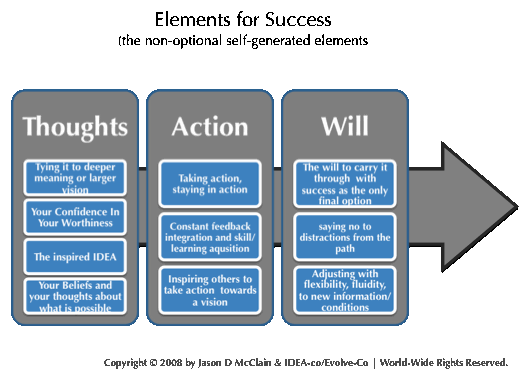
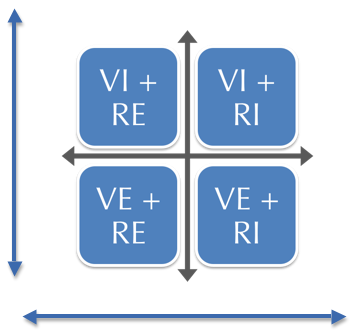
  • Created on .
  • Last updated on .
  • Hits: 3892

An Unconventional Approach to Suicide Prevention

Everything (everything? Yes everything) is hypnosis.

That is not a meta-model violation*. That is a Universal Truth. Every thought you think. Every song you sing. Everything you do in your mind is self-hypnosis.

You are doing it already. And some of you are even doing it consciously. At times. Most times, you are not. Most times the inmates (negative thoughts/negative self-talk, therefore, negative trances) are running the prison.

It is so easy to make a difference in someone’s life with words of encouragement or an acknowledgment of something we appreciate about them.

Strangers are even more positively impacted. They probably go home and tell their spouse or sibling or friend about the random stranger who said the thing to them that day that had them laugh or feel appreciated or … and all we did was use their name from their name tag and ask them if everyone was treating them kindly today. We treated them like a human rather than an extension of the scanner attached to the checkout counter.

There are many ways to disrupt negative states (or say what it is: a self-imposed negative hypnotic trance) in others. Humor is one. Authentic kindness that shows a depth of seeing another is one. Tickling someone is one. Making a funny face at a crying child when you can see it and their parent’s back is to you (one of my personal favorites for public transportation) [pro tip: only lasts until mom or dad wonder why the toddler is suddenly giggling and they start to look around. I always pretend to be looking out the window. Never been caught yet. Then do it again. Build rapport with the toddler as it is just the two of you connected].

There are many others.

Sometimes just being more enthusiastic about someone’s negative trance will have them snap out of it.

Let me give an example by way of a recent and true personal story.

I have a friend who is suicidal - has truly given up on life. I recited for him (accurately hallucinated) all of his reasons he may be thinking this was the best option and he would say, “that’s right!” “How did you know?” or “That’s exactly right” each time (building rapport deeply by accurately projecting his motivations which were not known to anyone but himself).

He’s 80, and he has much he wanted to accomplish that he has not, but he has become a bitter, anxious, cynical old man and is really just waiting out his days. He thinks he is worth more to his wife dead (insurance) than alive. And that may be true even to her. They divorced 40 years ago and I don’t think you do that again - at this point, you just say screw it. But to her, he is nothing but unfulfilled promises and wasted potential. They live separately and only see each other for the grandchildren on the weekends and she treats him poorly.

And he can be an ass. But ... **shrug**

The truth is he just does not have it in him to rally for a Third Act.

Anyway, he has brought up the idea of assisted suicide enough times to me that this last time, I said: “you are really asking if I will help you”.

Yes, he said.

So I went at it with full gusto and in 15 minutes came up with a foolproof plan that would be painless, look like an accident, and require only things that he already had in his possession.

And then I said, with a chipper tone in my voice, “Awesome! You always said I could have this apartment when you died" and looking around the room ... "I’ll be sure the artwork goes to the appropriate art galleries or donate them wherever you want them (he said his some and his grandchildren had no interest in them). But I would like to keep this one (pointing to one piece) Let’s set a date! How much time do you need to get your affairs in order?” He looked at me curiously and settled on December 15th.

We chatted for a bit more and then I left.

I returned the next day around noon time.

And I came into his office. He offered me coffee. And I said, again with cheer in my voice: “So! December 15th, huh!? We get to end all this suffering for you once and for all. I hope you are ion action around your will and such.” and then I said (tapping my watch on my wrist ) “we’re on a clock mister. Count down has begun! “Let's get this ball rollin’.”

Because of the rapport I had built, he never felt mocked (and he was clear I have no judgments about suicide) and because no one is ever sure if I am joking or not, really, he figured he had a solid assistant and… well, he was impressed by the plan.

But it made it real. 

So he sat me down and he said that as a result of my visit the previous evening, he actually felt much better about life. And it gave him hope and made him feel cheerful for the first time in several years. He said he would keep it in mind, but December 15th was probably not a realistic time-frame. He said he would re-think it after the holidays perhaps.

I could tell the desire had left him. Lifted as easily as a white linen window treatment in a summer breeze.

I could tell the trance was broken - because I aligned with it even more fully than he did - and had a good plan - and I was enthusiastic about him doing this thing he felt shame about. I embraced it more than he could himself. He felt seen, heard, safe, and supported.

And… I made him set a date so there was compression (what this does internally is it makes the images - usually- bigger, closer, and brighter in terms of sub-modalities; it became a more realistic fantasy if you will).

There is a transformational principle “that which you resist persists”. If you have full acceptance, there is no resistance. No pushback. No polarization. If I had tried to talk him out of it, he may have felt that he truly had no one who understood him and be driven further into isolation and despair. Instead, I offered to help him pack his bags for his trip to the afterlife, and he thought… maybe not time to check out of the Earth Hotel as a live guest.

And NOW I could tell him what I really wanted to tell him. Now he was open to it. And it was also evidentiary: “Well, you know, despair is a self-imposed trance. It’s created by your thoughts about the future and not having as compelling future to live into - imagining a negative one - predictably leads to despair. Good for you for noticing that and snapping out of it.”

I made sure he thought it was all him so he would feel a little better about himself. I certainly don’t need or care about the credit. And he is delightfully oblivious to my machinations: conspiring for his happiness and hopefulness.

And here is one of the takeaways: sometimes (actually, more often than not) the unconventional approach can produce the result the conventional approach is supposed to achieve (aborting the suicide in this case) yet fails to because it is not artful enough or flexible enough.

Remember the Law of Requisite Variety? The Law of Requisite Variety is a presupposition of NLP. It states that the system/person with the most flexibility of behavior will control the system. It is also the first law of Cybernetics.

In NLP we have the flexibility of approach to achieve a certain outcome that we are committed to. Other approaches are committed to one way of approaching something - the “method”. They are fixed and inflexible about that approach. And as a result, they have less success in achieving their outcomes - and their approach metastasized into dogma eventually. Or “conventional wisdom”.

If we have the mindset and the orientation to the outcome that it is an experiment and if one approach does not work, we will find another that does ... we are bound to be successful.

And it is true - as you just read - that we can change (and at times save) lives every day with the skills we are practicing here together.

Remember (in case I have not mentioned it yet) everything is hypnosis. Sometimes you can disrupt a trance by inflating it or “taking it to threshold” to expose its cracks. Like putting even more hot air in a balloon that was already full, the negative trance may just burst.

Sometimes all you need to do is ask someone a simple question like, “where would you love to go for a vacation”? And they are in a better trance than before, and they are likely smiling.

Imagine how much different the world would be if we all took on the intention to leave the person (especially strangers) we interact with feeling better than when we encountered them?

 
*Meta-model violation explained.

  • Created on .
  • Last updated on .
  • Hits: 1939

The Ultimate Meditation | The Law of Attraction is Already Working For You, But Not The Way You Might Think

Communication skills: we often think of how skilled we are communicating with others but the more important skillset is how we communicate with ourselves.
 
You are communicating with yourself every second of every waking moment. Not just stuff you say to yourself. That's obvious. But futures you imagine. Situations you think about. Imaginings of outcomes.
 
This is why meta-cognition and meta-awareness is the most important capacity to develop of all.
 
The ability to rapidly notice any thoughts that do not serve you - because everything is self-hypnosis - and change them to positive and empowering thoughts is the ultimate skill.
 
For some, they never notice the negativities - and then they wonder why the Law of Attraction does not work for them. It is. It does. Whether you realize it or not. The thing you think about most often, for the longest duration, with the most emotional intensity will come to pass.
 
So if you wake up with anxiety, filled with worry, you are imagining negative futures or outcomes. Probably accompanied by internal self-talk about how you might fail or “what if it does not work out”? Sitting down for a 10-minute meditation to think positive thoughts about what you want to create is not going to counteract hours of worry and fear.
 
No.
 
The real meditation is becoming aware of every thought you think every moment of every day. Become aware of that - and master it - and you will master your emotions, your inner life, and ultimately realize your vision.
 
Even when stuff goes sideways - and you have unexpected crises, with this ingrained as a habit, you will recover much faster and find solutions far more easily, and do it while having the pleasure of knowing it will all work out just fine no matter what.

--

This is an excerpt from Jason's forthcoming book on Evolutionary Relationships from the #RelationshipContinuum section.

To be Guided by Jason - whether you are currently in a relationship and want to transform it, or you are single and want to “do the next one right” - check out the Evolutionary Relationships offering.

Or just schedule a complimentary initial conversation here to get the process started.


  • Created on .
  • Last updated on .
  • Hits: 1833

Vulnerability and Sharing "Vulnerable" Things in Intimate Relationships

The most recent “Love of My Life” helped me see and understand something I was unaware of.

She would share something about her inner life with me and I would listen attentively, and when she was finished I would thank her for sharing it. I love understanding my lover at a deeper level so any time they share their experience I am definitely interested. On several occasions though, she would pause when finished, put a hand to my forearm and say, “that was really vulnerable for me to share”.

“Oh!” I would say. “Ok”. 

The reality is I have never really understood or agreed with the conversation around vulnerability in intimate conversations.  I understand it now.

But often, I will share something, and the person (usually the woman) I am sharing it with will acknowledge how vulnerable it was for me to share. Except it wasn’t. Why?  And, why not?

Let’s examine this together: 

If you feel something is “vulnerable to share” that means you are psychologically and emotionally exposing your underbelly to someone when you share it. Like when a cat reveals their tummy to you - and as a natural predator, they know they can be gutted so this is a sign of safety and trust. - Following the metaphor when someone shares something vulnerable for them it means they either feel safe enough with you, mustered enough courage to share it, were able to set aside their fears for long enough, or “white-knuckled it” though their fears to share it in spite of the fact that they are emotionally very sensitive about the matter and your response has the power to devastate them emotionally.

It also means they are dependent on you for your approval at this moment to feel okay about themselves or about the thing they are sharing. 

This is one of the many reasons supporting Agreement 1:  Telling the Truth and Hearing the Truth.

If we are to be sensitive to them and their needs and we want to increase the level of intimate sharing from them, we would do well to be caring and kind when they share something that took courage or they had fear around sharing. The more we make it safe for them to share - meaning we make it no big deal with no dramatic reactions - and thank them and acknowledge them for sharing it and the courage it took, the more they will share and the more intimacy and connection you will experience with them. 

They will open to you more and more.

That’s how we engage with them there. With kindness.

Brace Yourself


How we deal with it when the roles are reversed is very different.

Now, imagine it is you doing the sharing. If you feel it is vulnerable to share what this is pointing to your fear that they will judge you, shame you, stop liking you, be angry or hurt, or leave you when you share it. Setting aside any possibility that you are revealing you broke an agreement - that’s a very different animal - at its worst, this can be a sign of co-dependence. At best, it points to a lack of full self-acceptance as you are looking to them/hoping for validation or approval.

At this point, we can look back on both the sections on esteem for yourself.

Once you have fully accepted every aspect of yourself - meaning be willing to look in the mirror unflinchingly at all of your exceptional qualities, your faults, and everything in between - once you can face the truth about yourself fully - the whole experience of “vulnerability” fades away. Once you have self-acceptance, shame and shaming, and the fear of a lack acceptance from others and the corollary seeking or needing of their approval all evaporate - or at the very least you become immune in a healthy way.

--

This is an excerpt from Jason's forthcoming book on Evolutionary Relationships from the #RelationshipContinuum section.

To be Guided by Jason - whether you are currently in a relationship and want to transform it, or you are single and want to “do the next one right” - check out the Evolutionary Relationships offering.

Or just schedule a complimentary initial conversation here to get the process started.


  • Created on .
  • Last updated on .
  • Hits: 1643

From Conflict to Connection

From Conflict to Connection

If you are fighting, you should probably be fucking.

If you are a man in a hetero-normative relationship here is an inside tip: if you find yourself say “WTF?” because your woman is picking strange fights over little things, she’s not well-fucked. She may not even be aware that the static and tension in her body is her need to run sexual energy - and it needs to be about her pleasure, not yours.

The more feminine she is on the spectrum - from masculine to feminine - the more accurate this will be.

First, context is important as is the sequence. And there are a few dos and don’ts.

If you find yourself in conflict over something you consider silly - like you keep dropping your dirty underwear or socks wherever you please - the worst thing you can do is say: “you just need a good fucking” as a retort. This will lead to a bigger fight. Don’t be an asshole and … be an adult: pick up your own socks. Put your dirty underwear in the washer or the hamper or wherever it is you need to.

Pick up after yourself.

Don’t expect her to take care of you in any way - in fact, leave everything a little cleaner than you found it in the kitchen and the bathroom. She will be grateful and she should not have to pick up after you.

The healthiest relating is one where two autonomous yet complementary adults come together to create more than two.

Relationships are a quantum affair; 1+1 does not equal 2. It either equals less than 2 (conflict) or it equals more than 2 (synergy). And the degree of turnon and sexual desire in the relationship is a good sign of the degree of health and vitality in the relating.

Think about it: it is the unstated, the secrets, the unexpressed, and the built-up negative patterns and residue that get in the way of your desire for each other. This is why when you get all that stuff out of the way, connection and desire are restored or return to your dynamic.

But, let’s take the socks.

Pick them up. Take responsibility. Thank her for expressing her frustrations - this will encourage her to tell you the truth more. Ask her if there is anything else that she is frustrated with that you do.

Listen.

Hear the feedback and get it handled.

Then wait a bit.

Maybe 10 minutes. Maybe 10 hours. Depending on your dynamics. Then put some attention on her. Acknowledge how beautiful (or courageous or brilliant or … how much she excites you because of the way she embodies her femininity … something you authentically appreciate about her).

Whatever your way in, make love to her in a way that shows your enthusiasm for her, your desire for her, and focus on her pleasure first. Believe me, if you are focused on her pleasure, she will be more hungry and grateful for you than you could ever hope - and this is doubly true if you are good at playing her body like the heavenly instrument that it is.

As we have already talked about, getting good at sex - which takes communication, knowledge of physiology, and shame-free space, curiosity, and openness to explore the other’s body and desires - is critical for the long-term health and vitality of your relating, and as stated above, desire is a good barometer of the health and vitality - and the amount of truth being told and the amount of intimacy and safety - in a relationship.

AND … if you are a man in a hetero-normative relationship, sometimes your woman needs to get fucked until her eyes cross.

If you know how to hit her spots, you’ll find that you can occasionally toss your socks in the kitchen sink and she may just shrug it off because she’ll still be blushing/flushing from thinking about how you ravaged her and gave her otherworldly pleasure just a few hours ago.

The unevolved / pre-rational version of the dynamic is this: you can get away with a lot if you are fucking her well.

The same is true in the other direction.

How many women know that if he is being a mild jerk or is irritated by you, you can kiss him to shut him up? And if you kiss him well - or kiss him fully and passionately or gently and fully enough - he may even forget what he was annoyed by?

If you didn’t know … you do now.

Returning to the idea that she may not even be aware of her needs in her body and speaking of autonomy, am I saying to tell her what she needs? No. I am not. And if you are a woman reading this, that is not what I am suggesting. What would be best is if she/you were self-aware enough to express your needs - either attention or connection or love-making - or simply to have him go down on you - or to help you with a thing you are anxious about.

Notice the tension in your body and ask for what you need.

But as a man - know that she will be smoothed out if you are handling her sexual needs and desires well.

Now let’s explore the communication tool I call “From Conflict to Connection”.

This is a communication structure you will want to add to your agreements when you are engaged in #RelationshipGenesis. You could also consider it a subset and an expansion of Agreement #3:

-----

This is an excerpt from Jason's forthcoming book on Evolutionary Relationships from the #RelationshipContinuum section.

To be Guided by Jason - whether you are currently in a relationship and want to transform it, or you are single and want to “do the next one right” - check out the Evolutionary Relationships offering.

Or just schedule a complimentary initial conversation here to get the process started.


  • Created on .
  • Last updated on .
  • Hits: 2673

The Importance of Taking Time To Heal After A Breakup

The most cringe-worthy statements I've heard on how to handle breakup grief:

From a woman: "The best way to get over a man is to get under another one."  From a man: "Just drown yourself in p*ssy until you forget her."

There are so many things off with this I am not even sure where to begin, but I will start with the fact that it will not help you get over them at all. It may numb the pain - it may anesthetize you - but so much of the gift and benefits in facing the pain will be lost.

It is important to grieve and give yourself time to heal. 

After each relationship, I recommend taking at least 6 months and stay single and celibate during that time. In the last 15 years, I have had periods of being single and celibate that were 14 months, 18 months, 22 months, and 7 months. None of them started out as intentional - other than knowing I needed to take time - and the duration was undetermined when those periods began, but there are several solid reasons for this.

Reasons To Take Time After A Breakup

1. You are not truly fit and ready for healthy romantic love until you are fundamentally okay being alone; you have to love yourself before you can love another

2. So you do not repeat the same patterns and mistakes.  Have you ever wondered why you date a person with the same problems or had the same kind of conflicts in each of your relationships?  Almost like the movie Groundhog Day? You can avoid that by taking the time to do some conscious and intentional work to resolve those patterns and triggers and gaining the benefit of new and more subtle intricacies and patterns.

3. Learn what you need to learn from the previous relationship. 

a. What was your part in the breakdowns and conflicts? What could you do differently to have a more loving, easeful, fulfilling experience

b. Which areas do you need to heal from your more distant past that impacted that relationship - the stuff that predated that relationship but were uncovered by the level of intimacy you shared?

c. What triggers arise that need to be cleared or healed?

4. Uplevel your next partner and next level of relating

a. What did you love about the love or lover that you want again in the future? 
b. What are the qualities and characteristics you want in your next lover that they shared?  
c. What new and additional qualities or characteristics do you want or need in addition?
d. What did you miss or skip over that you need to make sure has attention in the future?

5. So you can be more open, more present, and ready to love fully - rather than guarded, closed down, still hurt and scared to love again. So you are ready to love more fully, deeper, and more completely than you have before.


What’s next is always better if you make sure you are better.

What’s next will always be better because you will make sure you are better.

If you avoid these important steps, you will - at best -  be engaged in spiritual and emotional bypass and at worst you will engage in transference - or worse still, just stuff it all down never to be addressed and it will fester and turn into even worse pathology down the road, negatively impacting your emotional and even physical health, and negatively impacting your loved ones around you and certainly your next relationships and you will end up being destined to repeat the same mistakes. 

Or you will simply shut down more and more and become less and less open and less and less present and therefore, less capable of true love and true intimacy.

Let’s avoid that.

Become intimate with yourself by taking time to heal and grow so you can be ready for an even deeper love that could be right around the next corner or in the next coffee shop once you are ready and open to the possibility.

--

The example from my own life that is most poignant here, was in early 2017 when I met the most recent love of my life.  I had been in love before, but never like this. A paragraph I was so smitten with her that I would drop things when I was around her. I would cut myself shaving if she stayed the night - something I had not done in a decade.

I was overwhelmed with my love for her and my attraction to her.

It will be useful for you to know a little bit about me and my relationship to convention and obligatory holidays - while being a romantic: I would often give her roses - always two dozen. Usually weekly or biweekly. And always hand-arranged by me. I wrote her poetry. I would make sure that I not only demonstrated but also verbally expressed my love and appreciation of and for her on a daily basis. 

But I had a rule about holidays. 

So I told her I would most likely never give her flowers on Valentine's Day - or any day it was _expected_ but she got roses at least once every two weeks. Always randomly. Always sweetly. And NEVER to make up for something or after a fight.

But I began to consider my relationship to obligatory holidays. 

And I saw that I wasn't just being post-conventional, I was being anti-conventional. And she was a more conventionally-minded woman, and because she was the love of my life and I want to be her life partner, and her family was more traditional, and her desires were more traditional, I decided to discard this rebellion against convention - and I let her know.

So ... I made lots of plans for Valentine's Day and I bought her 88 roses - it had to be more than two dozen and 8s on their side .,.. Well, twin infinity symbols, I thought. The arrangement was multiple colors that were arranged in a cascade and tied together with white ribbons.

But on Valentine's Day, she shut me out. She told me she did not want to see me. And she wouldn't tell me why. I almost panicked. 

 it wouldn't be until days later that she let me know that really she was still grieving her divorce and her ex-husband who she was never really in love with. And that was part of what she was grieving. and that she was still in love with him.

I received it well and I thanked her for her openness and her courage in sharing that.

Some months later as other interesting patterns arose I had never experienced before in relating, something seemed off to me. Following my intuition, I decided to ask her how long she usually took between relationships. She let me know that she never took time between any relationship in her life - and she was in her early forties.  

It had a lot of things make sense. 

Three years later we eventually ended it, and while I am still very grateful for that love, and for the experience of her, as she was a truly extraordinary woman - the most brilliant and beautiful and graceful woman I had ever had the pleasure of being lovers with, it would have been much much easier for us and much better for my heart, if she had healed and taken time after her divorce before dating again.

And if I were a better man - or a more patient man, perhaps we would still be together. But that is another story for another section.

For now, I simply make sure that any woman I date is healed from the previous relationship and has taken time to herself - at least 6 months from the previous relationship - to be alone and autonomous.

I put a structure in place so I could avoid making the same mistake with this romantic heart of mine in the future. I highly recommend you do the same to be kind to yourself.

---

This is an excerpt from Jason's forthcoming book on Evolutionary Relationships from the #RelationshipPostmortem section.

To be Guided by Jason - whether you are currently in a relationship and want to transform it, or you are single and want to “do the next one right” - check out the Evolutionary Relationships offering.

Or just schedule a complimentary initial conversation here to get the process started.

  • Created on .
  • Last updated on .
  • Hits: 2935

Becoming Your Own Guru | What Triggers are and How to Best Relate to Them

Given all this talk of responsibility and blame, how do we best relate to triggers?  What are they? How do they occur?

Triggers are most often referring to feelings of hurt or anger.  What I mean when I say “trigger” is that you lose the balance of your mind or that you “lose facility with self” in a disproportionate way.

Some people call it “going into red”. Some refer to it as a “trauma response”. Some refer to it as “pissing you off”, or what have you. There can be many names for it, but I think the disproportionate nature of it - where you say things you have to apologize for or simply can’t communicate responsibly - or simply yell or lash out or hurt the other person physically or verbally - is symptomatic of being “triggered”.

We usually speak about them in a relationship as if the other person is somehow to blame for our lack of emotional facility or rationality.  “They triggered me” or “they made me angry” or my personal favorite “you made me worry” we can be heard saying.

Yes. That’s right:  they put a gun to your head and made you fantasize horrible things may have happened to them. When really all that was happening was their cell phone battery died. Or they fell asleep. But they made you worry.

What is the problem with this? 

Not only does this give our power away, but it also makes other people responsible for our feelings, which is simply not the case.

They did not trigger us - it is not their behavior that is the problem:  it is our relationship to what they did that is the problem. Or it is how we interpreted it - what we made up or made it mean - that produced the emotional response in us. We got triggered.  Or it triggered something from our past. More often than not, something that happened triggered off something from our past - or a series of events from our past - hence the disproportionate nature of the trigger. 

We’ve all experienced this in the micro. If your lover keeps leaving dirty underwear on the counter or leaves the empty toilet paper roll on the dispenser without replacing it … and it happens over and over again - you may have a disproportionate response to that and blow up at them about that or about something else. 

This is good news; something from our past that is unresolved or in need of resolution has presented itself.

This is a gift if we relate to it as such.

My partner does not trigger me. I get triggered. Or something from my past was triggered.

If I relate to it like they triggered me AND I wait for them to come in after me and “make it right” I am not only playing a victim, I am making them responsible for my trigger and my happiness. Even worse: they now have all the power over my current emotional state: and I gave it to them by blaming them.

There are also some who use this as a control dynamic/power play; withholding love or connection until you “make it right” when in fact you broke no agreements. But they hold you hostage - or perhaps you have done this yourself to someone to feel special or … extract your pound of flesh.

This is not the exercise of power - it is the use of emotional force. True power comes from developing your facility with self; learning to navigate your interiors - so that you can have ease, flow, and happiness in your life - and a funny thing happens when you do: people enjoy being around you more when you manage your own internal experience - because you are giving them the freedom to be themselves.

They will thank you for being gracious. They will thank you for being understanding. But mostly, they will continue to be more and more self-expressed as you will have clean relating absent of any shame or irresponsibly expressed anger. They won't feel blamed simply for being themselves.

Here is where I give you two new tools - practices really - one for resolving shame, hopelessness and other “emotional atmospheres” as I like to call them, and one for dissolving anger while simultaneously building empathy and compassion.

If you master these simple practices, you will enjoy lasting and increased levels of joy, happiness, and ease, where you used to beat yourself up, get frustrated or angry - or blamed others for things and felt powerless.

You will become equanimous.

This will give you true power, but it is absent of any force.

One of my favorite translations of the word "guru" is "one who is solid in themselves" - so they can not be blown over by external events. I have no interest in being your guru. But I am heavily invested in helping you become your own guru.

These tools will speed you on that path.

  • Created on .
  • Last updated on .
  • Hits: 3317

Four Agreements for Healthy Relationships | From Chance to Wisdom; From Conflict to Connection

The Four Agreements

From Chance to Wisdom. From Conflict to Connection.


In my experience, there are four agreements that are necessary as foundations for any healthy relationship regardless of the context. Meaning it doesn't matter if it's professional if it's friendly, or if it's sexual/intimate.

In fact the more intimate it is the more important I think these agreements are, but unfortunately - and paradoxically - the less likely someone is to actually be willing to have this conversation. I think that's for many reasons, most of them self-esteem issues are at their source. 

Let me explain: If we are attached to the hope that someone will like us to the degree that it becomes a need and therefore induces fear in ourselves, and we have scarcity around whether or not we will actually find somebody who is a fit, or whether or not we can find someone else if a relationship does not work out, we have a tendency to overlook things that we know are important to take care of because if the person doesn't like us then we may take that personally if it's the case of a self-esteem issue, or we don't want to set up any barriers to them liking us or connecting with us.

But in doing so, we skip over critical foundational steps - and virtually assure we end up with someone who is not a fit or find ourselves in a conflict without the agreement reality as to how we find our way out of it and get back into connection.

So we ignore wisdom in favor of the immediacy of connection. At its worst, of course, this borders on codependency and external validation and that a path that if you continue down that road leads to frustration, heartache, and worse.

However if we have an abundance mindset that there are plenty of people out there who might be a fit for us - and fit is more important than not being alone - and we understand that it's easier to find somebody who's a fit that it is to deal with the frustration and challenges and eventual heartbreak of someone who is not a fit, and we are internally validated in terms of our esteem for ourselves, then we choose wisdom over chance or … worse: predictably negative results.

The Agreements

Four Foundational Agreements For Healthy Relating

  1. We tell the truth and we hear the truth and we value truth over comfort
  2. We do not hold anyone accountable to agreements they have not made
  3. If we are upset, we make a request (for a new agreement)
  4. We accept that we are responsible for our own experience and our own emotions.
    1. Make no assumptions
    2. Don’t make anything up

Agreement 1:  Truth Over Comfort

The first agreement is that we tell the truth and we hear the truth and we value truth over comfort. 

The “comfort” might be our own, or it may be the comfort of others.

If we are afraid to say it, or afraid that somebody can’t hear it or might take it personally, that’s probably the very thing that should be said - and the longer we delay the telling of that truth, the bigger it becomes in our mind and the worse it will be when we tell them - for the relating, for our internal anxiousness around sharing it, and for them when they find out how long we delayed. Telling the truth brings relief for all without delay. There may be broken agreements to clean up - something we will address later on in this book, but that aside, telling the truth should increase intimacy and connection. Hearing the truth - if done openly and spaciously - always will.

This is not an excuse to be a jerk.

There is a popular theme in some circles where someone is a jerk (that is a technical term) and they finish it off with “I am just speaking my truth”.

That is not in alignment with the spirit of this rule - because most often “speaking your truth”  is just being self-indulgent. The spirit of this rule is to increase intimacy.

We want to tell the truth with skillful means - meaning in a way that honors both ourselves, in a way the other person is best able to receive it, as well as caring for the relating or the relationship - the 3rd entity that is created by the synergy of the two of you.

Relationships begin to die in the unsaid.

Telling the truth and hearing the truth are - at the very least - different sets of capacities. That can not be overstated. And as I have said, communication skills are physical skills that take practice - and these component skills definitely take a lot of practice.

Telling the truth takes courage. Hearing the truth takes openness. And the list goes on and on - in both columns.

But imagine telling the truth about something - something you are scared to share about yourself - and having your partner thank you, express gratitude for trusting them to share it with them, and acknowledge you for the courage that it took and to express that they trust you even more now - and to do it without judgment - with love and acceptance. 

Imagine how much closer you will feel. How that thing is no longer in your mind inhibiting your connection and your openness.

Your partner just heard the truth effectively and you telling the truth has just effectively increased your intimacy and connection.

Now, let’s lay out how this typically goes in an average relationship:

--

This is another excerpt from the forthcoming book #EvolutionaryRelationships from the section titled #RelationshipsGenesis 

  • Created on .
  • Last updated on .
  • Hits: 290

Agreements for Healthy Relating | Agreement 1: Truth Over Comfort

The Agreements

From Chance to Wisdom 

In my experience, there are four agreements that are necessary as foundations for any healthy relationship regardless of the context - meaning it doesn't matter if it's a professional context, if it's friendship, or if it's sexual, intimate, and romantic.

In fact the more intimate it is the more important I think these agreements are, but unfortunately - and paradoxically - the less likely someone is to actually be willing to have the conversation that’s required. That's for many reasons, most of them self-esteem issues are at their source and fear-based.

Let me explain: If we are attached to the hope that someone will like us, to the degree that it becomes a need for their approval and therefore induces fear in ourselves, and/or we have scarcity around whether or not we will actually find somebody who is a fit, or whether or not we can find someone else if a relationship does not work out, we have a tendency to overlook things that we know are important to address because if the person doesn't like us then we may take that personally in the case of a self-esteem issue, or we don't want to set up any barriers to them liking us or connecting with us.

But in doing so, we skip over critical foundational steps - and virtually assure we end up with someone who is not a fit or find ourselves in a conflict without the agreement reality as to how we find our way out of it and get back into connection.

So we ignore wisdom in favor of the immediacy of false connection - so as to not "rock the boat". At its worst, of course, this borders on codependency and external validation and that a path that if you continue down that road leads to frustration, heartache, and worse.

However if we have an abundance mindset - a certainty that there are plenty of people out there who might be a fit for us - and fit is more important than not being alone - we understand that it's easier to find somebody who's a fit that it is to deal with the frustration and challenges and eventual heartbreak of someone who is not a fit, and we are internally validated in terms of our esteem for ourselves, then we choose wisdom over chance.

The reality is we are actually choosing wisdom and communication over something much worse than chance: predictably negative results.

When do I open the conversation for these agreements?  Usually after a successful first date.

Some people may fret at this moment - and they are worried it is too late - they already skipped over these agreements and find themselves in the quagmire of shoulds and implicit agreements and unstated yet clear expectations you never agreed to. That can be an icky and frustrating place.

But don’t fret: you can transform any relationship - or “reboot” or - or start over from scratch and begin to date someone again - you can use the agreements as a way to transform friendships - I have. I have used the agreements and the conversation around them to bring years-long friendships back to life.

We’ll talk about skillful means - how most effectively to do that - after we lay out the agreements and flesh them out fully.


The Agreements

Four Foundational Agreements For Healthy Relating

  1. We tell the truth and we hear the truth and we value truth over comfort
  2. We do not hold anyone accountable to agreements they have not made
  3. If we are upset, we make a request (for a new agreement)
  4. We accept that we are responsible for our own experience and our own emotions.
    1. Make no assumptions
    2. Don’t make anything up

Let’s examine each of these agreements fully.

Agreement 1:  Truth Over Comfort

The first agreement is that we tell the truth and we hear the truth and we value truth over comfort. 

The “comfort” might be our own, or it may be the comfort of others.

Here is an excellent standard: if we are afraid to say it - or afraid that somebody can’t hear it or might take it personally - that’s probably the very thing that should be said. 

And as I am sure you have experienced, the longer we delay the telling of that truth, the bigger it becomes in our mind and the worse it will be when we tell them - for the relating, for our internal anxiousness around sharing it, and for them when they find out how long we delayed; telling the truth brings relief for all without delay. There may be broken agreements to clean up - something we will address later on in this book, but that aside, telling the truth should increase intimacy and connection. 

Hearing the truth - if done openly and spaciously - always will.

Telling the truth is not an excuse to be a jerk.

There is a popular theme in some circles where someone is a jerk (that is a technical term) and they finish it off (or begin it) with “I am just speaking my truth”.

That is not in alignment with the spirit of this rule - because most often “speaking your truth”  is just being self-indulgent. The spirit of this rule is to increase intimacy and to increase connection. Thus, we want to tell the truth with skillful means - meaning in a way that honors both ourselves, yet delivered in a way the other person is best able to receive it.  As well as caring for the relating or the relationship - the 3rd entity that is created by the synergy of the two of you.

Why is this so important?  Relationships begin to die in the unsaid.

The grass isn't always greener on the other side of the fence; the grass is always greener where it is tended to, cared for, and nurtured.

If there is enough unsaid in the relationship, you are not even relating to the human in front of you anymore - you are relating to all the stuff you have not said, or do not think you can say - and that shows up as being distracted, shut down, simply not present, or simply being silent. So instead of relating to the dynamic and vibrant human in front of you, you are simply in your head about … all the things. 

That build-up - that residue - kills true intimacy.

And yet, telling the truth and hearing the truth are - at the very least - very different sets of capacities. 

That can not be overstated - and as I have said over and over again, communication skills are physical skills that take practice - and these component skills definitely take a lot of practice.

To start with, telling the truth can take a lot of courage. Hearing the truth takes openness and, at times, a willingness to hear feedback and truths that are difficult to hear. 

And the list goes on - on both sides.

But imagine telling the truth about something - something you are scared to share about yourself - and having your partner thank you, express gratitude for trusting them to share it with them, and acknowledge you for the courage that it took and to express that they trust you even more now - and to do it without judgment - with love and acceptance. 

Imagine how much closer you will feel. How that thing is no longer in your mind inhibiting your connection and your openness.

Well, your partner just heard the truth effectively and you telling the truth has just effectively increased your intimacy and connection.

Now, let’s imagine how this typically goes in an average relationship:

You attempt to share something it takes a lot of courage to share. They react strongly or, perhaps they judge you, perhaps they get triggered, and you feel a little less safe to share that vulnerably in the future.

In this case, you must share truth over your own comfort. You must resist the seduction of going into victim mode and blaming them for making it less safe for you to tell the truth. 

At the same time, we must apply this principle to ourselves in that we must strive to create a space that will have them more likely to tell us the truth - and create a safe enough space for them to share vulnerably.

Is this a double standard? Of course, it is. 

But a double standard that requires you to take more responsibility for your communication is not a double standard at all. It is the standard. If you both take this on - and apply it to yourselves without pointing fingers, you can have easy, fluid, mature communication in the most difficult of situations.

So, yes you share vulnerably in the face of their judgment. However, you must also endeavor to provide a safe enough space for them to share more and more openly - a space for them to expand into. If you don’t, they will be hesitant to tell you the truth in the future - and you do not want that. 

That begins a process that ends up people being blindsided when someone finally leaves them - seemingly out the blue. But it was not out of the blue at all. I began by making it a little less safe for them to tell the truth - because you had difficulty hearing or dealing with the truth.

But never expect the same in return.  Unless of course you are reading this book together, and you have made that explicit agreement.  And that provides a perfect segue to the agreements

2. We do not hold each other accountable to agreements we have not made

What does this mean?  No “they should have known” or “shoulds” in general. And, we understand the difference between an agreement - or rule that we have both agreed to - and expectation, which is usually an unstated desire, and a standard and/or a boundary. To fully understand - and therefore be able to agree to - the 2nd agreement, let’s distinguish the difference among those.

[...]
--

This is an excerpt from Jason's forthcoming book on Evolutionary Relationships from the #RelationshipGenesis section.

To be Guided by Jason - whether you are currently in a relationship and want to transform it, or you are single and want to “do the next one right” - check out the Evolutionary Relationships offering.

Or just schedule a complimentary initial conversation here to get the process started.

  • Created on .
  • Last updated on .
  • Hits: 4283

Agreements For Healthy Relating | We Do Not Hold Eachother accountable to Agreements We Have Not Made

Agreement 2:  We do not hold each other accountable to agreements we have not (explicitly) made

Holding people accountable to agreements they have not made - by punishing them for not being aware of your preferences - is just one aspect of unclean relating. It is also fundamentally unjust.

How do they punish? By withdrawal and withholding.

Intimacy, connection, love, all those things. The things you are there to experience with them.

Sometimes they dress it up as "making sure you understand the impact". Oh, I understand. I understand what they are doing and I see the control game they are attempting to play.

And the degree of attachment and emotional enmeshment one has and external validation one seeks is the degree to which one will be controlled by these gimmicks.

Play a higher game. If your partner will not join you in that cleaner, higher game - will not co-create it with you - choose a new board to play on.

We do not hold each other accountable to agreements we have not made

What does this mean?  How does this occur? What are the indicators?

We’ve all done this. We’ve all had this done to us. Some more recently than others.

The word “should” is one huge indicator, and all-too-often we punish the ignorant - and for what? For not reading our minds? Fro simply being themselves? Sarcasm aside: how do we punish them? 

Most often by withholding intimacy and connection - while blaming them for that very choice we just made. It’s not pretty.

While there is something to be said for having an overlap in world-views and values as a natural fit, I have known people who grew up in the same small town, went to the same church, and still had different ideas, standards, opinions, and rules about how a relationship, a partnership, or marriage should operate in the day-to-day. While you may begin to intuit your partner's needs and desires, this only comes from a process of educating one another about our preferences.

No “they should have known” or “shoulds” in general. Not in Evolutionary Relating.

As an Evolutionary, we understand the difference between an agreement - or rule that we have both agreed to - an expectation, which is usually an unstated desire, and a standard, and/or a boundary.

To fully understand - and therefore be able to agree to - the 2nd agreement, let’s distinguish the difference among those four.

First, if you are upset by something they did or did not do, ask yourself, “do we have an explicit agreement about this”?  If the answer is no, then you can skip to Agreement 3 and decide if you want to make a request around this particular thing or not. If so, and if they agree - it then essentially binds both of you to a new agreement.

Bear in mind that the more rules you have in your relationships the less freedom of expression both parties will have and the more attention you have to have on those rules and agreements. And the truth is - if you are looking to bind someone to an agreement to limit their behavior in some way because you are uncomfortable with how they are - when no real harm is being done by their behavior - but you want to control them or you fear something happening - then you are trading self-expression and spontaneity (read: fun) for stability and safety. And there is a place you are not free emotionally if you want to control or constrict them in some way.

There is nothing wrong with that - just be aware that is what you are doing - and look deeper for the work you can do to allow yourself more freedom there, which will, in turn, give others the freedom to be.

But even if it hasn’t been communicated we still can’t hold that person accountable. If it has been communicated and the person agrees then it’s a new agreement And they can be held accountable.

But in terms of holding someone accountable to an agreement they have not made - it occurs all the time. So if you do not have an explicit agreement around something and you find yourself cutting them off or punishing them in some way - be it punitive or by simply withholding connection - you can reconnect again and take care of your own needs by simply making a request - and they then do not have to guess what your needs are, you are taken care of, and you can get back to connection and love - which hopefully is the primary purpose of your relating.

Hopefully.

If you want to "make them pay", or are extracting a pound of flesh, or withholding connection so they “feel the impact”, there is a much better way.

And really, would you rather be righteous and indignant ... or be in connection and in love?

--

This is an excerpt from Jason's forthcoming book on Evolutionary Relationships from the #RelationshipGenesis section.

To be Guided by Jason - whether you are currently in a relationship and want to transform it, or you are single and want to “do the next one right” - check out the Evolutionary Relationships offering.

Or just schedule a complimentary initial conversation here to get the process started.

  • Created on .
  • Last updated on .
  • Hits: 2033

Evolutionary Relationships | Questions From a Commentor on #RelationshipGenesis

Evolutionary Relationships | Questions From a Commentor on #RelationshipGenesis

Do all relationships have a beginning, middle, & end?

Is it egocentric to hope or aim for a life-long evolutionary dyad? How do you move forward when you sense the end is a painful cliff?

--

Q:  “Do all relationships have a beginning, middle, & end?”

Yes, they do. Though how much time, energy, and focus is spent on each of those stages - the duration of each stage - varies widely.

Sometimes the beginning may take a very very long time. Sometimes they happen very quickly. Sometimes there is a seemingly paradoxical combination of both.

For instance, with my last relationship, I had known her for 12 years and had always had a bit of a crush on her. In fact, I still remember the red dress she was wearing when I met her in 2008.

 But circumstances were such that it would have been inappropriate for me to express that at the time. 12 years passed, and then we just happened to be in the same city at the same time and she reached out to me asking if I was in fact in that city - I think I have Facebook's proximity function in Messenger to thank for that.

 Anyway, the circumstances were such now that it was no longer inappropriate for me to express it, so I did. And we decided to meet up for a date and to catch up, had an incredible kiss at the end of that date, and then ended up living together for several months almost immediately after that.

And yes, all relationships end. 

Sometimes it ends after just a few months in a volatile fashion. 

Sometimes it ends amicably and it is navigated and negotiated and the two parties can remain friends but just realized that it was not a fit in the context of romance or intimacy for them to be together.

Sometimes the end does not occur until one of you dies after many many many years - decades - of being together. 

But be that as it may, all relationships eventually have an end

Q: Is it egocentric to hope or aim for a life-long evolutionary dyad? 

I think we should have as a starting point the belief or even the conviction that you can have everything that you desire in your relationship.

 Sometimes that's not possible if you're in a relationship already and you realize that something is very important to you, and the other person is either incapable or uninterested in engaging in that way of relating with you. 

However, I think it would be fantastic. 

If you are single, then I think it's appropriate to have that as part of your criteria if it's something that is very important to you and would be fulfilled in that way.

 That’s about values and forms - what is important to you in relating and how that would show up in a way that would fulfill that for you - and if you want that to be a component of your primary, intimate/romantic relationship, be clear about that and seek out another human who desires the same component to their relationship as well.

 Having said that, it is entirely possible for you to use everything that occurs in your relationship as an opportunity to evolve yourself, regardless of whether or not the other person is engaged in that with you consciously. 

However, if you are in a relationship with someone who is not engaged in their own personal evolution - meaning they aren't taking responsibility for their part in things and using the reactions, triggers, sticking points, and even the connection itself as a way to consciously evolve - being the only one to do this in the relationship can become a very lonely endeavor and can even lead to you building resentments depending on how one-sided it may be and how important that is for you as a quality in your relationship.

Q (first version): How do you move forward when you sense the end is a painful cliff?

Q: (commenter edited version) How do you move forward when you see dissolution as an undesirable end state?  

I find it fascinating that this last question was edited - and what it was edited to.  At first, the question was about how you move forward when you sense the end has a painful cliff. Then it was edited to ask about how you move forward when dissolution is an undesirable state.

This tells me a couple of things: it is quite likely that you are vacillating between whether or not breaking up or ending the relationship you are currently is a good idea; you're of two minds about it.

However I do not know you, or the relationship you are in - if in fact, you are in one (for all I know you are in grief over one that ended, or simply contemplating all of this theoretically/hypothetically) - but it at least seems fresh and relevant for you.

If you are in a relationship, I also do not know who you are in a relationship with or what your dynamics are, so I'm going to make some sweeping generalizations and some educated guesses.

The first version first:

Q (first version): How do you move forward when you sense the end is a painful cliff?

First of all, the mindsets are so very important.

It will hurt - you may even feel like your heart is being torn out of your chest - and that you are doing it yourself even.

I left my ex-wife in 2003 when I was madly in love with her still - and after 17 years we just reconnected and we had the very same chemistry - scorchingly hot and dynamic - and our attraction was just as strong, and she is even more beautiful and brilliant at 48 years old as she was when she was 30 years old -  but the interpersonal dynamics that were at play that had me leave were even worse today than they were then, and I noticed that within 48 hours of us communicating over video and in text. 

Just not a fit.

If you are certain it is not a fit, honor yourself and your own happiness by getting out. That intuition you are ignoring - that feeling in your gut that is telling you it is not a fit is likely right. Listen to yourself.

 There is no way to sugarcoat this:  it will hurt. 

It may even be the most painful thing you do - heck, after I left her in 2003, I could barely function for 6 months or so. And, I got through it. You will get through it, and when you are on the other side, you will be glad you did.

Q: (commenter-edited version) How do you move forward when you see dissolution as an undesirable end state?  

So again I will stress that I do not know if you are in a relationship, who you're in a relationship with, or whether or not there are other people involved.

Each of those situations will have different consequences.

For instance, what you mean by dissolution being an undesirable end-state, could mean because you are married, and the tax implications or the property costs, or perhaps you have a child and the impact on the child in the parenting situation would be untenable from your current perspective.

But let's assume that you are just two people, that you are in a heteronormative relationship, and there are several reasons why you would think it would be an undesirable end state - because in your comment previous to the edit you said that you were afraid that it was headed towards a “painful cliff”.

So I am going to assume again that you are of two minds.

With that assumption, I will say this:

While it takes two to tango, it only takes one to transform.

 What I mean by that is if you are committed to transforming the relationship, it is entirely possible for you to do that on your own whether they want to or not, as long as they are willing to still be in a relationship with you, you can transform it just simply by transforming how you relate to the relationship, how you relate to them, and perhaps beginning your courtship again even if you are in the “middle” of the relationship.

 Actually what I should say there, is especially if you are in the “middle” of the relationship.

Your commitment to transforming it can - and will - have an effect on her and your relationship. 

If you begin to look at her with fresh eyes - and begin to cherish her every day and use everything that comes up as an opportunity to evolve yourself, then it does not matter what she does or how she behaves, or what your patterns are.

You will “win” either way.

Either you will transform the relationship completely, getting you both back into connection, back to your love, OR you will succeed at epically developing yourself, becoming even more spacious, and gaining capacities and a level of depth you never thought possible.

BUT  … but only if you play the game of being 100% responsible for your own experience.

For one look at that, you can check out the excerpt from the upcoming book that addresses how to relate to your triggers in a powerful and empowered way.

--

This is an excerpt from Jason's forthcoming book on Evolutionary Relationships from the #RelationshipPostmortem section.

To be Guided by Jason - whether you are currently in a relationship and want to transform it, or you are single and want to “do the next one right” - check out the Evolutionary Relationships offering.

Or just schedule a complimentary initial conversation here to get the process started.

  • Created on .
  • Last updated on .
  • Hits: 1562

Agreements For Healthy Relating | Agreement 3: If We Are Upset, We Make a Request

Agreement 3: If we are upset and we would like a new rule or new agreement, we make a request. 

This could be as simple as, “my request is you open doors for me on a date” or “my request is that you call if you are going to me 5 or more minutes late”, or “my request is that on our dates you turn your phone off - or silence it” so you are fully present.

Or it could be something with more gravity and/or more impact:  “if you are dating other people, my request is that you let me know that”, or “my request is that we be monogamous”.

This is how to have clean communication, to get what you want, and to get back into connection as cleanly and as quickly as possible.

All too often I have seen proponents of so-called “conscious” communication manipulating (or attempting to manipulate) the other person through simply expressing displeasure and then being upset that they did not pick up on it.

All too often women in so-called “conscious” or “transformational” communities talk about how the man should get better at hearing “feminine” communication.

There is certainly some truth to that - men need to pay attention to minimal cues more and can develop more subtle awareness both linguistically and -  but it also codifies implicit communication 0- and can lead to passive-aggressive tendencies that leads to the ickiest (that is a technical term) kind of control where one person is controlling the other person through their lack of emotional facility - often intentionally.

And once you allow this to work, and this dynamic seeps into your relating, it can be one heckuva downward spiral that gains momentum.

And then you have devolution, not evolution.

Let’s explore what you may be upset by.

It could be a trigger (something unresolved from your past that is stacked on top of other similar events and therefore disproportionate).  It could be a boundary that was crossed (you may or may not have been aware of it being a boundary but your upset can bring that into the foreground). It could be a broken agreement with the person you are in a relationship with.

First, reflect on whether or not you are holding them accountable to an agreement they have not made. 

Next, explore whether or not it is triggering something from your past: the disproportionate nature of it will point to that. Relate to this as an opportunity to heal that. It’s a gift they just handed you, really, without knowing it. 

If they broke an agreement you had made with them, there are several steps:

First, ask, “it is my understanding we had __________ agreement. Is that your understanding?”

It is my experience - and my observation - that most people simply forgot. So all it takes it to bring the agreement back into awareness.

Obviously, if it is a larger transgression, like that breaking an agreement around dating or sex, that would be nearly impossible to forget, like “we agreed to be monogamous” then the next step is to offer incredible grace.

For example: is there anything I have done to create the conditions for you to [most likely] not tell the truth about what was happening.

Some of you may be protesting right now, but remember two critical things:

  1. Communication skills are physical skills. So take every opportunity to get as much practice as you can
  2. We take responsibility for our part in things - despite the fact that it will give them grace. And we do it for healthy selfish reasons: to build self-esteem and to increase our capacity for spaciousness and depth.

“Grace” in this context is defined as “unmerited mercy”. But again, that is just fine, because we do it for us - for our own personal evolution - not for them.

--

This is an excerpt from Jason's forthcoming book on Evolutionary Relationships from the #RelationshipGenesis section.

To be Guided by Jason - whether you are currently in a relationship and want to transform it, or you are single and want to “do the next one right” - check out the Evolutionary Relationships offering.

Or just schedule a complimentary initial conversation here to get the process started.

  • Created on .
  • Last updated on .
  • Hits: 1997

Evolutionary Relating | Introduction to the Book

This is from the introduction to the forthcoming book. You can find additional excerpts here.

-----

It’s the one thing that unites and connects us all.

We are not united by national origin, gender, politics, ethnicity, and the like. Not universally. The one thing that universally unites us is this:

Love

It's the one thing every human has in common.

Any poem about love in any language still transmits the same experience regardless of the language we translate it into. Sufi mystic Rumi and Nobel Prize winner Pablo Neruda were separated by several centuries yet both their poetry still translates to this:

Love

Love. Love and a clear reverence for the women they loved without losing any of their masculine centers. It's almost become a lost art.

But it does not matter where your lover came from or whether you have the same birth language - or even speak the same language. Or what color they are. We can fall in love with anyone from any place - from any religion or cultural background - at any time.

We’ve all experienced some version of it. 

Perhaps it was the rush of the chemical attraction--they touched your hand and the electricity was unforgettable. Or maybe it wasn’t the chemistry, maybe it was the feeling of finally being home. Or a kind of comfort and safety you felt almost immediately. Or maybe it was a feeling of familiarity--as if you've known someone for years even though you just met them.

Then at some point when those feelings (many of which we discover are Illusions and projections) are dispelled, and the person begins to behave in ways that disappoint, confound or even anger us, we may begin to question the connection that we have with them and at times, perhaps, even our own judgment. 

Inevitably, we come face-to-face with how many assumptions we've made. How we have built our entire relationship and levels of trust, as well as our fantasies about the future, on these assumptions. And in our pain and confusion, we often make grave errors that only make matters worse and tragically make our future in that relationship - or the next - even worse still.

Sucks, right?

But you know what? 

Virtually all of that is avoidable.

Most of us do not know how to set ourselves up for success in the beginning - we start dating based on chemistry and attraction or availability - not on aligned values. We do not know how to have the conversations to set a baseline for what we will agree on - what our agreed foundation is - heck, some people wait so long to have these conversations that they are not even sure if they are monogamous or both dating other people months into dating (!)


These are conversations that need to be had sooner rather than later. And some people know that, but they don’t know how to have those conversations.

Or worse, they are simply too scared to have them.

Then when conflict arises,  we lack the tools to navigate the situation in a way that feels good, let alone connective and satisfying to both of you.  

Or when the relationship stalls we don't know how to keep it alive, sexy, and have it continue to inspire and uplift - to bring out the best in us.

Then when it ends we have no constructive way to deal with the grief, the self-doubt, the anger, and no capacity to deal with feelings of betrayal or loss or confusion. 

At that point, some of us immerse ourselves so deeply into the process and feelings of loss that we may even think that we are destined to repeat the cycles - and perhaps some of you have - that do not work and lack fundamental workability.

This book strives to solve most of the avoidable challenges and problems that arise in all three stages of relationships and provides structures and tools to assist you in working through the unpredictable - and in some cases unforeseeable - problems that arise. 

In the beginning: how to avoid unwarranted bliss and the inevitable crash - disappointment and even, how to avoid mediocrity in the middle or simply being in a habit rather than in a relationship, how to deal with anger fear jealousy all those things that can arise and create conflict in that middle stage. And of course, the confusion, anger, and grief that can arise when it ends if it ends and how to set yourself up for Success without vilifying the other person and how to reclaim your power if you've lost yourself in the relationship. 

As so many of us have friends who want to comfort us. But they rarely challenge us in our pain and while we blame.

Many of the tools and approaches offered to you in this book aren't just mindsets - how you relate to yourself and your experience and how you approach the world -  but equally as important - communication structures and practices to implement.

I am writing this book because - frankly - I have likely made more mistakes and had more failures most likely than you have.

But I've also endeavored to always learn from them. Because failure is the best teacher. And create distinctions from which you can avoid those mistakes if you apply them. I've gone to the edge of experience and found out what works and what does not work. 

And I am here, back from the edge, to report.

That, and I am a die-hard, gushy hearted romantic. Admittedly this is a difficult book for a self-proclaimed romantic to write. 

Many of the things I will suggest herein don't seem romantic at all. But it will help you to avoid the heartbreak of an all-too sensitive and vulnerable heart.

As a romantic: I hope this book will save you pain and help you experience more happiness than you would have otherwise.

I hope you experience ever-increasing levels of joy, depth, and intimacy. That you can relate with each other. That you can love even more freely - knowing that the structures are there to catch you should you fall.

And love again, even more deeply.

--

This is an excerpt from Jason's forthcoming book on Evolutionary Relationships from the #RelationshipGenesis section.

To be Guided by Jason - whether you are currently in a relationship and want to transform it, or you are single and want to “do the next one right” - check out the Evolutionary Relationships offering.

Or just schedule a complimentary initial conversation here to get the process started.


  • Created on .
  • Last updated on .
  • Hits: 2530

Guilt, Shame, and Self-Acceptance | How Shame Requires Your Consent

Shame, Guilt, and Shaming

I caused quite a stir a few years ago when shaming and the campaign against shaming was all the rage. And the stir I caused was by simply posting “shame requires your consent” followed by “self-acceptance is the antidote to shame”.

These two concepts are very closely related and let me explain how and why they are both so important - and how much freedom they can provide you if implemented and - through practice - embodied. But first, let’s distinguish a few things. Primarily, what is the difference between guilt and shame - because they are different and the distinction is important and most of us have them collapsed.

Guilt and Shame

“Shame gives guilt a bad name.”  -Mark Michael Lewis

Guilt and Shame. 

For years my good friend Mark Michael Lewis and I debated several concepts. These were spirited yet friendly conversations over the years - sometimes conversations on a single topic would span years. And one of these conversations had centered around guilt and shame and we only came to a resolution on it when we shared the sensations associated with each of them. How did shame feel in the body? How did guilt feel in the body? When we discussed the sensations, we discovered that we actually agreed. It was simply that we had not defined our terms.

For the purposes of our discussion here, guilt is defined as "a realization - an “a-ha” moment if you will - that you violated your own value system - and the feeling you that must make it right". It’s then followed by a bit of an adrenaline rush; you feel more alert and you feel compelled to fix it somehow - through acknowledging the wrong, through making amends somehow, or doing something to restore yourself in your own guidelines. In sum, guilt is the feeling you did a bad thing: a behavior you do not condone for yourself. We have all done something we are not proud of; a wrong we know we must right. Something that keeps bothering us in the back of our minds. Sometimes even years later. It may be something small - something that when we go to the person and attempt to clean it up they may not even remember it happening.

Shame is taking the additional step of thinking you are therefore a bad person. Bad or wroshame nunng at your core. It is when we take “I did a bad thing” and then tack on “so I’m a bad person”. Not only is that confusing of logical levels - confusing behavior, or what we do with identity, or who we are - but the heavy, oppressive feelings that can even lead to debilitating feelings where one may not even want to get out of bed - actually slows our progress. We have to move through the shame before we can step into the light and take the actions necessary to right that wrong. It’s an unnecessary step that provides no value.

And, sadly, there are times when people use this sort of self-flagellation for attention and comfort or even love  - and to avoid the shaming that may come from the other who they feel they have wronged. 


And as long as we are on the topic of shaming - let me drop this idea on you that may have a hard landing:  


Shame requires your consent

Think about this for a minute.

For someone to shame you effectively - which is them attempting to impose their value system onto you by emotional brute force - meaning for it to actually work, there has to be some part of you that buys into whatever they are judging you for. If you were 100% aligned with your own behavior - if you had 100% self-acceptance of all aspects of your being - it would fall flat. You may even laugh at their attempts to shame you, or at the very least shrug it off.

And it is at this moment that you realize that self-acceptance is the antidote to shame.

Self-acceptance does not mean you are okay with being a horrible person and running rampant over other people. What “self-acceptance” means is two things:

1. Being willing to gaze unflinchingly and without judgment at every aspect of yourself - both positive and negative aspects. To look in the mirror. Or if someone pointed out something you classify a character defect - something you perhaps are currently working with on your own development path that you would simply accept the truth of what they are pointing out. To refuse to be in denial about aspects of yourself.

and

2.“The refusal to be in an adversarial relationship with yourself”, as Dr. Nathaniel Branden put it.

There is tremendous freedom in admitting aspects of yourself and your desires to others as well - tremendous freedom.

It is also where the work begins. Once you acknowledge aspects of yourself that are out of alignment without your own espoused values or principles, then work must begin to bring that part of yourself into alignment or dissolve it altogether. And once you have reclaimed disowned parts of yourself and reintegrated them into the whole, and you lack internal conflict and a fractured self, then you not only can begin to move with greater velocity toward your hopes, desires, dreams, goals, and have the life you secretly long for, but your lack of internal dissent will lead to a glow about you - a true presence and you can be truly present with people.

And this is where we talk about how being shame-free leads to being able to have true presence - which people are naturally drawn to - vs simple charisma, which can be faked.

Some people have questioned “without shame, what would inhibit our behaviors which may harm others? What about having a conscience?” 

Well, that’s what guilt is for.

To be living in shame or using shame as a way to beat up on yourself or on others is to not only miss the point of taking action to right wrongs, but it is to deny the one thing we can all agree on:  universal innocence, and our inherent Divinity. Our oneness with Spirit. Our very connection to the beauty of all that is. Moment to moment.

The Kingdom of heaven is within. Stop obscuring it with the heavy clouds of shame.

--

This is an excerpt from Jason's forthcoming book on Evolutionary Relationships from the #RelationshipContinuum section.

To be Guided by Jason - whether you are currently in a relationship and want to transform it, or you are single and want to “do the next one right” - check out the Evolutionary Relationships offering.

Or just schedule a complimentary initial conversation here to get the process started.


  • Created on .
  • Last updated on .
  • Hits: 2001

Relationship Postmortem | How to Decide When It's Time To Leave

#RelationshipPostmortem

While most of this section is going to deal with what to do after the breakup - how to process the grief, how to use that period of deep pain for your own development, transformation, and personal evolution, and how to set yourself up for success in the next relationship so you don’t repeat the same mistakes, we’ve all wondered at some point … 

When is it time to leave?

This may be the most difficult question for us to answer for ourselves and there are so many variables - if there are children involved it makes it even more complicated even if the end result is the same.

But one thing we want to be sure of is that we do not stay in the relationship for the wrong reasons.

What are some of the “wrong” reasons?

Let’s start with a few mindsets or orientations to the process before we answer that question. For me personally, these aren’t just mindsets or beliefs, they are convictions; I am willing to assert them as self-evident truths.

First: every human is worthy of a loving and of a fulfilling romantic relationship and/or partnership.  What does fulfilling mean? For me, it means that you're lit up in every way: sexually, lovingly, intellectually, and spiritually. That they are an incredible lover and your best friend. Most important of all:  that you can express yourself - just be you - without being judged or shut down. That you are appreciated, encouraged, loved, and feel a deep connection to this person. That you can communicate through anything.

At the very least, your values need to be aligned enough - and your preferred forms of those values - how they would show up in your relationship need to have enough overlap that the little things don’t matter.

But whatever “fulfilling” means to you, every human is worthy of a loving and of a fulfilling romantic relationship and/or partnership. 

If you are reading this and you are single, you can use the Values and Forms exercise we laid out earlier in the book as a way of determining a greater degree of likelihood for success in your relationship. Values are a far greater determinant of compatibility than any typing system [zodiac, Myers-Briggs, Enneagram, etc] as your level or stage of ego development will have a far greater influence - for instance at a certain stage you may experience differences as problematic, at yet another stage you may begin to see them as more of a benefit - complementary rather than conflicting - and so on. 

If you are reading this and you are in a relationship, you can use the same exercise to gain an understanding and deeper insight into why you are in conflict and … ultimately … whether you are a functional fit or not.

Second:  while it takes two to tango, it only takes one to transform [the relationship].

This is another fundamental truth. If you alter your internal relationship to the person and behave differently - and come at the whole situation fresh and open to possibility, they will respond to that. It may take longer than you desire - but I firmly believe [and this part may not be true but it is still the powerful way to relate to it]  any relationship can be transformed if one person is lovingly but unwaveringly committed to transforming it. You can infuse new life into it at any point. 

The question is not can it be transformed or not, the question is how.  

Not all relationships should be, but I believe all relationships can be transformed.

Lastly - and this makes a good segue to the “wrong” reasons to stay in a relationship:  

Longevity is not an effective gauge for success. You can be in a relationship that feels dead 20 years and people will congratulate you just based on the amount of time you have been together. Here’s the problem with that:  most humans aren't in a relationship. They're just in a habit.

Having said that, there are a few “wrong” reasons to stay in a relationship:

1. You are afraid to be single or alone. 


If you are afraid to be alone you are very likely in some form of co-dependent relationship and are having to sacrifice your happiness and - at times - your mental or emotional well-being. 

In this case, if you are in a relationship you consider “dysfunctional”, leaving may be the bravest and most powerful and empowering thing you can do - despite (or maybe even because) of how scary it is at first.

2. You don’t think you are good enough to have a more fulfilling relationship.

In my research, I was surprised at how often this came up - that some people didn’t think they were worthy of a more fulfilling relationship - or a higher quality partner.

If this applies to you, the first step here is to rest in the conviction that you truly can have everything you want in a relationship and in a partner. The second step is to simply accept that you are worthy of a fulfilling - whatever that means to you - and loving relationship.

3. You are worried about what people will think or how the “failure” of the relationship - be it a divorce or a long-term relationship. 

This is another one that many people suffer with. Friends, parents, siblings or other family members, community members, church fellowships and the list goes on of conventionally-minded people who have no idea what it is like inside your relationship attempting to shame you into staying together or staying in an unfulfilling - imposing their values onto you. 

Your happiness should always outweigh their embarrassment - or yours for that matter. 

4. Guilty feelings or not wanting to hurt them or feelings of obligation

But no matter the situation, if you have exhausted your mental and emotional resources and you come to the conclusion you have tried everything you can try, it may be time to leave.

You may have financial and logistical concerns - everything from splitting wealth to immediate housing questions to questions of reputation and social circle impact - but nothing - I say nothing - is worth staying in an unfulfilling relationship watching pieces of your heart die-off along with your own vibrancy and aliveness.

You can start new - if you are conscious about what you want, you may find it far more quickly than you thought.

Just be sure to wait the appropriate amount of time as we covered in The Importance Of Taking Time After A Breakup - so you can be ready for that love when they walk around the corner and you bump into them.

Because if you look and are open to it, love truly isall around us.

--

This is an excerpt from my forthcoming book on Evolutionary Relationships from the #RelationshipPostMortem section. You can read other excerpts here.

To be Guided by Jason - whether you are currently in a relationship and want to transform it, or you are single and want to “do the next one right” - check out the Evolutionary Relationships offering.

Or just schedule a complimentary initial conversation here to get the process started.

  • Created on .
  • Last updated on .
  • Hits: 2808

The Problem With Most Polarity Coaches [Part 1]

Read the introduction to The Problem With Most Polarity Coaches »HERE«.

Part 1:

-

There are two major problems I see in the “masculine polarity coach” space.

The first is that it is not evolution - not a new stage, wave, or level that is solving the problems of the stage before. Rather it is a contraction and a regression to previous forms. Instead of moving from rigid to flexible to fluid, it moved from rigid to flexible and then back to fixed/rigid. This is not a solution that will work in our post-conventional world. It may be attractive for a while. It provides respite from what seems like chaos and the mental and emotional fatigue in those that do not have the capacity to engage with that. AND it is an answer (and direct response) to the milquetoast nature of what has become the conventional norm in our society with empowered women and emasculated and uncertain men.

Many men have become afraid, timid, and uncertain. And many women are aching for a man they can surrender to - but surrender not because of his degree of force or dominance - that will do for a while for some, but quickly turns unhealthy. While they may want to be “claimed” at first, they will often find it stifling and will long to be free from the possessiveness that can turn into.

And the second is that what some think is clarity is not - it is simply rigidity born out of the fear of the unknown and discomfort with fluidity. It is a regression - not an evolution. A contraction - not an expansion to embrace more of what is. That and/or it is a trauma response and so the unhealthy masculine experiences a contraction, regression, and that comes out a dominance with an unhealthy residue.

This is why so many people who are highly sensitive to what feels “off” know that many of these polarity coaches feel out of tune.

Let me be clear: I am not saying that one should never lead, be in control, and even be dominant, but to do it from a healthy place of creation rather than an unhealthy regression will have a palpable difference in texture; one will make her drip with desire and naturally surrender. One will frighten her into submission - with varying degrees of subtlety. Both may turn her on at first, but the clean, healthy approach will be more sustainable as it is deeply intimate. While the other will be shorter-term and has a subject-object quality to it. Cool for a single BDSM scene perhaps, but not for sustained play.

The answer to the problem of the lack of polarity in Stage 2 relating is not the regression that most of the coaches promote. It is not a return to 1950s style patriarchal households, but rather an expansion to include - and embrace - previous forms but to do so in context, and have greater fluidity.

Healthy Stage 3 relating involves - at the very least - a woman who knows she does not need a man for her life to work - she gained her autonomy at Stage 2 - and with that freedom, her authentic desire to surrender in the presence of healthy Stage 3 masculine is motiveless except for her own feminine pleasure and arising desires - physically, emotionally, mentally, spiritually. And reciprocally, a man who is coming from a Stage 3 level of ego development does not desire a woman who is simply submissive. That may work situationally, but for a sustained, healthy partnership, he desires an empowered and autonomous woman who chooses to surrender to him for her own pleasure. In context. When she chooses.

In this scenario, it is more of a dance. It is fluid. It is contextual. And its lack of rigidity is the very element that gives it its sustain as well as its heat.

What do I mean by these stages? Movement through stages of ego, moral, and emotional development. Stages of increasing wholeness, stages of increasing degrees of freedom and acceptance, increasing choice. From fixed to flexible to fluid. From ego-centric to ethno/natio-centric to world-centric. It can be discerned what one needs to resolve or release at one stage and what they need to embrace or include in their map to move to the next stage; to evolve. It is critical to all humans because where we are on that scale/matrix/stage conception determines - by and large - how we relate to ourselves and how we relate to and interpret events around us.

[ File # csp6711653, License # 2379505 ]Licensed through http://www.canstockphoto.com in accordance with the End User License Agreement (http://www.canstockphoto.com/legal.php)(c) Can Stock Photo Inc. / beholdereyeWhen it comes to polarity and masculine/feminine (which we all have degrees of in each of us and these are not gender-bound), at each stage of development, we have even more options for expressions of those modes of being [see attached image]. This is both the beauty and wonder of it and - for some - the scary nightmare part of it.


This can make a lot of - heck most - people uncomfortable, and in the face of it, most regress and contract. Sadly, they will have more and more pressure and their position will become less and less tenable in an ever-changing and evolving world.

The choice is simple: embrace the complexities and expand our embrace of difference and expand the scope of what we can navigate, or regress to a more 2-dimensional view of man-woman relations. But here’s the thing: no matter how much they may resist it, there is a directionality to personal and cultural evolution. So go ahead and dig the heels of your boots in and grow your beard out, but the world is moving forward whether you embrace it or not.

-


Post Script: the unfortunate thing is that it seems these polarity coaches have all read "Selling to the Lizard Brain" or something as their marketing is effective at triggering the most base of fears and desires and as such will always attract more people at first. Even those who disagree with them are drawn to it. But their model is bankrupt - spiritually and emotionally - and ineffective at creating sustainable, intimate relationships - regardless of how effective their business model may be at scale.

-

Continue The Problem With Most Polarity Coaches, with Part 2 »HERE«.


  • Created on .
  • Last updated on .
  • Hits: 1975

The Problem With Most [Male] Polarity Coaches [Part 2]

Part 1 of The Problem With Most Male Polarity Coaches is back »here«.

Part 2 is below.

jason angel black white hallway thigh


Recently I have peeked into male-oriented polarity groups and I’ve been researching how a lot of men are coaching men around relating to women in all-male containers. 

I am going to make some sweeping generalizations here, and I know not all men’s groups and coaches will fall into this category, but the overwhelming majority I have seen falls into what I will talk about. And I will explain why I think they are making some grave mistakes.

First, they are addressing a real problem. The problem that has women lamenting “where have all the real men gone?” for at least the last decade. The problem of the lack of polarity. The problem of milquetoast intimate relating between men and women. There are many things in our cultural evolution that have led to this problem - one I have been examining and hearing about for over a decade now with some intentionality - but I’ll get into the “why” we find ourselves here at another time. For now, suffice it to say they are addressing a real problem. That, and men who feel isolated or guilty simply for being men. So there are men attempting to regain their masculine core.

Fair enough.

But what I have noticed - by far - are men giving men coaching that has them be liked by other men. Not be more effective with feminine yet empowered women. It’s as if they are more comfortable high-fiving in the locker room than they are gazing into a women’s eyes while you make slow, deep, connected love to them.

The themes I see are these:

  • Women are basically children and behave like children and you have to treat them that way
  • Women “can’t be trusted” because they have feelings that are transient that make agreements or understandings fluid and - the one that finally had me say “enough” and write this:
  • At her worst, she is broken and at her best, she is fractured. No matter how many accolades, successes, or children - a man is what makes her feel complete.

Frankly, it borders on misogyny.

==

My basic reaction to this is: “Wow. How do you say you date young women with low self-esteem to make yourself feel superior without saying you date young women with low self-esteem to make yourself feel superior?”

==

Jesus man.

There is a lot to unpack there, but to men who buy into this sh*t: don’t listen to men who have clearly only dated low-quality, still in trauma, or immature women who have low self-esteem.

These opinions not only reveal more about those men who think these things but also, reveal a lot about the kind of woman he has dated and continues to attract than it does about women in general.

These aren't insights. They just reveal low consciousness. Average mindsets. Mediocre relating and below-average relationships.

But if you say any crap congruently enough, plenty of people will buy it. Especially if they are lost and looking for direction. And in the echo chamber of man-on-man polarity coaching, there is a lot of crap. But are they effective with women? Are they having fulfilling relationships - regardless of how long? Or are they just plowing through one-night stands and getting high-fives from their “bros”.

Humans rise to the expectations we hold for them, communicate to them, and if we are developed enough and aligned enough within ourselves, we become a truing element - we don’t even need to declare a boundary usually because it is woven into the fabric of our being. It is an outgrowth of self-respect.

Just as when a woman says “all men ever want is sex”. First, if she believes that, she will attract those kinds of men. Basic Law of Attraction stuff - and then her confirmation bias will make it seem like the ultimate reality.

Similarly, if men think all women need a man to feel complete, can’t take care of themselves, and are basically childlike and/or broken, they will notice, attract, and continue to date those types of women. Basic Law of Attraction stuff - and then his confirmation bias will make it seem like the ultimate reality.

What a sad, self-fulfilling prophecy that is.

You will attract what you set out as a standard. And if you are embodying and conscious about that standard, you won’t even notice women like these men talk about. Or, you will notice them, see where they are at, and knowing you are solid in yourself and that you are worthy of higher quality women, you won’t spend your time - WASTE your time - trying to figure out how to navigate their world.

Opportunity costs.

In doing so, you will find a woman who is already autonomous - she does not “need” a man, yet she desires one. She craves a man she can surrender to - not because he dominates or controls, but because he leads. But also a woman you can deeply respect, feel reverence towards, but a woman who does not want to control you or want you to lose your center.

An Evolutionary Gentleman does not waste his time on low-quality experiences in general; he dates only women he can appreciate, love, respect, and feel reverence for - her mind, her heart - the curve of her hip and thigh - all of her.

Is there a nature to the feminine? Sure. Of course.

But there are stages to the feminine just as there are stages to the masculine - and to ego development. So how they show up, will be different. But if you can not have reverence for, deep appreciation for, and feel like the woman you are with is your equal - you are simply finding comfort and the ego trap of superiority by f*cking below your pay-grade.

Grow up, dude. Know what you want. Know what her qualities and capacities are that you desire - mentally, verbally, physically, sexually, emotionally - and go for depth and fit AS WELL as all the other more conventional aspects. And stop wasting your time dealing with the bullsh*t that comes from a girl who is not a good evolutionary fit or you just because you want to get your d*ck wet.

Play a better game.

A more fulfilling game.

Go for connection and depth and fit. And if you are not comfortable - fundamentally - with being alone, you will continue to sell yourself out - and sell yourself short - by dating women who do not love themselves - so are okay being with a man who thinks she is less than. Which still says a lot more about you than her.

You know who does not feel emasculated or threatened by powerful women? A man who is solid in himself.

Become that man so you can date deep, profound women - not lost little girls.

-

Continue The Problem With Most Polarity Coaches, with Part 3 »HERE«.

  • Created on .
  • Last updated on .
  • Hits: 2047

The Problem With [Most] Male Polarity Coaches [Introduction]

One of the things I have noticed about the current conversation around masculine/feminine dynamics and masculinity, in general, is just how threatened some men teaching polarity seem to be by certain things.

Notice I did not call them leaders - just people teaching these dynamics. There is a flavor to the way they teach it that reminds me of a born-again Christian who was recently baptized, or someone in a 12-Step program in their first few months of sobriety. Or a recent convert from one religion to another, or like somebody engaged in partisan politics who feels that the other side is evil even when they agree with their proposal. Or somebody who has recently found a transformational path - be it meditation or a community or a weekend workshop - and find it to quench a thirst that they've had for decades - and can’t stop talking about it and are hounding you to go.

This is understandable. As humans when we find a solution to a problem that we suffered from that may not have even been articulated previously we engage in it with a certain zeal.

The problem is there is an even greater need for clear, powerful, centered, principled men and the masculine these days. Feminine women are craving it - and the world is crying out for principled leadership, a commitment to truth, and is longing for depth.

And that last part is the real challenge here.

Make no mistake: men who are two-dimensional in their approach to masculine-feminine dynamics [meaning they lack depth, understanding of context, and when to powerfully lead and when to be more in flow, and the ability to calibrate to what is needed when and with whom] are the loudest voices in this domain. But you can engage in polarity without being polarizing.

You can be clear without being a dogmatic fundamentalist. We are all evolving all the time. What is the nature of personal evolution? The increasing capacity to take on an ever-increasing number of perspectives. To understand. To be able to argue from the other side and only then to show why you disagree with it. To honor it and then offer a better approach. It’s clear that these dogmatic, fundamentalists are in reaction. They are in fear. You can tell by their reactivity and their deflection. You can tell by their lack of tolerance for dissent.

You can tell by the things they are triggered by: Prince, conversations around gender identification, and their assertion that the trappings - the costume - of masculinity [beard and boots] are the answer. If they were really certain of their own internal masculine core - what I am calling a Column of Iron and Light - they would not be threatened by any of these things.

They would know it does not matter what someone wears. Don’t mistake reactivity and contraction for clarity and warriorship.

They are not offering a new, emergent path. Rather they are offering a 50s style approach because it makes them feel safer in chaotic times. That is also intrinsic to the nature of evolution: when we are under pressure, we contract and regress. We go back to stable structures that give us comfort. But that is not what we need right now. What we need is a new path that provides a better option that addresses the current chaos, and provides clarity in the face of it without denying or deflecting the realities of our current, complex times.

What we need are more Evolutionary Gentlemen.

Continue with Part 1 of The Problem With Most Male Polarity Coaches »here«

  • Created on .
  • Last updated on .
  • Hits: 2030

The Problem With [Most] Male Polarity Coaches [Part 3]

Part 2 of The Problem With Most Male Polarity Coaches is back »HERE«.

Part 3 is below.

Evolutionary Gentleman | Integral Polarity
Yet another one of the things I have noticed is the male echo chamber in these groups and with polarity coaches: rather than teaching men how to be more effective with women which would require discovering what kind of experience they want to have and then providing that - from a place of an authentic desire and deep appreciation of the feminine - they teach men things - from strategies to mindsets - that simply have them garner approval from other men.
 
And often, there is a thinly veiled resentment or outright misogynistic flavor to it.
 
I understand some of it: they are wounded in a way. And perhaps still not over the last woman or series of women. Or maybe they have yet to evolve beyond the subject-object level of sex and relating. Still others are afraid to lose their center around an extraordinary woman and feel if they open to her and provide the experience she desires he’ll lose himself or become emasculated in some way.
 
I have to wonder if this kind of man ever had his masculine core well-established to begin with.
If you are clear who you are and what your boundaries are, and you honor them, resentment never occurs - the structure of resentment is crossing your own boundaries repetitively - extending yourself beyond your range - or allowing someone to cross them continually without saying anything or expressing those boundaries and then blaming the other person for it.
 
It’s a kind of co-dependent behavior mixed with a victim/blame orientation.
 
There’s no power there.
 
It tells me that these men are still acting from their wounds - around mother or lovers or ex-wives - and/or have distortions around relating in general and perhaps fear true intimacy. There is a certain surrender in true and full intimacy - a letting go - that requires a solid - and simultaneously fluid - core. So one can fully let go into full abandon and love - and still find your way back.
 
So there is a way in which all those fears are bundled together and serve as a kind of false masculinity.
 
Everyone is on their own path and at their own stage of development in every context, and this is no different. But there is a place one can arrive at beyond the fear, free from convention, a place where intimacy is no longer avoided or fear, but is simply a place of authenticity where two souls meet - and if you visit that place often enough you will find that full authenticity and full intimacy in every way - mental, emotional, physical, and spiritual is the place of fulfillment.
 
But first, you have to know who you are, and have full acceptance around who you are, your desires, be fully comfortable being alone … and have a deep appreciation for the other - for the feminine - but also be so solid in yourself that you don’t fear full, wild, abandon.
 
You no longer fear … love.
  • Created on .
  • Last updated on .
  • Hits: 1553

Purpose, Service, Offerings, Path, Upcoming NLP Training

I’ve been in this business a long time. Over 18 years now. But recently someone I knew and followed me on social media reached out to me and was not even sure if I even still engaged in one-on-one work.

Of course, I do. Of course, I am.

But that indicated to me I needed to reach out to you and just review the past and mention an upcoming training as well.

-

At some point, I was called to purpose in a way that had me know in my bones that there was nothing for me to do but be in service of others evolving.

Engaging in it professionally began in 2004, and while it took me a couple of years of making all the mistakes one can make in this particular business I finally figured it out or “cracked the code” if you will in 2006 which was my first 6-figure year in this business.

After 18 years and after guiding well over 500 clients through 6-month programs, I thought it might be time to re-introduce myself as a lot of people following me here have only seen a slice of my work as my focus shifted to relationships and relating and I have received a lot of feedback lately around how people perceive my work. Many - an odd number - think I only work with men. And recently someone called me a “relationship expert”. I openly laughed at that and responded: I am not sure there even is such a thing as a “relationship expert”.

Also, hilariously, a client I recently signed from here on Facebook reached out and asked if I was even still in this business. That cracked me up.

So to correct and clarify the record I’ll list off the phases my business and offerings have gone through over the years, and then ground the whole thing in how I was called to purpose at a certain point of my path - while briefly illuminating some milestones along the way.

✨2004-2006 figuring out how in the heck to make it an actual business. Even though I had been a sales trainer for Tony Robbins, I quickly figured out that the relationship between client and Guide is too intimate to simply bolt on a sales system from some other business - which is where most coaches and those teaching coaches how to build their business get it wrong.

✨2006-2008 and to the Present: offering comprehensive Personal Evolution - with three phases to that structured - yet formless - 6-month program. What do I mean by that? The Phases 1. Healing and Clearing, 2. Education, self-esteem, sense of self, navigating your interiors, etc., and 3. Integration and ad hoc application were always the same regardless of the context, just sometimes called other things. But the form - what was handled in each phase - is entirely dependent on the outcomes drawn out of the client. It is purely in service of those.

🔥At one point I signed 49 clients in a row to 6-month programs [no one said no in that stretch] so I figured it was time I systematized my sales system - or reverse-engineered it is more accurate.🔥

✨2008-2014-ish I added teaching coaches and holistic practitioners how to build their businesses. The best part of my sales system is ~98% of the people I work with report it never feels like sales because it is entirely outcome-based. More on that another time.

🔮But if you think that personal evolution is not part of building your business you are … mistaken. Clearing out negative imprints and beliefs about money and spirituality, working on your worthiness of receiving, clearing fear and anxiety, and perhaps shame are all critical for your business success. So we always start there because then when we implement business strategies in Phase 2, it moves with so much more velocity and ease in your nervous system.

✨2014-2018 I did a few corporate gigs for small personal development companies - both designing coaching packages for them and teaching their team how to sell them ethically using my system.

✨2019 my attention turned to relationships, so-called “polarity”, and … well, what a clean, healthy, and evolved relationship would look and feel like.

It clearly began as more of a critique of the complete stuff I saw out there in the space. So many unclean and unhealthy principles that were clearly coming from a place of regression and for most relationship coaches - clearly from their wounding rather than from a place of vision and emergence. And as a die-hard romantic, I felt there was simply a better way.

Some of you may have seen my 4-part series on my website critiquing polarity coaches (especially the male coaches).

✨Along the way I designed and facilitated 5 NLP Evolutionary NLP Practitioner certifications - all 7 months long - in 2006, 2017, 2019, 2020, and 2022. Why “evolutionary”? Because to me, all work we do is better served by understanding Integral Theory - Quadrants, Levels, Lines, States, and Types. So both stages of ego development and emotional and moral development a la Graves, Gebser, Kohlberg and Gilligan, Wilber, et al - or simply verticality (or stages of depth if you prefer that metaphor) is critical to know what your client needs when, in what order, for what outcome.

But in terms of rapid transformation healing your past reducing triggers and clearing trauma - including generational trauma - there is nothing more efficient, elegant, effective, and holistic than processes like Time Line Clearing, Parental, Core Transformation, sub-modality shifts, and the like.

And therein lies another misconception about my work. While yes, I have been a certified NLP Master Practitioner and trainer since 1995 [29 years now], I do not identify as such.

I am an Evolutionary Guide™ (which transcends but includes “coach”). I accelerate evolution. Your evolution. But it also means I work within an Integral framework.

My work is best suited for people who have already done a lot of personal development - perhaps in weekend workshops, etc, and even therapy, but want more intentionality around their outcomes with more effective approaches.

ANYWHO ...

I am also offering another Evolutionary NLP Practitioner Certification training. This will be the 6th.

It is designed for coaches, healers, practitioners, professional communicators, and humans who just want to massively accelerate their personal development within a container - and with logistics designed - for integration.

It kicks off in just a few months.

You can see full details for the NLP training (including curriculum, logistics, and an extensive FAQ section here: https://evolutionarycompanies.com/nlp-training

If you want to have a complimentary 30-minute initial conversation with me to see whether it makes sense for us to work together in service of your outcomes, you can just go ahead and schedule that here: https://calendly.com/evolve-co/30min

Wishing you only good things. Always.

In Your Service,

McClain

  • Created on .
  • Last updated on .
  • Hits: 887

Cults | Also: Practitioner and Coach Categories and Types

Someone asked me if I had watched "The Deep End" - the documentary about Teal Swan. I had never heard of her. I watched the trailer and as soon as I heard her speak, I knew she was full of sh*t. Took me 5-10 seconds.

Then I had someone tell me the kinds of things she has people engage in and I was disgusted. after stating what I saw as the positive purpose of the exercise, I broke down for the person the dynamics and meta-structures of what she was up to in those instances and why one should not do that to participants, and how it is actually counter-productive.Jason McClain

But this is not about her - it is about cults and cult-like communities in general, many of which are far worse and include a lot more systemic pathology. And the exposure of some of them in recent years ... has me thinking about cults and coaches and politics and just how and why people fall for these people, be they gurus or politicians. Which got me thinking about the transformation industry in general.

I try to spend as little time as possible thinking about the coaching and practitioner industry. That might seem strange since I have been in it for so long (full-time since 2004), but honestly, the more I am exposed to it, the more I find myself recoiling. Maybe it is what I perceive as a lack of depth in the industry, or - as a meme one friend sent me the other day said, “God, please give me the confidence of a 25-year-old life coach”. But in contemplating it - and in noticing trends over the 30 years I have been engaged in transformational communities, I have distinguished a few “types”.

These are off the top of my head, so I am open - and welcome - any feedback, comments, or additions. Or for you to share your own experience in encountering these or other categories of “coach”.

✨✨✨✨

🔮The Regurgitator: they parrot the thing they just read, heard, or learned in a workshop and they get it all over everyone. Very little precision, and it often feels very gross (vs subtle) and like a blunt instrument. A lot of projection may be involved. You can contort yourself to see how it fits, but it really has little to do with what is happening for you or your desired outcomes (if they even asked you about that). They also have little apply-to-self or self-reflection. 

🔮The Mentor: they have vast experience in one area and teach others how they succeeded (sometimes often after a lot of trial and error or at least one major failure).

🔮The Technician: They are very skilled in a very narrow area - one modality - and it is the only lens they view things through, they are, however, very competent at that one thing.

🔮The Mindset Master: They really have one primary tool: linguistic or perspective reframes. “If you just think about it differently, you’ll feel better”. While this is true - and critical for day-to-day happiness and an integral part of developing facility with self, the problem with this one is if used as the only tool - or over-applied - it often steps over somatic feelings and emotional build-up that will need to eventually be cleared out - and in doing so they stack up in their body and may lead to a massive meltdown of sadness or depression later on. The deeper thing needs to be addressed and often goes unaddressed so they are engaging in bypass or what I heard recently may be termed as “toxic positivity”.

🔮The Synthesizer: they consume all forms of personal development and likely have for some time and then come up with their own version that is an amalgamation or an integration - or new material entirely that builds on what came before. They are also very good at pulling from that experience and applying it at a more individual level for people - choosing the approach or modality that will best serve them in the presenting context at that time. There is both depth and breadth.

🔮The Guru: This one seems to have deep spiritual knowledge and has adoring followers. Their followers' eyes glaze over when they talk about them as if they are under a spell. Sometimes it is unclear what specific value they bring or if the followers integrate the teachings into their lives. People often fall in love with them and at some point, their illusions are shattered and they become very disillusioned. As much as they were in love with them is the degree to which they will now have disdain for them.

The benefit, of course, is the feelings of community and acceptance the student experiences with other followers and the shared experience. Until, of course, the inevitable descent into pathology or cult-like dynamics. Over 80% of them seem to engage in sexual misconduct at some point.

I have a theory that the larger a transformational community becomes, the more it tends toward pathology even if the leader is pure in intention, teaching, and their own personal ethics.

🔮The Scam Artist: This speaks for itself. Some of them just see a way to make money and do not even see themselves as scamming people, but are usually very entitled, charge above market rates for their services out of the gate with little experience, and may even encourage a “wish list” purchase, etc. (like a dominatrix or escort would), including tools for their business they could and should ethically purchase themselves. Often they do month-to-month agreements instead of extended offerings because they either do not have the energetic capacity to hold someone over several months, or are not competent enough to continue with a client beyond the quick sale of the 1-month agreement. Maybe it’s a side gig. One of many. They also get a dopamine hit from being in a position of authority in someone’s life, no matter how fleeting or temporary that may be - and they often come from that place, not from a place of serving their client in achieving their outcomes.

They don’t last long, thankfully.

🔮Professional Scam Artists: Megachurch preachers, Trump, et al. Grifters and con artists all of them. Praying on the old and the feeble-minded.

🔮The Hobbyist: “I give my friends advice all the time, I may as well get paid for it!”. Enough said.

✨There is also the therapist turned coach, which is always interesting - and of great value for some.

✨And on the other end of the spectrum, the young sex worker turned coach (but in a different context). The challenge there is they bring a lot of the dynamics from their previous offerings into the business of coaching and that does not translate well professionally or inter-personally. They essentially have to re-learn business.

--

If you are interested in becoming a clean and skillful practitioner (or a synthesizer) attend my next practitioner certification training. Full details about that training are »here«. If you are curious about working with me one-on-one, schedule an initial conversation »here« to have a conversation and we will discover if we might be a fit or not.


  • Created on .
  • Last updated on .
  • Hits: 894

The Necessary Spiritual Awakening of the Evolutionary Gentleman

There (hopefully) comes a point in every human’s life when they have a post-conventional sexual unfolding. When they long for depth and settle for nothing less than a full body-mind-spirit connection with our lovers. This is, of course, even more true for an Evolutionary Gentleman. It is a necessary aspect of how he relates to himself, women, and intimate sexual connection.
 
What do I mean by a “post-conventional sexual unfolding”?
 
masculine feminine polarity
As always, a brief summary of developmental stage conceptions is useful here. As we evolve through stages - unfold more of our depths - we experience ourselves and the world in different ways; we react from and interpret through certain perspectives.
 
From pre-personal to personal to trans-personal. From egocentric to ethno/natio-centric to world-centric. From rigid to flexible to fluid. From being emotionally stuck to having emotional choice to being emotionally free. From vengeance to justice to grace. Stages of increased wholeness, stages of increasing inclusivity, stages of increased facility and personal freedom.
 
How we relate to sex and intimacy is no different.
 
From subject-object sex to transactional sex to deeply spiritual and intimate union. It’s important to note that we all start where we all start and we can not skip over stages. To do so would be the worst kind of bypass. We must explore the stage fully, satisfy our hunger there, navigate it for long enough until we realize its inherent limitations and lack of depth before we embrace the deeper level - transcending yet including the benefits of the stage while shedding the drawbacks.
 
In hetero-normative romantic relationships, it moves from us vs them (men’s “team” and women’s “team”) to man-woman partnership to masculine-feminine divine union.
 
My own awakening came 25 years ago. There was a time in my life where I was very fortunate to have been able to have a long period of extended discerning promiscuity. I had a new lover about every 10 days for about a year - and none of them were one-night stands. They usually lasted at least a weekend or a few weeks. I was doing it openly and ethically even then - I would let the woman know before we had any intimate contact what I was available for and what I was not so I was being responsible with them and making sure no one felt led on or misled. I can tell you that on more than one occasion that conversation - which I considered an emotional consent conversation - was too intense for some and many wondered why we were even talking about it, but none chose to opt-out as a result.
 
Truth, openness, transparency, and giving others choice has always been something that I value, and I will never regret that. BUT … my point is, I had a high volume of lovers through my bed during this period.
 
It took me less than a year to realize the spiritual bankruptcy of this. Feel its emptiness. Its lack of meaning and connection. Its lack of depth and intimacy.
 
And I still remember the exact moment.
 
It was 3 or 4 am, and I was sitting on my bathroom floor with these two lovely brunettes, and for the last few hours I had done everything a man could want to do with two women - and I looked at them both with their heads in my lap - and at that moment ... I was bored.
I felt the ache of the lack of love - even if I deeply appreciated them and was fond of them.
 
That’s when I knew this phase had run its course and I was done with that kind of sexual shenanigans.
 
I encourage every man (and woman for that matter) to have these experiences until they are full - until they are satiated and feel into the emptiness. It is not something you can skip over and still have healthy personal spiritual evolution.
 
For men, this can show up as denying their desires and the pseudo-spirituality that shows up as being cut off from the diaphragm down. Or - say - having an aversion to the words c*ck and/or p*ssy (maybe they don’t call them “dirty” but they still judge them as “bad because they are [supposedly] not spiritual”. PSSST: it is “transcend and include” not transcend and deny or suppress or transcend by bypassing. Transcend and include. You don’t stop having fun, uninhibited sex, you just have more range with the kind of sex you have and you are more discerning with who you have it with.
 
For men, this can even have a positive effect on premature ejaculation and/or erectile dysfunction. At least some of which is psychological, and for the former, the “oh my gosh, I am actually having sex!” excitement can lead to the unpredictable timing of his issue spewing forth.
 
But, having moved through these stages, and with the full integration of your body - mechanical, physical, technique, touch - and your mind - connection, values, cognitive compatibility, communication - to spiritual - bring all the previous forward but adding depth, presence, openness, and unfettered intimacy - he may find that he is not even fully erect the first, second, or even third time they make love. But his turnon and excitement for his love and his lover grow more intensely over time, increase with their connection and emotional intimacy and grow as they engage as spiritual beings on every plane.
 
In my experience, it is important to recognize each step, stage, wave, and ring of depth as important - and to experience each of them fully - not denying or suppressing them or aspects of them (that just leads to a splintered, disowned self and creates shadow along the way) to accept and embrace each one fully, appreciating the process, and loving the very self even while you are in an infinite unfolding.
 
This is the path of any Evolutionary.
 
And in this context, it is - most certainly - part of the path of the Evolutionary Gentleman.
  • Created on .
  • Last updated on .
  • Hits: 1667

NLP Training, Spiral Dynamics, Rapport, Values

This quote/principle is one of those things IPerception is Projectionalways knew and in my early and mid-20s

discovered frameworks to know what specifically it reveals about them so we can have a deeper understanding as well as more skillful means of communicating with them.

This is just one of the reasons I include a section on Spiral Dynamics and the evolution of value spheres in 2025 NLP training because it gives us an incredibly elegant framework to not only discern but to speak into the values of others while fostering a sense of deep understanding, but also knowledge around what they need to let go of or what they need to embrace to reach the next higher or deeper stage of unfolding.

And yes. There are even applications in contexts like marketing, but what it does in every context is it allows us to see and understand why and how others see the world differently than we do even if - especially when (?) - we don't agree with them. I remember about a decade ago I was leading a sales training and spent a couple of hours on spiral Dynamics and taught the organization how to determine which value sphere the person they were attempting to enroll was coming from, and which language would speak into their world about the services they were offering in a way that could be better heard. Same product or service, slightly different language. Still accurate. But spoke to different values.

For this particular set of skills and distinctions they were teaching, some people were going to be interested in deeper connection, intimacy, and community.

While others would be interested in learning it as a skill set to become more competent. One set of values is the Green meme the other set of values is the "Orange" meme.

Why just focus on those two memes? They're the ones that actually might be interested in those kinds of services and they're also economically the largest clump in our society.

I bring up this particular example because one of their directors spoke to me afterward and she said very excitedly, "I'd always loved the model Spiral Dynamics but I had no idea how it could be useful for us".

That of course is one of the things I love to do, is to have these abstract models and Frameworks grounded in real-world applications for people. Take systemic thinking, and give it utility.

More importantly, for my broader point: if you're going to help someone evolve, you need to begin by entering their world first.

Only once you've entered their world can you then expand it.

And while getting rapport through things like matching and mirroring physically can be very powerful and very rapid, it is also momentary and transient. Once you understand somebody at a very deep level and can speak to their values they will feel seen in a way that is relatively rare for them, and if you are to be in service of them, this is just one critical component.

  • Created on .
  • Last updated on .
  • Hits: 454

Leadership: Evolved | What is Authenticity?

What is Authenticity?

Just like being honest isn't just about telling the truth when asked, authenticity isn't just about being yourself. 

Some will point to it being open about your desires. Others will point to it being about drawing boundaries and saying no when that's true for you - especially to avoid being in a co-dependent dynamic with someone you're attracted to whom you hope to curry favor with. Still others - and still deeper some will point to your ability to say yes to something you desperately want (but aren't sure you feel worthy of), not struggling within yourself to be a yes to life. 

We've all been turned off by the obvious people pleaser. Why? The inauthenticity. The disingenuousness. 

They nod too quickly at everything you say. They always agree. They might even clumsily try to finish your sentences.

You know that's someone you can't really trust. 

These are all valid ways of describing authenticity. All valid descriptors. 

But what does it mean for a leader to be authentic? To lead authentically? 

Being True to Yourself – Acting in alignment with your values, beliefs, and your true self rather than trying to conform to external expectations or adopting a leadership “persona.”

Leading Without Masks – being absent of pretense, manipulation, or disingenuousness. Instead of playing a role, be open about strengths, weaknesses, and emotions.

Acting with Integrity – Making decisions based on principles rather than convenience, fear, or self-interest. Authentic leaders follow through on commitments and remain ethical even under pressure.

Connecting with a Deeper Purpose – Leading from a place of meaning and service rather than seeking power, status, or approval. This means being clear on one’s personal mission and using leadership as a vehicle for positive impact.

Why Authenticity Matters in Leadership:zap:

Trust, Trust, Trust 

It builds Trust – People follow leaders they perceive as real and consistent.

Encourages Open Communication – others feel safe expressing ideas when leaders are open themselves.

:sparkles:Enhances Resilience – Leaders who embrace authenticity handle challenges with self-awareness and emotional balance.

:sparkles:Inspires Others – When a leader’s actions align with their words and values, they naturally inspire commitment from their team, audience, clients, etc.

What stops people?

Fear. Fear of being judged, fear of staying a course when there is pressure for short-term gains, fear of being judged, fear of having their competence questioned ... etc.

That fear-based inauthenticity can lead to a whole host of problems, not the least of which is staying too long in a course of action that is getting poor results, but most of all ... it undermines trust because leaders who indulge in this kind of behavior usually then blame others. 

There is no more abhorrent inauthentic action as a leader than throwing someone under the bus when you should take responsibility.

This is just part of what we'll explore on Tuesday, April 1st @ 6pm Pacific. 

Grab your spot at the registration link here:


https://www.eventbrite.com/e/leadership-evolved-inspiring-trust-registration-1296013504279

leadership, authenticity

  • Created on .
  • Last updated on .
  • Hits: 251